


When November arrives, news of the autumn leaves starts coming in from all over Japan. On TV, reports show the mountains turning red and gold, and alongside the weather forecast you begin to see “peak color” updates. On weekends, more and more people head out to the mountains with family and friends, or visit the gardens of temples.
In spring, we go out to see the cherry blossoms. In autumn, we go out to see the red leaves. In Japan, enjoying the scenery of the seasons is one of the ways we spend our days off.
This autumn custom has a name: 紅葉狩り (momijigari).
Why do we call going out to look at autumn leaves “kari”? The word means hunting. But no one is catching an animal, and no one is collecting leaves. These days, momijigari mostly means walking under the colored trees, taking photos, and enjoying the view.
I have used this word since I was a child, without ever thinking about it. But when I stop and think, it is a little strange to speak of “hunting” autumn leaves.
The habit of going out in search of autumn leaves can be traced back more than a thousand years in Japanese literature. Aristocrats of the Heian period (平安時代, 794–1185) wrote poems about the leaves on the mountains. People in the Edo period (江戸時代, 1603–1868) visited famous spots and left pictures of them as 錦絵 (nishiki-e), which are woodblock prints made by layering many colors.
And today, when autumn comes, we check when the leaves will peak and plan our days off.
The times have changed, but the custom of going out to see the autumn landscape has continued. Let me trace that history back, starting with the word itself.
“Hunting” autumn leaves: the word behind the custom
Let’s begin with “kari” (狩り).
According to the dictionary 精選版 日本国語大辞典 (Seisenban Nihon Kokugo Daijiten, a major dictionary of the Japanese language), “kari” can mean catching birds and animals, but it can also mean going out into the hills and fields to admire the beauty of flowers and the like. 桜狩り (sakuragari), or “cherry blossom hunting,” is one example of this usage.
Originally, though, “kari” seems to have had a much narrower meaning. The encyclopedia 世界大百科事典 (Sekai Daihyakka Jiten) explains that in Japanese the word was originally used only for particular wild animals. A book from 1464 titled 『狩詞記』 (Kari-kotoba-ki) uses it only for deer.
So when, and how, did admiring things come to be called “hunting”?
The truth is, we don’t know. You sometimes see the explanation that wandering into mountains and fields to look for what you want resembles hunting, but no source is given for it.
The word もみじ (momiji), on the other hand, has a known origin. According to the encyclopedia 日本大百科全書 (Nihon Daihyakka Zensho), in the Nara period (奈良時代, 710–794) it was called “momichi,” and it came from the verb “momitsu,” meaning “to change color.” In other words, momiji was originally a word for something that happens in nature in autumn.
Even if we cannot settle on a single origin for the word, the act of going to the mountains to find autumn leaves has been recorded in old literature.
A representative example comes from poetry of the Heian period.
What the aristocrats saw a thousand years ago
People’s love of autumn leaves is recorded in writing as far back as 『万葉集』 (Man’yoshu), the oldest surviving collection of Japanese poetry.
In the Heian period, autumn leaves became an important theme in court culture. 『古今和歌集』 (Kokin Wakashu), compiled in 905, is regarded as the first poetry anthology made by imperial order. Most of the poems in the second half of its Book 5, the autumn section, are about autumn leaves.
It includes this poem by 紀貫之 (Ki no Tsurayuki), one of the anthology’s editors:
見る人もなくて散りぬる奥山の紅葉は夜の錦なりけり
(Miru hito mo / nakute chirinuru / okuyama no / momiji wa yoru no / nishiki narikeri)
The autumn leaves that fall deep in the mountains, with no one there to see them, are like brocade worn in the night.
“Brocade” here is 錦 (nishiki), a splendid cloth with patterns woven from threads of many colors. However beautiful a garment may be, if you wear it in the dark, no one sees it. Tsurayuki compared the leaves falling unseen in the mountains to a gorgeous robe that nobody gets to admire.
When I read this poem, I was struck that someone more than a thousand years ago was thinking this while looking at autumn leaves.
When we find a beautiful view, we sometimes want to show it to someone. And when we imagine that, in some place no one knows, the same beautiful scene appears every year, we feel a little sense of loss.
The poem comes with a 詞書 (kotobagaki), a short note placed before a poem that explains the occasion on which it was written. This one reads, “Composed when I went to Kitayama, intending to pick autumn leaves.” In other words, Tsurayuki had gone into the mountains to break off a branch of colored leaves.
Today, breaking off branches or taking leaves home is not a normal way to enjoy autumn leaves. But for the aristocrats of the Heian period, going to the mountains and holding a branch of red leaves was probably part of the pleasure of autumn. Nihon Daihyakka Zensho explains that, as an event, momijigari was at first almost entirely an elegant pastime of the court and the aristocracy.
The word “momijigari” itself also appears in old writing. The example given in Nihon Daihyakka Zensho comes from 『夫木和歌抄』 (Fubokuwakasho), an anthology compiled around 1310. It is a poem by 源俊頼 (Minamoto no Toshiyori):
時雨れゆくかたのの里のもみちかり頼むかげなく吹く嵐哉
(Shigure yuku / Katano no sato no / momichi kari / tanomu kage naku / fuku arashi kana)
Going out to see the autumn leaves in the village of Katano, in the passing rain, with no shade to rely on, the storm wind blows.
時雨 (shigure) is the on-and-off rain that falls in late autumn and early winter. The scene sounds familiar. You go out to see autumn leaves, and the weather suddenly turns on you. People today know that experience too.
And one of the places that became known for its autumn leaves in that era was 嵐山 (Arashiyama) in Kyoto.
Sekai Daihyakka Jiten explains that in the Heian period, pastimes such as momijigari and 紅葉合せ (momiji-awase) became popular, and that Arashiyama in particular became a famous place for autumn leaves.
Arashiyama had close ties to retired emperors. A 上皇 (jōkō) is an emperor who has abdicated. According to the official website of 天龍寺 (Tenryu-ji), the temple, Arashiyama, a scenic area, as well as 渡月橋 (Togetsukyo Bridge) and 亀山公園 (Kameyama Park), were all once part of the temple’s grounds. Before Tenryu-ji was founded in 1339, there was a temple called 檀林寺 (Danrin-ji) here. After Danrin-ji fell into ruin, Retired Emperor Go-Saga (後嵯峨上皇) built a 仙洞御所 (Sento Gosho), a palace for a retired emperor, and Retired Emperor Kameyama (亀山上皇) also set up a temporary residence.
Arashiyama is still one of Japan’s best-known places for autumn leaves. Aristocrats a thousand years ago and we today are enjoying autumn in the same place.
Of course, the mountains and people’s lives were different then. Even so, I find a certain charm in history when I think of a custom of going out to see autumn leaves handed down over such a long time.
The people of Edo and the nishiki-e prints
Momijigari, once the pastime of aristocrats, gradually came to be loved by ordinary people.
The Edo-Tokyo Digital Museum, run by the Tokyo Metropolitan Library, says that for the people of the Edo period, the greatest pleasure of autumn was going to see the autumn leaves.
Edo, which is now Tokyo, had its own famous spots. Among them, 海晏寺 (Kaian-ji) in Shinagawa was so popular as the top place in Edo for autumn leaves that it appeared in many pictures.
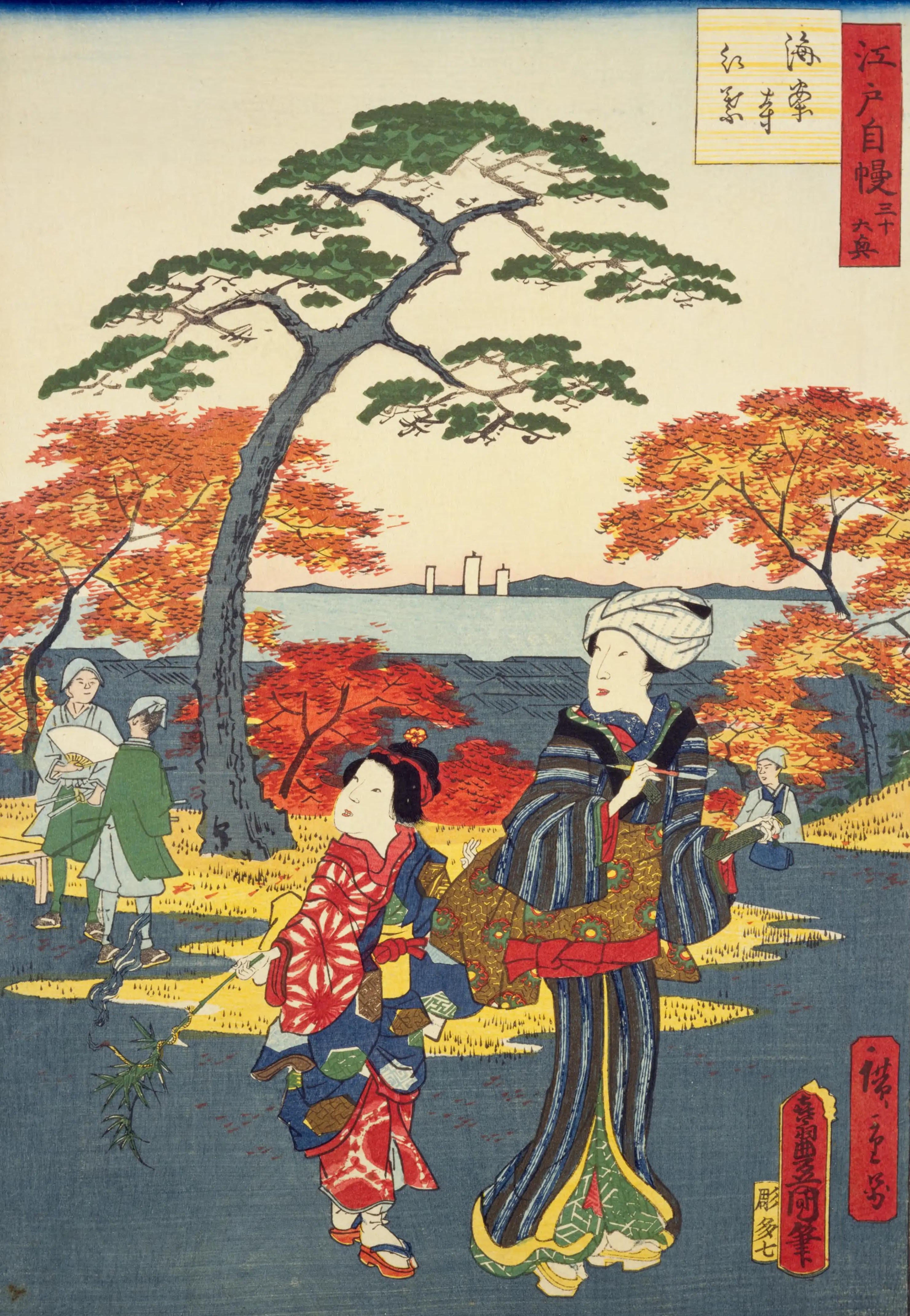
When people think of 浮世絵 (ukiyo-e), the woodblock prints of the Edo period, many picture kabuki actors or portraits of beautiful women. But many prints of famous places and landscapes were also made. The places people visited and the pleasures of the seasons became subjects for pictures.
Famous places were also gathered into books, not just pictures.
『江戸名所図会』 (Edo Meisho Zue, “Illustrated Guide to Famous Places in Edo”), published between 1834 and 1836, was written by 斎藤長秋 (Saito Choshu) and illustrated by 長谷川雪旦 (Hasegawa Settan). It recorded the history and present state of shrines, temples, famous places, and historic sites, based on visits to the places themselves.
Today, when we decide where to travel, we search the internet for photos and look at maps. For the people of Edo, guidebooks and pictures like these were probably a way to learn about places they had never been. Some may well have carried a book like this as they set out to visit those places.
Wondering where to go on a day off and looking for a place with beautiful autumn leaves is something modern Japanese people know well.
The people of Edo and we today are both waiting eagerly for news of the leaves.
When a mountain of red leaves becomes the setting for a story
Momijigari also became the subject of stories.
One is the 能 (Noh) play 『紅葉狩』 (Momijigari). Noh is a traditional Japanese performing art. The play is attributed to 観世信光 (Kanze Nobumitsu).
The setting is 戸隠山 (Mt. Togakushi) in Nagano Prefecture. A warrior, 平維茂 (Taira no Koremochi), enters the mountains and comes across a group of beautiful women holding a banquet beneath the red leaves. He is invited to join, but the women turn out to be 鬼 (oni), demons from Japanese folklore. In the end, with the help of a god, Koremochi defeats the demons.
In a mountain of beautiful autumn leaves, a story unfolds between humans and demons.
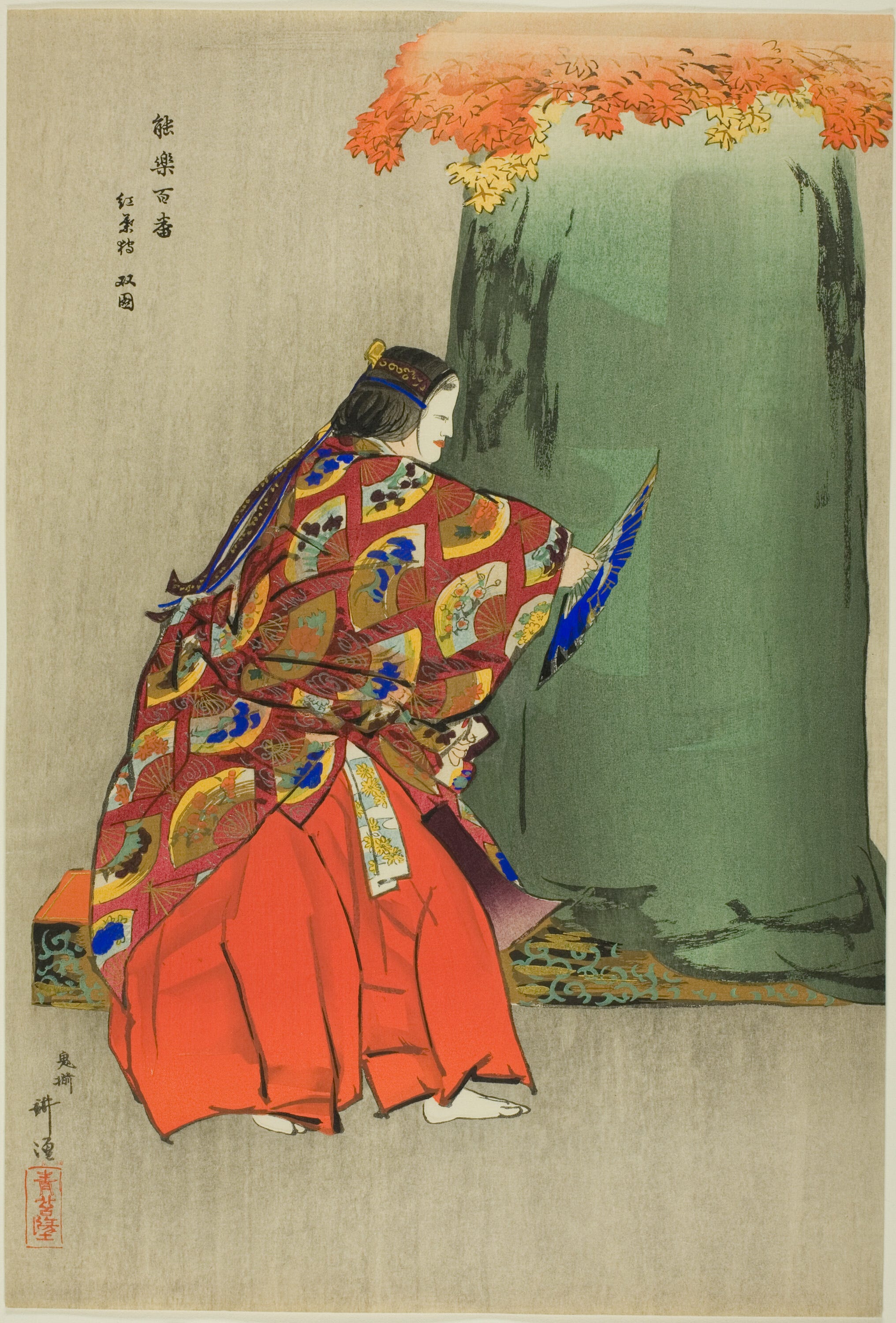
The tale did not stop with Noh. In 1658, in the Edo period, a 浄瑠璃 (joruri, a form of narrative chanting) piece called 『平維茂紅葉狩』 (Taira no Koremochi Momijigari) was published. In 1887, in the Meiji period, a kabuki dance called 『新曲紅葉狩』 (Shinkyoku Momijigari), with words by 河竹黙阿弥 (Kawatake Mokuami), had its first performance at the 新富座 (Shintomi-za) theater in Tokyo. The scene in which a beautiful woman turns into a demon on a mountain of red leaves has kept being performed on stage, taking a new form in each age.
Togakushi is a place I have written about here before.

Of course, the demons in Noh are figures in a story. Still, I think the fact that a landscape of beautiful autumn leaves also became the setting for a tale of luring people into another world shows how much depth there is to momijigari.
Autumn mountains hold more than the modern pleasure of the view. They also hold stories that have been handed down over a long time.
Dazzling leaves in the mountains of Hokkaido
When I talk about autumn leaves in Japan, there is one view I can never forget.
It is the autumn leaves I saw on 黒岳 (Mt. Kurodake), in the 大雪山 (Daisetsuzan) range of Hokkaido.
I was born and raised in Hokkaido, and a few years ago, in mid-September, I climbed Kurodake to see the autumn leaves.
When people think of autumn leaves in Japan, many picture Kyoto in November. But Japan stretches a long way from north to south, and the timing of the colors varies greatly from place to place.
According to the 層雲峡観光協会 (Sounkyo Tourism Association), in the Daisetsuzan range the colors start near the summits from late August. They then move down the mountains toward the hot spring town at their foot, and can be enjoyed until around mid-October. The association promotes these leaves as “the earliest and most beautiful autumn leaves in Japan,” and says the background is climate conditions such as the large temperature difference between day and night, the cool air, and the clear skies.
That said, no figures are given to back up the claim of being “number one in Japan.” It is best taken as a name used by the local tourism group.
Kurodake is 1,984 meters (about 6,509 feet) high. From the base at 層雲峡 (Sounkyo Gorge), you take a ropeway and a lift to reach the 7th station at 1,520 meters (about 4,987 feet). Japanese mountain trails are divided into ten stages, and “7th station” is one of those markers. The hot spring town at the foot is around 670 meters (about 2,198 feet) above sea level, so even on the same mountain, the progress of the colors differs greatly between the base and the summit area. According to private autumn-leaf reports, the peak near Kurodake’s summit is around mid-September.
The day I visited, the sky was perfectly clear.
The sunlight seemed to pour down from very close by. The leaves, in every color, shone as if reflecting it, and it was so dazzling that I had to squint.


Until then, I had thought of autumn leaves as a calm, gentle landscape that soothes the heart.
But the leaves on Kurodake that day were rich in color, almost blinding. It was nothing like the momijigari I had imagined.
I was surprised that the same autumn leaves could look so different depending on the place and the weather.
For me, Kurodake that day is the place that changed my image of autumn leaves.
And as the leaves in the Hokkaido mountains near their end, Kyoto is just about to reach its peak. In Arashiyama, Kyoto, the peak comes in late November. Even within Japan, the best time to see autumn leaves can differ by more than two months depending on where you are.
Momijigari in Japan today
By late November, the center of autumn leaves moves to Kyoto. This year, as across the country, the leaves in Kyoto are expected to peak a little later than usual.
Temples in Kyoto are again holding special openings at night this autumn, in addition to their daytime hours. A 夜間特別拝観 (yakan tokubetsu haikan, a “special night viewing”) is an event in which the grounds, normally closed after dark, are opened for a limited period. At 清水寺 (Kiyomizu-dera), there is a special night opening during the peak season. 永観堂禅林寺 (Eikan-do Zenrin-ji) and Tenryu-ji in Arashiyama also hold light-up events.
Unlike in daylight, the colors and outlines of the trees stand out under the lights. It is a form of momijigari that belongs to our time: enjoying the leaves after sunset.
At the same time, more and more temples require advance reservations or applications. The night opening at 東福寺 (Tofuku-ji) requires an application in advance, and both 瑠璃光院 (Rurikoin) and 圓光寺 (Enko-ji) require reservations during the autumn leaf season. Tofuku-ji’s official website warns that it expects heavy crowds during its autumn special opening.
Famous autumn-leaf spots draw many visitors, not only from within Japan but from overseas as well. I have also been to Arashiyama in Kyoto. Even to me, living in Japan, Kyoto today looks very crowded with international visitors.
No one wants to go out to see the leaves and come home worn out by the crowds. This autumn, the city of Kyoto is taking measures against crowding in Arashiyama. On peak-season weekends and holidays, temporary traffic restrictions are in place, and guides are stationed at the 竹林の小径 (Chikurin no Komichi, the Bamboo Grove path). The plan is to steer visitors toward areas such as 奥嵯峨 (Okusaga) and the Kameyama area of Arashiyama Park, spreading people out from the most crowded areas.
The 京都市観光協会 (Kyoto City Tourism Association) publishes the 京都観光快適度マップ (Kyoto Sightseeing Comfort Map), which forecasts crowd levels on a five-step scale. It advises that “just by shifting the time you visit, you can avoid the crowds.”
If you want to feel the solemn atmosphere and the quiet elegance that we think of as typically Japanese, I think it is also a good idea to shift your plans a little and visit one of the lesser-known places.
One example is 三千院 (Sanzen-in) in 大原 (Ohara), a little way from central Kyoto. According to its official website, the temple began in the Enryaku era (延暦年間, 782 to 806), when 最澄 (Saicho, also known by his posthumous title Dengyo Daishi) built a small hall on Mt. Hiei. After the Meiji Restoration of 1868, it moved to its present site in Ohara, and it has built up a history of about 1,200 years.
Temples in Japan are tourist sights, but they are also still places of prayer. The visitor guidelines on Sanzen-in’s official website say: “This is a place of faith. Please refrain from loud conversation and phone calls on the grounds, and spend your time here quietly.” That request is meant for people who come to see the autumn leaves, too.
If you are visiting Kyoto, please try to plan around both time and place. The Kyoto City Tourism Association recommends 朝観光 (asa-kanko, “morning sightseeing”) before 9 a.m. Being able to choose where to go by checking crowd forecasts is one feature of momijigari today. Before you go, check each temple’s official website for the latest information on visiting hours and reservations.
The leaves that start to change in Daisetsuzan in late August keep descending the mountains until mid-October, and reach their peak at the temples of Kyoto in late November. In Japan, autumn is a season in which the color moves from the mountains to the towns, and from Hokkaido to Kyoto, over the course of several months.
Just as the aristocrats once set out to Kitayama to break off a branch, and just as the people of Edo made their way to Kaian-ji, people this year are again heading out to their own places to see the autumn leaves.
You can also support my work by buying me a coffee through buy me a coffee.
—Written by Sumire
You may also enjoy these stories

Defeating Demons with Beans

At the end of January, walking into a Japanese supermarket reveals a world overflowing with extraordinary colors. Replacing the quiet lingering of the New Year, the shelves are filled with angry red and blue masks, alongside unnaturally bright yellow permed wigs. Beside them, wooden measuring cups known as 升 (Masu) — square measuring boxes are piled high with roasted soybeans, and in the seafood section, vibrant signs promote pre-orders for lavish sushi rolls called 恵方巻き (Ehō-maki) — lucky direction rolls.