


This Saturday article is part of the “Life in Japan” series.
Unlike the in-depth essays published on Tuesdays, this series focuses on everyday life in Japan, sharing seasonal changes and daily scenes from a more personal and familiar perspective.
I rarely catch colds, but until a few days ago, I had been in bed with a summer cold. Colds during the hot season can be troublesome because even after the fever goes down, the fatigue and cough often linger, making it difficult to feel fully recovered. Cicadas were singing outside and the summer days continued, but I spent several days almost entirely indoors.
I have finally begun to feel like myself again, although severe heat continues across many parts of Japan. Please take good care of yourselves and enjoy the summer safely.
And now, in the middle of this Japanese summer, the summer vacation that children look forward to is about to begin.
Schools in Japan have a summer vacation, a winter vacation, and a shorter spring vacation before the new school year begins. The dates of long school vacations at public schools are not the same throughout the country, and the beginning and end vary slightly by region. In many areas, summer vacation lasts for about six weeks, from late July until the end of August. In places with severe winters, such as Hokkaido, summer vacation may be shorter, while winter vacation is longer.
Some Japanese companies also provide summer leave or time off around Obon. Because this period overlaps with the school summer vacation, it becomes easier for parents and children to take several days off together, and more families make plans for travel, visits to their hometowns, festivals, and fireworks displays. It is also one of the busiest times of the year at train stations, airports, and on expressways.
When I was in elementary school, summer vacation was something to look forward to, but it was also a battle with a large amount of homework.
Math and Japanese workbooks, book reports, independent research projects, illustrated diaries, and one-line daily journals. The assignments differ depending on the school and region, but children in Japan usually bring home many tasks to complete during summer vacation.
On the first day of summer vacation, we would make a schedule and think, “This year, I will finish everything early.” But it was difficult to overcome the desire to play. Homework that was supposed to be completed little by little was postponed, and panic would set in as the end of August approached. I think many people in Japan have had this experience.
For an independent research project, children choose their own subject, conduct observations, experiments, or investigations, and turn the results into a completed piece of research. Some create something like a book, while others make models or devices. Some observe plants or insects, while others study cooking, local history, or scientific experiments. When summer vacation ends, the classrooms are filled with the results of these projects.
When illustrated diaries and one-line journals are left untouched until the second half of summer vacation, real memories gradually become insufficient. You can no longer remember the weather or what you did on a particular day, and the entries slowly begin to fill with lies. Of course, I also have experience inventing random summer memories to fill the blank spaces.
During summer vacation, it is easy to sleep late, stay up at night, and lose a regular daily rhythm. The local radio exercise gatherings helped bring structure back to our mornings.
Radio taisō is a widely known form of exercise in Japan in which people move their whole bodies to music and spoken instructions. For many Japanese people, their bodies begin to move naturally as soon as the familiar music starts.
It is taught in physical education classes and practised at school sports days, as well as at community events. Some companies and factories also have all their employees perform radio taisō during the morning assembly. Public broadcasters air exercise programmes every morning, and some people exercise at home while watching television or listening to the radio.
Radio taisō began in 1928, inspired by an exercise programme introduced by an organisation responsible for an insurance service to promote public health. It later spread throughout the country through schools, workplaces, local communities, and broadcasting.
Radio taisō is so widely known in Japan because it is not simply a trend belonging to one generation. People experience it repeatedly in many areas of daily life from childhood onward. Children and older adults can perform the same exercises together to the same music.
During summer vacation, radio exercise gatherings for children are held in local parks and open spaces. People gather at around six or six thirty in the morning, and adults and children exercise together to music played over the broadcast.
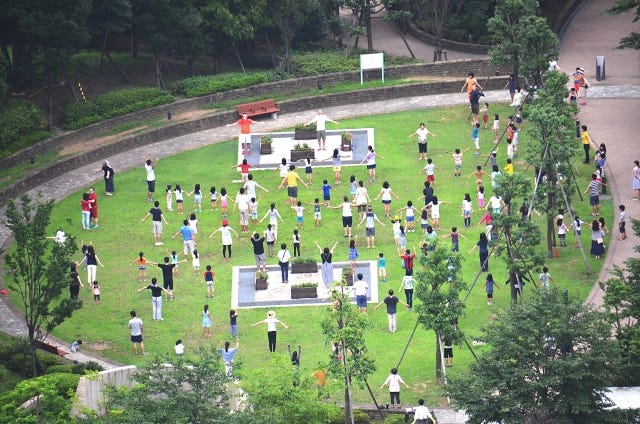
The origin of these summer radio exercise gatherings is said to be the Children’s Early Rising Event held in Tokyo in 1930. The aim was to encourage children to continue waking up early and maintain a regular daily rhythm by exercising in the morning, even when they were not attending school. That purpose continues in local radio exercise gatherings today.
In the area where I lived, children went to the park with radio exercise cards hanging around their necks. After the exercises, we received one stamp or sticker on the card. It was satisfying to watch the proof that we had attended without oversleeping increase day by day, and collecting the stamps became another reason to wake up early.
Depending on the number of days we attended, we sometimes received stationery, sweets, or other small prizes at the end of summer vacation. The length of the programme and whether prizes are offered vary by area. Some communities continue throughout summer vacation, while others hold the gatherings for only a few days.
Children were not the only people who gathered in the park in the morning. Parents and older local residents also joined. It was a time to see people in the neighbourhood whom we did not usually have many opportunities to speak with. Radio taisō helps children maintain healthy routines while also creating a place for local residents to connect.
When I entered junior high school, I also had club activities during summer vacation. At my school, both sports clubs and cultural clubs practised almost every day, so we continued going to school throughout the vacation.
Compared with the long summer vacations in some other countries, summer vacation in Japan is relatively short and still includes homework and club activities. During my school years, it never felt like a period when I was completely separated from school. I was always thinking about how to finish my assignments while still finding as much time as possible to enjoy myself.
By the time club practice ended, the heat outside had begun to soften slightly. Some evenings, I had barbecues with friends or family, or played with handheld fireworks in front of the house or in the garden.
I also wore a yukata to local festivals. I remember inviting someone I liked, walking together, trying to decide what to buy from the food stalls, and staying close so that we would not lose each other in the crowd. My summer vacations hold both the simple happiness of childhood and the bittersweet memories of junior high school.
From this time of year onward, fireworks displays are held across Japan.
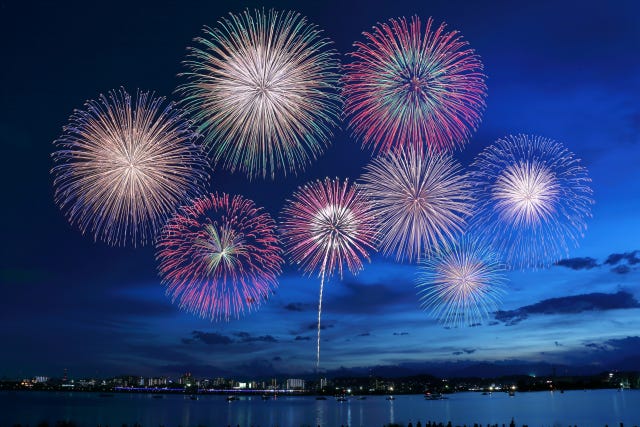
Crowds gather along wide riverbanks, lakes, and coastlines to look up at fireworks launched into the night sky. When a firework bursts, people may respond with a collective “Oh” or with applause. Rather than constantly shouting and cheering as they might at a live music performance, many people spend the time carefully watching the shape and colour of each firework, the pause before it bursts, and the sound that resonates through the body.
I also tend to keep looking at the sky and wait for the next firework rather than talking continuously. At a fireworks display, I enjoy not only the brightness at the moment of explosion, but also the smoke that remains after the light disappears and the sound that reaches us slightly later.
Gunpowder, the material used in fireworks, was developed in China and was introduced to Japan together with firearms around the sixteenth century. Fireworks for entertainment became widespread during the Edo period.
An event often associated with the development of Japan’s summer fireworks displays is the fireworks at the Ryōgoku River Opening, which began in 1733. Fireworks were launched near Ryōgoku Bridge on the Sumida River as part of an event held to mourn those who had died in the famine and epidemic of the previous year and to pray for protection from disease. It became an annual event in Edo and continues today as the Sumida River Fireworks Festival.
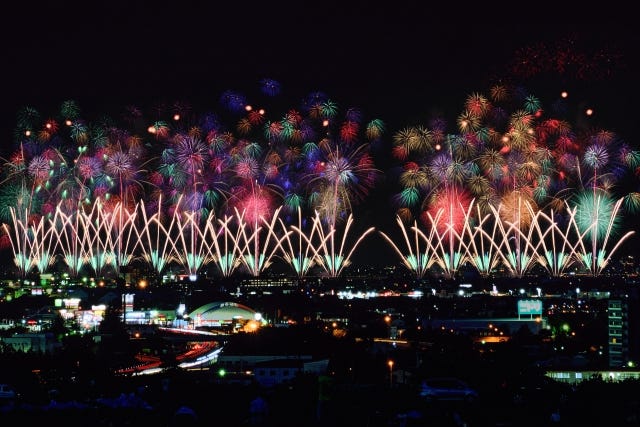
The call “Tamaya!” that can sometimes be heard at fireworks displays also has its origins in the Edo period.
Two famous fireworks makers active in Edo were known by the shop names Kagiya and Tamaya. When an impressive firework was launched, spectators called out “Kagiya!” or “Tamaya!” to praise the firework maker. In modern terms, it was similar to shouting, “Wonderful!” or “Magnificent!”
“Tamaya!” remains the better-known call today, but it was originally not the name of the firework itself. It was a call of praise directed toward the craftspeople who made it.
One of Japan’s most famous fireworks events is the Nagaoka Festival Grand Fireworks Show, held every year on August 2 and 3 in Nagaoka City, Niigata Prefecture.
【長岡まつり大花火大会 The Nagaoka Festival Fireworks Festival】
The Nagaoka fireworks carry prayers for the victims of the Nagaoka air raid on August 1, 1945, as well as wishes for recovery and peace. Large fireworks, including shō-sanjakudama shells, vast star mines, and the Phoenix Fireworks of Prayer for Recovery, are launched above the Shinano River. In 2024, approximately 340,000 people attended over the two days.
Another major event is the National Fireworks Competition, known as the Ōmagari Fireworks, held in Daisen City, Akita Prefecture.
The Ōmagari Fireworks is a competition that has continued since 1910, bringing together selected fireworks makers from across Japan to compete in technical skill and artistic expression. It is also the only competition in Japan to include daytime fireworks, which use coloured smoke to create changing shapes and patterns. Attracting around 700,000 visitors each year, it is one of the largest fireworks events in Japan.
While the Nagaoka fireworks carry forward prayers for mourning, recovery, and peace, the Ōmagari Fireworks is a competition in which fireworks makers demonstrate their technical and artistic abilities. Even among Japan’s major fireworks displays, their origins and purposes differ.
I enjoy going to large fireworks displays with family and friends, but small handheld fireworks in front of the house also feel like an essential part of the Japanese summer.
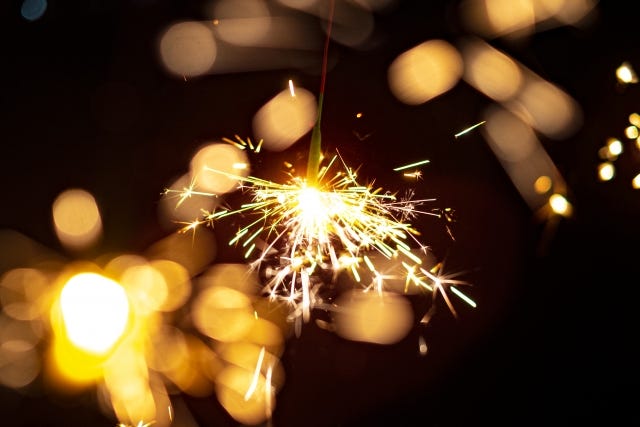
We prepare a bucket of water and light the fireworks one by one. Some release bright, energetic sparks, while senkō hanabi end with a small glowing ball of fire. We compete to see whose senkō hanabi will last the longest and watch closely until the flame finally falls. It is a familiar summer experience, very different from a large fireworks display.
Now that I have recovered from my cold, I will leave tomorrow on a reporting trip.
I will conduct interviews and take plenty of photographs so that I can continue sharing the appeal of Japan with all of you.
I hope you will look forward to it.
—Written by Sumire
You can also support my work by buying me a coffee through buy me a coffee.
You may also enjoy these stories
When Japan Opens the Sea and Mountains for Summer

This Saturday article is part of the “Life in Japan” series.
What Is Washi? Discovering Handmade Japanese Paper in Yame

In Japan, 和紙(washi, Japanese paper)has been made in many regions since ancient times.
The homework procrastination made me laugh — I was exactly that kid too. I remember the classrooms filling up with independent research projects like you describe, but what stayed with me even more was the first day back itself: that strange half-beat where you don’t quite know how close to stand to your friends anymore, after weeks apart.
If I may ask, what is the purpose of having children keep one-line journals? Is there a particular aspect of their day they are ask to focus on?