


In November, small children dressed in colorful kimono begin to appear at shrines across Japan.
Girls wear red or pink kimono, while boys are dressed in hakama. Some walk carefully in their unfamiliar traditional sandals, while others make their way through the shrine grounds holding a family member’s hand. Parents and grandparents watch with delight, taking photographs and adjusting the children’s clothing.
It is the season of 七五三 (Shichi-Go-San), a traditional Japanese celebration that takes place in autumn.
Shichi-Go-San is an occasion to give thanks for a child’s healthy growth and pray for their future health and happiness. The custom of dressing children in formal clothing and visiting a shrine at the ages of three, five, and seven remains important to many Japanese families.
The tradition has a long history, originating in ceremonies that marked stages of childhood through changes in hairstyles and clothing. Ukiyo-e prints from the Edo period also depict children dressed for these celebrations, surrounded by people honoring their growth.
Through these artworks and historical records, we can trace the history of Shichi-Go-San.
The Origins of Shichi-Go-San: Kamioki, Hakamagi, and Obitoki
Shichi-Go-San is a traditional celebration of childhood milestones, generally observed on November 15.
Traditionally, both boys and girls celebrate at age three, boys at age five, and girls at age seven. In the past, these ages were usually calculated using the traditional Japanese age-counting system, in which a child was considered one year old at birth and gained another year each New Year’s Day. Today, many families use actual age instead, and customs vary by region and household.
On Shichi-Go-San, children dress in their finest clothing and visit a Shinto shrine to give thanks for their growth and pray for continued good health. Some families receive a blessing from a Shinto priest, while others take commemorative photographs or enjoy a meal with grandparents and other relatives. Although November 15 remains the traditional date, many families arrange their visits on convenient weekends in October or November.
The origins of this celebration can be traced to ceremonies marking children’s growth, practiced among the aristocracy during the Heian period (794–1185).
Three of the most significant were 髪置 (Kamioki), 袴着 (Hakamagi), and 帯解 (Obitoki).
Kamioki is the ceremony associated with the celebration at age three.
In earlier times, it was customary in some parts of Japanese society to shave or cut young children’s hair short. When children reached a certain age, families celebrated the beginning of growing their hair longer, marking their transition beyond early childhood.
Among the warrior class during the Edo period, some ceremonies involved placing an imitation of white hair on a child’s head as a wish for longevity. White hair symbolized a long life, expressing the hope that the child would live to an old age.
Today, three-year-old children celebrating Shichi-Go-San are often seen wearing a sleeveless outer garment called 被布 (hifu) over their kimono. Easy for young children to wear, these garments are popular in bright colors and decorative patterns.
Hakamagi celebrates a child wearing hakama for the first time.
This ceremony was practiced among the aristocracy during the Heian period and was later adopted by warrior families. Hakama are traditional Japanese garments worn over a kimono, covering the lower body from the waist. They are still worn today at graduation ceremonies, coming-of-age celebrations, and in certain martial arts.
The age and gender associated with Hakamagi varied over time, but the ceremony eventually became linked to the celebration of boys at age five.
Obitoki is the ceremony associated with the celebration of girls at age seven.
Young children’s kimono traditionally had attached ties that made them easier to dress. As children grew older, they began wearing an obi, a sash used to secure a kimono, instead. Obitoki celebrated this change in clothing.
Today, seven-year-old girls celebrating Shichi-Go-San often wear elaborate kimono with wide obi, accompanied by decorative accessories and carefully arranged hairstyles.
Growing one’s hair, wearing hakama, and tying an obi.
These ceremonies made a child’s growth visible through changes in appearance.
Behind them lay a deeply felt wish for children to survive and grow up healthy.
At a time when medical care and sanitation were far less developed, young children frequently lost their lives to illness. Reaching another milestone in childhood was a source of great joy for their families.
Japan also has an old saying, “七つまでは神のうち” (Nanatsu made wa kami no uchi), which can be translated as “Until the age of seven, children belong to the realm of the gods.” It expresses a close association between young children and the divine, although its interpretation has varied across regions and periods.
Kamioki, Hakamagi, and Obitoki each developed from different traditions, but all expressed a wish to celebrate a child’s growth and pray for their continued well-being.
During the Edo period, these ceremonies became associated with shrine visits and family celebrations, gradually developing into the form of Shichi-Go-San we know today.
Shichi-Go-San in Edo-Period Ukiyo-e
During the Edo period (1603–1868), urban culture and publishing flourished, and many ukiyo-e artworks depicting everyday life and annual celebrations were produced.
浮世絵 (ukiyo-e) is a form of Japanese art encompassing woodblock prints and paintings that portray aspects of life and culture. Its subjects included kabuki actors, famous places, landscapes, seasonal events, and family celebrations.
For understanding the history of Shichi-Go-San, artworks depicting children’s clothing and celebrations provide valuable historical evidence.
One such work is 七五三祝ひの圖 (Shichi-Go-San Iwai no Zu, Celebrating Shichi-Go-San) by 三代歌川豊国 (Utagawa Toyokuni III).
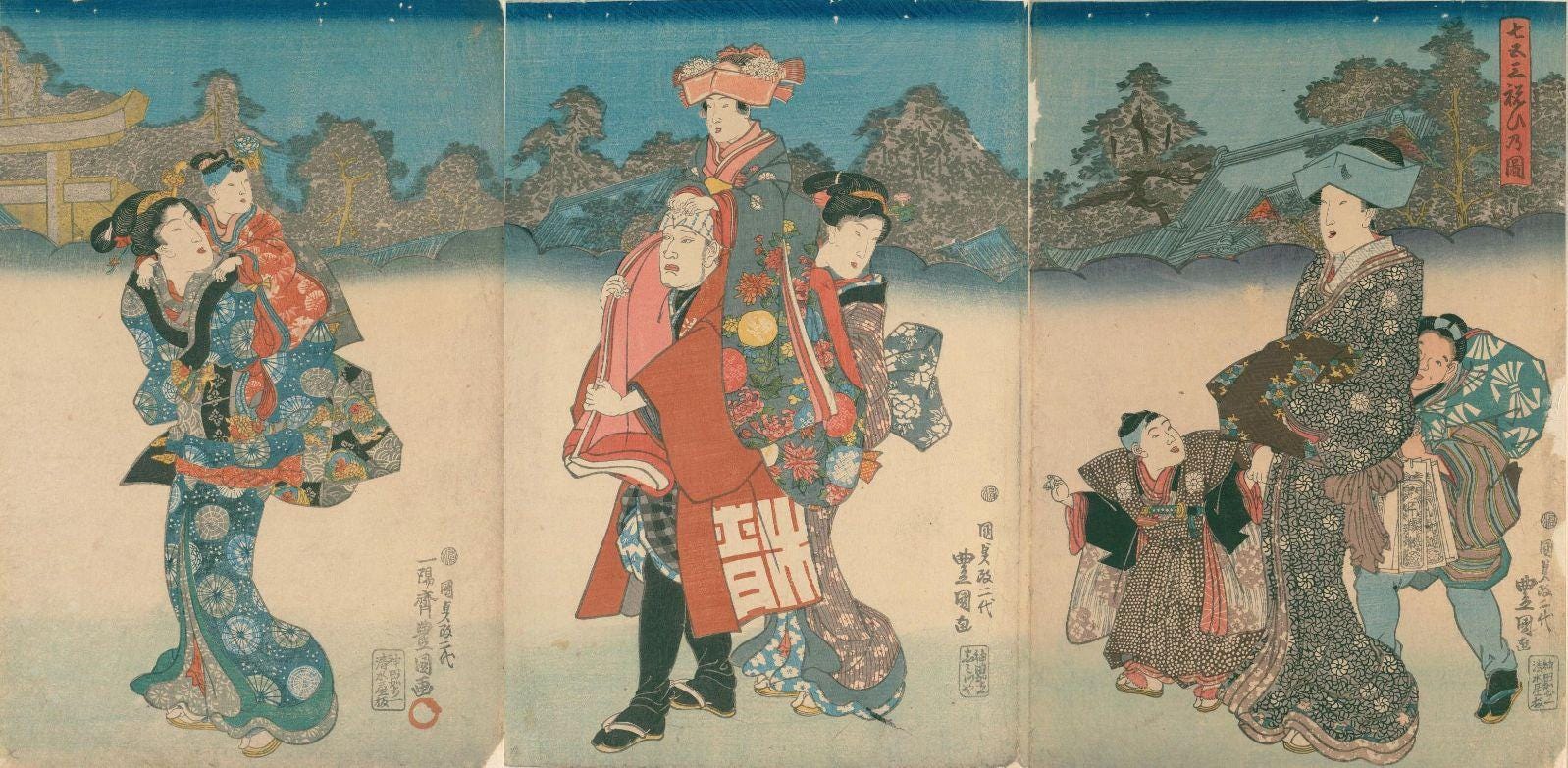
The artwork was created as a triptych, a composition formed by placing three woodblock prints side by side to create one continuous scene.
According to the National Diet Library of Japan, the images depict the Hakamagi celebration for a five-year-old on the right, Obitoki for a seven-year-old in the center, and Kamioki for a three-year-old on the left.
Each child is dressed in formal clothing, with adults accompanying them.
The five-year-old boy wears hakama, while the seven-year-old girl wears an obi. Their garments, colors, patterns, hairstyles, and accessories are depicted in detail, allowing us to see how children dressed for these different milestones.
Look also at the adults surrounding the children. The artwork portrays people attending the celebrations and helping the children prepare for their special day.
During the Edo period, such occasions were celebrated with family members, relatives, and others close to the household.
One historical source documenting these customs is 東都歳時記 (Tōto Saijiki), published in 1838.
This book records annual events and seasonal customs in Edo, the city now known as Tokyo. It includes an event observed on November 15 called 嬰児宮参 (Eiji Miyamairi), a shrine visit for young children.
According to its account, families celebrated Kamioki at age three, Hakamagi at age five, and Obitoki at age seven. They prepared clothing according to their financial circumstances and visited a shrine dedicated to the local guardian deity, or 産土神 (ubusunagami).
An ubusunagami is a deity believed to protect the land and its people, traditionally associated with birth and growth and revered by the local community.
After visiting the shrine, families would call on relatives, and some would invite acquaintances to an evening feast.
Shrine visits took place throughout much of November, with the fifteenth serving as the principal date.
Families prepared special clothing for their children and visited shrines. They then called on relatives or gathered with others for a celebratory meal.
These historical accounts offer a glimpse into how families in Edo celebrated the growth of their children.
From Edo to the Rest of Japan
Ceremonies celebrating children’s growth existed throughout Japan, with different regions preserving their own customs.
The practice of celebrating children at ages three, five, and seven around November 15 developed primarily in Edo and its surrounding areas.
During the Edo period, these celebrations were observed among warrior families and wealthy townspeople. By the Meiji period (1868–1912), they had become increasingly popular among ordinary households in urban Tokyo.
The National Diet Library also preserves historical materials depicting children visiting shrines for Shichi-Go-San during the Meiji period.
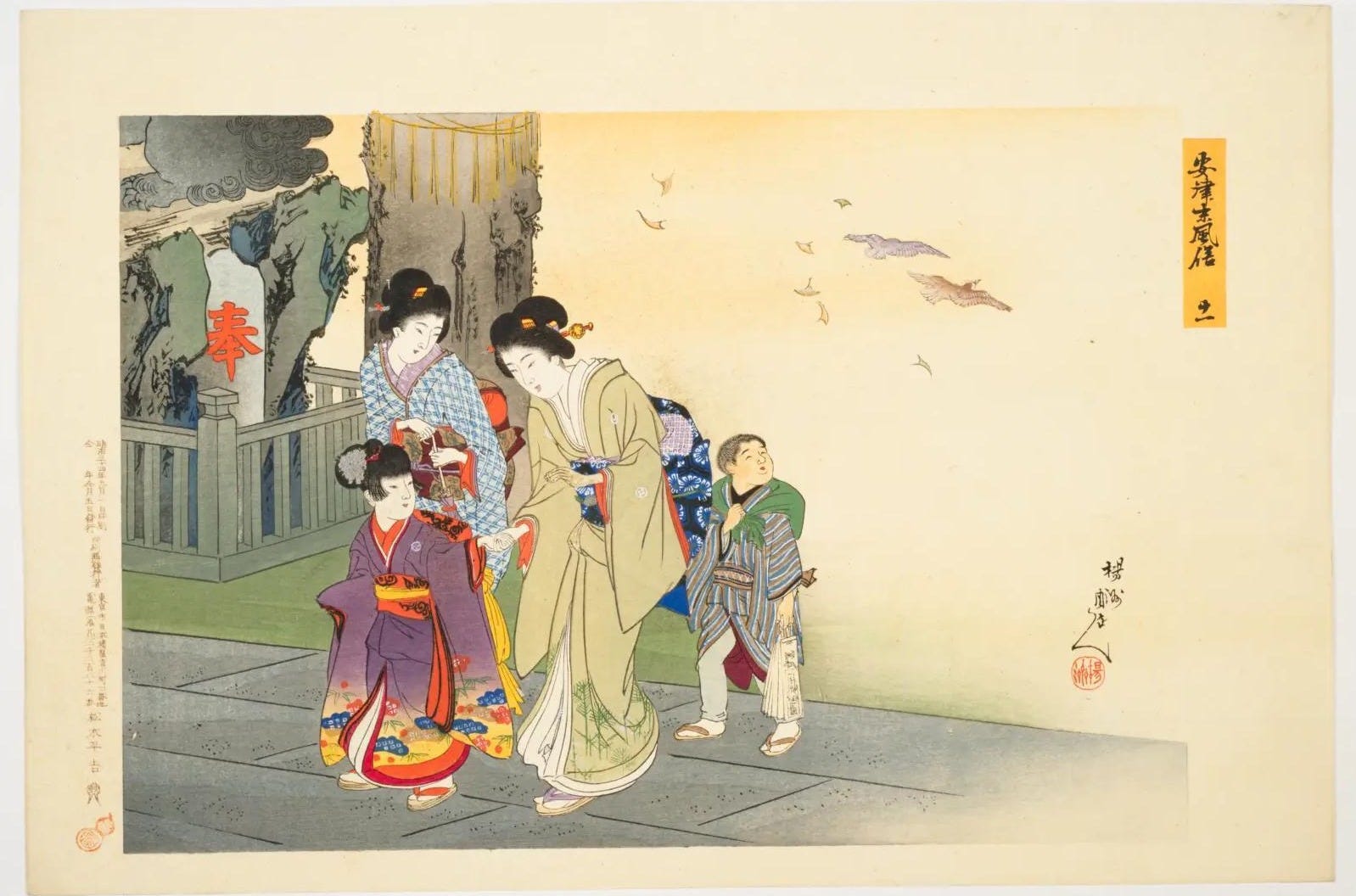
The illustration shows children in formal clothing accompanied by women.
According to the National Diet Library’s explanation, the boy is holding a piece of Chitose Ame in his left hand.
千歳飴 (Chitose Ame) is a long, thin candy given to children as a wish for longevity.
The word chitose means “a thousand years.” The candy symbolizes the hope that a child will enjoy a long and healthy life. It traditionally comes in red and white, colors associated with auspicious occasions in Japan. Today, the wrappers are often decorated with symbols of good fortune and longevity, such as cranes, turtles, and pine, bamboo, and plum blossoms.
There are several theories about the origins of Chitose Ame. One well-known account traces it to candy sold in Asakusa during the Edo period, which became popular as a symbol of long life.


By the Meiji period, dressing children in formal clothing and buying Chitose Ame to celebrate their growth had become established customs among ordinary families in Tokyo.
Shichi-Go-San subsequently spread to other regions during the modern era and the postwar years. It became especially widespread nationwide during Japan’s period of rapid economic growth in the 1960s.
Today, it is one of Japan’s best-known celebrations for children.
Families observe the occasion in different ways. Some receive blessings at shrines, while others rent formal clothing for professional photographs or enjoy a special meal with grandparents. The sight of children dressed in colorful kimono and hakama has become a familiar part of November at Japanese shrines.
As I explored this history, I found myself remembering my own Shichi-Go-San celebration.
A Red Kimono and Red Lipstick: My Childhood Memories of Shichi-Go-San
When I was little, I wore a red kimono for Shichi-Go-San.
I went to a hair salon to have my hair styled, and someone applied red lipstick to my lips. My hair was arranged differently from usual, I wore a beautiful kimono, and the red lipstick made me look a little more grown-up.
I remember looking at myself in the mirror and feeling delighted, as though I had taken a step closer to adulthood.
That day, I went to show my grandmother how I looked in my special outfit.
My family also took me to a shrine, where we had commemorative photographs taken. I remember people around us smiling at me and speaking to me when they saw me dressed up.
I was happy to be wearing such a beautiful kimono, but I also felt a little embarrassed by all the attention.
Another thing I remember clearly is the Chitose Ame.
The candy I received seemed astonishingly long to me. I remember asking my mother, “Am I really allowed to eat all of this by myself?”
At that age, getting such a large piece of candy all to myself mattered far more than the meaning behind its length.
Learning about the history of Kamioki and Obitoki as an adult brings back the excitement I felt that day.
In earlier centuries, growing one’s hair longer or wearing hakama or an obi for the first time marked important stages of childhood. For me, having my hair styled, putting on lipstick, and wearing formal clothing was also an occasion when I felt a little more grown-up.
I now think differently about the smiles of the people who made me feel so shy that day.
I went to show my grandmother my special outfit, visited a shrine with my family, and received kind words from people we happened to meet. As a little girl, I barely understood how many people were celebrating my growth.
The Edo-period Tōto Saijiki describes families visiting relatives after their shrine visits and inviting acquaintances to celebratory gatherings. Looking back, my visit to my grandmother feels connected to that long-standing custom of sharing a child’s milestones with loved ones.
Shichi-Go-San is a joyful occasion for families, but it can also become an unforgettable day for the children themselves.
My memories are full of small, distinctly childhood experiences: the excitement of wearing a red kimono and my surprise at receiving such an unusually long piece of candy.
Looking back on that day helps me appreciate how many people cared for me and watched over me as I grew up.
Celebrating a Child’s Growth
In Japan, visiting a shrine has long been part of marking important moments in life.
Families may visit for a baby’s first shrine visit, 初宮参り (Hatsumiyamairi), or for 初詣 (Hatsumōde), the first shrine visit of the New Year, when people pray for health and happiness. Shichi-Go-San is another occasion when people come to shrines to celebrate a milestone and offer their prayers.
Tracing the history of Shichi-Go-San reveals a tradition that developed from childhood ceremonies such as Kamioki, Hakamagi, and Obitoki, through Edo-period shrine visits and family celebrations, and into the present day.
At its heart is the joy of seeing a child grow up safely and the hope that they will continue to enjoy a healthy life.
This year, many children across Japan will once again celebrate Shichi-Go-San.
As they walk hand in hand with their families, I wonder what these little children will remember about their special day.
It is a day when adults celebrate their growth and wish them happiness in the years ahead. Perhaps, someday, it will become a treasured memory for the children themselves.
—Written by Sumire
You can also support my work by buying me a coffee through buy me a coffee.
You may also enjoy these stories
Why Are There So Many Deer in Nara?

Did you know that there is a city in Japan where wild deer have been cherished as messengers of the gods for more than a thousand years?
What I Learned About Food Preservation from My Great-Grandmother’s Life

From Memories of My Great-Grandmother’s Home to Japan’s Regional Food Preservation Traditions