


From Memories of My Great-Grandmother’s Home to Japan’s Regional Food Preservation Traditions
As October draws to a close, people across Japan are beginning to prepare for winter. Japan stretches a long way from north to south, with mountains covering much of the country. Over generations, communities have developed ways to preserve seasonal harvests, adapting their methods to the climate of each region.
In areas with heavy snowfall, preserving food was essential for getting through the harsh winter. In milder regions, people made use of dry winds and sunshine. By drying, salting, and fermenting ingredients, they found ways to store food and make the most of what they harvested.
Whenever I think about these traditions, I remember a particular place.
My great-grandmother’s house in rural Hokkaido (北海道).
The house is no longer there, but the scenes I remember from childhood visits have become some of my most treasured memories.
In summer, I would look out from the engawa (縁側), the wooden veranda of a traditional Japanese house, toward the mountains and fields. I also helped harvest the gooseberries and haskap berries growing in the garden.
Gooseberries, known locally as guzuberi (グズベリー), belong to the currant family. Haskap (ハスカップ) is a small, blue-purple berry popular in Hokkaido. It has a distinctly tart flavor and is often made into jam.
I loved helping with the harvest. Picking haskap berries was particularly messy because their reddish-purple juice stained my fingers and palms. As a child, I would become so absorbed in picking them that both my hands ended up purple. The stains were difficult to wash off, and I imagine my mother may have found that rather troublesome.
My great-grandmother used the freshly picked haskap berries to make jam. She also harvested shiso (紫蘇), a fragrant Japanese herb, from the garden and prepared a concentrated syrup for making shiso juice. Rice plants grew lush and green in the field in front of the house, and on hot days, watermelons were cooled in the water of a nearby stream.
When autumn arrived, daikon radishes hung from the ceiling of the veranda to dry. Some were later made into pickles as part of the preparations for winter.
Looking back, life in that house followed the seasons. Fruit harvested in summer was processed and preserved, while autumn was the time to put vegetables away for winter.
At the time, I was simply happy picking berries and eating watermelon cooled in the stream. I never gave much thought to the purpose behind all those everyday activities.
Only as an adult have I come to realize that, through her daily routines, my great-grandmother was showing me the knowledge involved in growing and preserving food.
Living with the Four Seasons
In Japan, the crops available for harvest change throughout the year. Wild mountain vegetables emerge in spring, while cucumbers, eggplants, and other vegetables grow in summer. Autumn brings the rice harvest, along with potatoes, other root crops, and fruits. Winter is the season for vegetables such as daikon radishes and Chinese cabbage.
Today, advances in agriculture and distribution make it possible to buy a wide variety of ingredients throughout the year. In the past, however, seasonal harvests had a much greater influence on what people could eat.
Preparing enough food for winter was particularly important in colder regions. People stored what they harvested in autumn and processed ingredients so they would last longer. Preserved foods were prepared during summer and autumn to help keep their families fed even when the land was covered in snow.
Rice, the staple food of Japan, is one of the most important examples.
Although the exact timing varies by region and variety, rice is harvested in autumn across much of Japan. After harvesting, the grains are dried, processed, and stored under suitable conditions. In the past, people carefully stored each year’s rice harvest to ensure that they had enough to eat until the following harvest.
In my October 7 article, I introduced Kannamesai (神嘗祭), a Shinto festival at Ise Jingu (伊勢神宮, Ise Grand Shrine), where newly harvested rice is offered to the deities. For Japanese people, rice has long been more than a daily staple. It also has deep connections to religious gratitude and annual ceremonies.
People developed a variety of preservation methods for vegetables and fruits as well. Drying reduces moisture and helps ingredients keep longer, while salting or pickling in rice bran can extend the storage life of certain foods. Fermentation produces distinctive flavors, and cooking fruit with sugar is another way to improve its keeping quality.
Many of the foods developed through these practices remain part of Japanese meals today.
Dried Persimmons: A Familiar Sight in Late Autumn
After moving to Fukuoka (福岡), I encountered an autumn scene I had never seen in person before.
Persimmons were hanging beside the window of someone’s home.
Several peeled persimmons hung in a row, exposed to the outdoor breeze. I had seen photographs and videos of how dried persimmons were made, but this was my first time seeing someone prepare them at home.
It was different from the winter preparations I remembered growing up in Hokkaido. Even within Japan, moving to another region can introduce you to an entirely different set of seasonal sights.
Dried persimmons, called hoshigaki (干し柿), are one of Japan’s traditional preserved foods.
Japanese persimmons can be broadly divided into sweet and astringent varieties. Sweet persimmons can be eaten fresh when ripe, while astringent persimmons contain compounds that produce a strong, unpleasantly dry sensation in the mouth. Drying is one way to turn these astringent fruits into something delicious.
The persimmons are peeled and hung in a well-ventilated place to dry. As they gradually lose moisture, their sugars become more concentrated, making them taste sweeter. At the same time, the soluble tannins responsible for their astringency become insoluble, so the fruit no longer tastes as astringent.
Have you ever noticed the white powder that sometimes covers the surface of dried persimmons?
These are sugar crystals that form naturally on the surface of the fruit. Although they may look as though they have been dusted with sugar, the sweetness comes entirely from the persimmons themselves.
Dried persimmons have a long history in Japan. They appear in the Engishiki (延喜式), a collection of laws and ceremonial regulations compiled during the Heian period (794–1185). In some regions, they have also traditionally been eaten during New Year celebrations.
Dried persimmons are still produced across Japan, with different varieties and processing methods giving each regional specialty its own flavor and texture.
One well-known example is Ichida-gaki (市田柿), produced in Iida City (飯田市) and the surrounding Shimoina District (下伊那郡) in southern Nagano Prefecture (長野県).
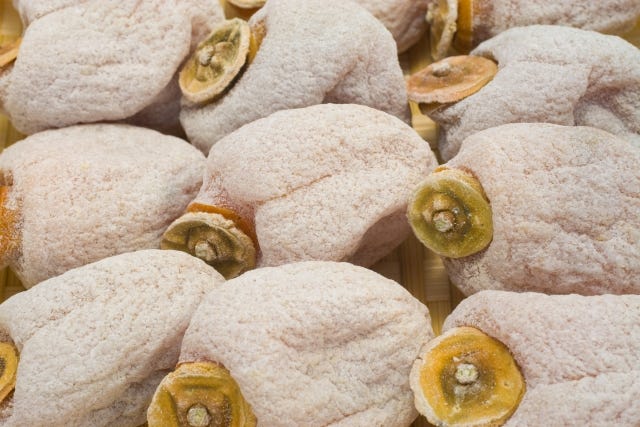
These relatively small persimmons develop a fine coating of white sugar crystals. Inside, the flesh is amber-colored, with a soft, pleasantly chewy texture.
The production area lies in the Ina Valley (伊那谷), a basin where temperatures vary considerably between day and night. River fog also forms from late autumn into early winter. These conditions of temperature and humidity are well suited to producing Ichida-gaki.
During the drying season, farmers hang rows of persimmons known as kaki noren (柿のれん), or persimmon curtains. The sight of countless persimmons hanging together has become a familiar seasonal feature of the region.


In the Date area (伊達地方) of Fukushima Prefecture (福島県), another specialty is Date no Anpogaki (伊達のあんぽ柿).
These persimmons retain more moisture than many conventional dried varieties, giving them an exceptionally soft texture. Their flesh remains a vivid orange, with an almost melting consistency.
The Fukushima Basin experiences considerable differences between daytime and nighttime temperatures and receives relatively little precipitation. Producers in the Date area have also developed sulfur fumigation techniques that help preserve the persimmons’ bright color.
The structures used for hanging the fruit are known locally as kaki base (柿ばせ), and their appearance is another familiar sign of winter in the region.
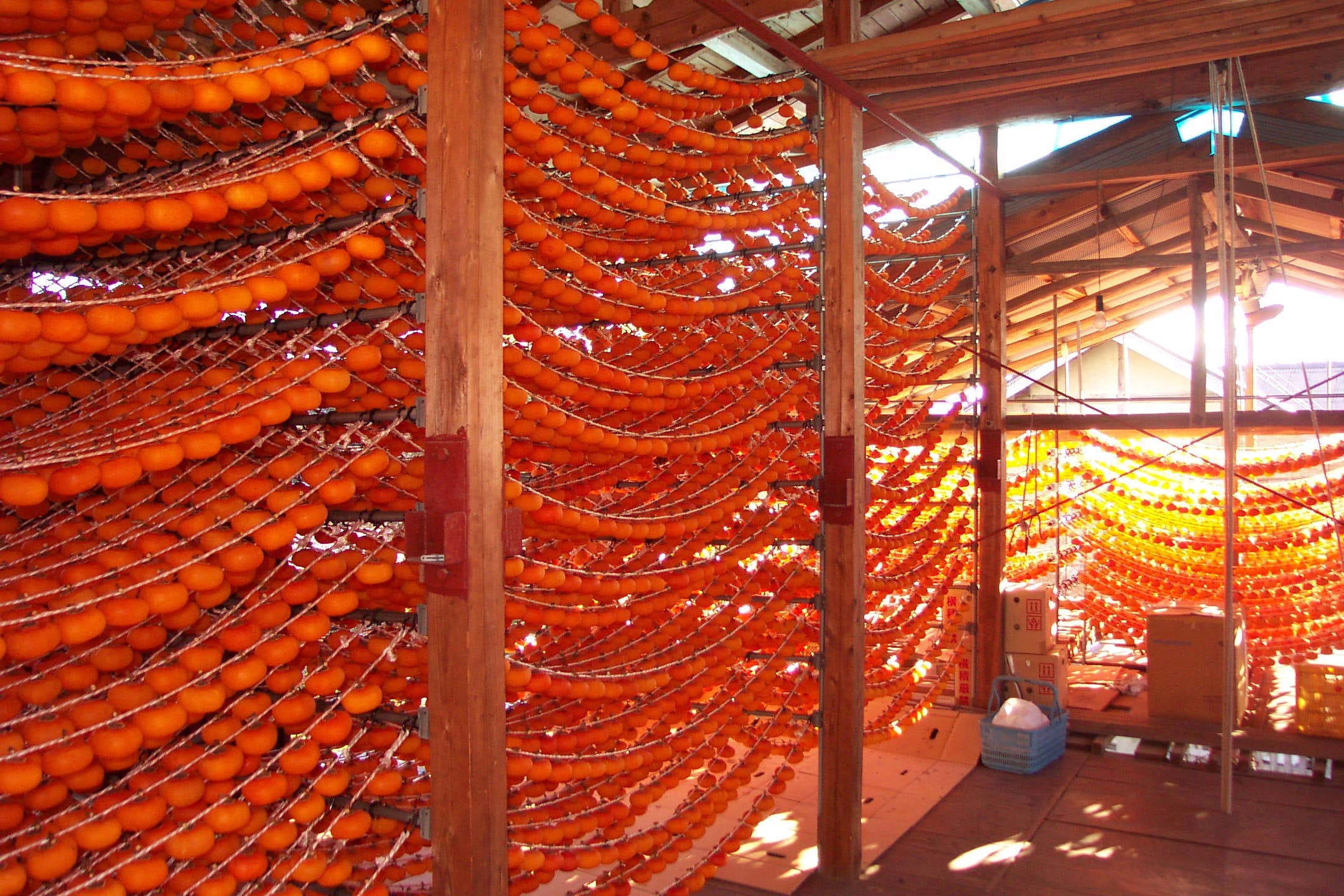
Although both specialties are made by drying persimmons, the varieties used and the finished textures differ considerably.
Remembering the persimmons I saw hanging beside a window in Fukuoka, I now find that simple scene even more interesting. It is part of a food preservation tradition that has continued in Japan for centuries.
Drying Daikon: Making Use of Winter’s Cold
Thinking about my great-grandmother’s home also brings back the daikon radishes that hung from the veranda in autumn.
As a child, I never gave much thought to why anyone would hang radishes from the ceiling.
Daikon (大根) is a common ingredient in Japanese home cooking. It appears in simmered dishes, miso soup, hot pots, and oden, a dish of ingredients slowly simmered in a seasoned broth. It is especially familiar on the table during colder months.
One traditional way to preserve daikon is to dry it.
Thinly sliced and dried daikon is called kiriboshi daikon (切り干し大根). In some regions, it is also known as sengiri daikon (千切り大根), and it has long been used in Japanese home cooking.
Fresh daikon contains a great deal of water. Cutting it into thin strips and drying it removes much of that moisture, reduces its volume, and makes it easier to store.
Before cooking, the dried strips are rehydrated in water. A common preparation is to simmer them with carrots and aburaage, thin slices of fried tofu. Drying gives the daikon a distinctive sweetness and chewy texture, making it a familiar everyday side dish in Japan.
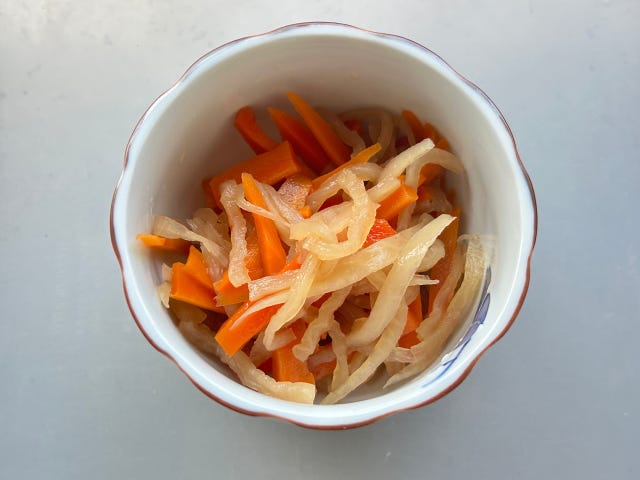
Miyazaki Prefecture (宮崎県) is one of the country’s major producers of dried daikon.
In Kunitomi Town (国富町), daikon is typically dried from late November through around February. Farmers spread thinly sliced radishes over racks set up in their fields.
During winter, cold, dry winds known as Kirishima-oroshi (霧島おろし) blow through the region. Together with the area’s frequent sunny weather, these winds help remove moisture from the radishes.
Another distinctive tradition can be found in Tano (田野町), an area of Miyazaki City (宮崎市), where whole daikon radishes are dried on large structures called daikon yagura (大根やぐら).


These towering racks are built using materials such as bamboo, with harvested radishes suspended in long rows.
The sight of so many daikon hanging in the open air is one of the characteristic winter scenes of Miyazaki.
In colder regions, including Miyagi Prefecture (宮城県), people have developed another method that makes use of freezing temperatures.
This preserved food is known as shimi daikon (凍み大根), or freeze-dried daikon.
The radishes are first boiled and then hung outside in the cold. As they repeatedly freeze, thaw, and dry, they gradually lose moisture. It is a traditional preservation technique that relies on the natural conditions of areas where winter temperatures fall below freezing.
In Miyazaki, people take advantage of dry winds and sunshine. In northeastern Japan, they make use of freezing winter air.


Even when preserving the same vegetable, the methods vary according to the climate.
The daikon I saw hanging at my great-grandmother’s home in Hokkaido may have been nothing more than an ordinary household task for her generation.
Now, as I learn about traditional foods from other parts of Japan, I am surprised by how many different ways people have found to preserve something as simple as a radish.
Another Way to Preserve Daikon, Born in Snow Country
Drying is only one of Japan’s traditional preservation techniques. Pickling vegetables in salt or rice bran is another.
In regions with heavy snowfall, families traditionally prepared large quantities of pickled vegetables during the autumn harvest to help provide food throughout winter.
One well-known example is iburigakko (いぶりがっこ), a specialty of Akita Prefecture (秋田県).
Iburigakko is made by smoking and drying daikon radishes before pickling them in a mixture that includes rice bran and salt.
It has a distinctive smoky aroma and a satisfying crunch. Today, it is one of Akita’s best-known regional specialties.
The origins of this food are closely connected to the local climate.
In southern inland Akita, winter arrives early. Daylight hours become shorter in late autumn, and snowfall makes it difficult to dry daikon outdoors.
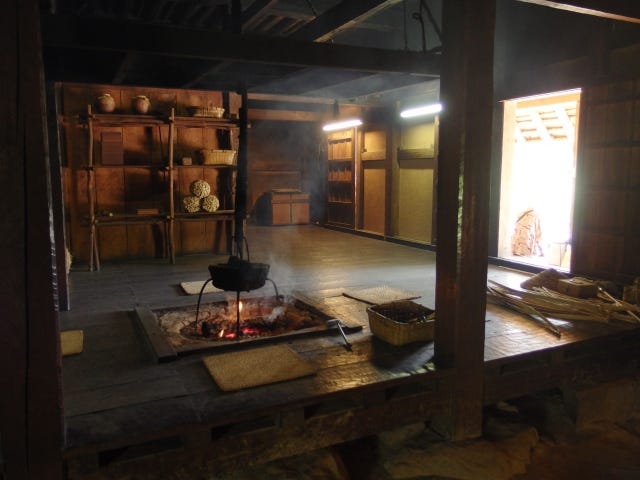
In response, people traditionally hung radishes above the irori (囲炉裏), a sunken hearth inside the home.
An irori was a feature of traditional Japanese houses, used for heating and cooking. It was also a place where family members gathered.
The heat and smoke from the hearth helped dry the daikon. Afterward, the smoked radishes were pickled in rice bran, salt, and other ingredients to produce food that could be kept through winter.
The name itself reflects the preparation method. Iburi means smoking, while gakko means pickles in the local Akita dialect.
Today, producers generally use dedicated smoking facilities rather than household hearths. In places such as the Sannai area (山内地区) of Yokote City (横手市), however, smoke can still be seen rising from daikon-smoking sheds around November and December.
In Miyazaki, people use winter winds to dry daikon. In Akita, they traditionally used the heat and smoke of indoor hearths.
Each region developed practical solutions based on the ingredients available and the challenges presented by its winter climate.
I find it fascinating that methods originally developed to preserve food have also produced flavors unique to each region.
Why These Traditional Foods Remain Part of Japanese Life
Today, people in Japan can buy a wide variety of ingredients regardless of the season.
Refrigerators and freezers are common, and advances in food processing and distribution have transformed how we store and prepare food. Freezing and modern freeze-drying technologies also allow many foods to be kept for extended periods.
There is no longer the same need for households to prepare large quantities of preserved food in advance. Most of us can simply buy what we need, when we need it.
Yet dried persimmons, dried daikon, and traditional pickles remain familiar parts of Japanese meals.
I think this is because preserving food is no longer their only purpose.
Making dried persimmons requires peeling each fruit, hanging it to dry, and carefully monitoring its condition. Preparing dried daikon involves more than simply cutting vegetables and leaving them outside. The weather and the progress of drying must be checked. Iburigakko requires smoking, pickling, and allowing the radishes time to mature.
Making these foods takes both effort and time.
Today, we can buy frozen vegetables or prepare dried foods simply by adding hot water. In a world where meals can be prepared so quickly, spending days or even weeks making preserved foods can feel like a kind of luxury.
What was once necessary work for surviving winter has become something people may choose to do because they value the process and the result.
Preservation techniques have also become ways of creating delicious flavors.
Modern food processing has its own advantages, of course. Convenience matters, and many traditional preserved foods are now produced using specialized equipment and machinery.
Even so, I find something appealing about older methods that involve choosing seasonal ingredients, watching the weather as they dry, or allowing them to mature over time.
There is a period of waiting before the food is ready, and the maker’s experience can influence the result. Learning about these processes changes how I appreciate even a single dried persimmon or a small serving of pickles.
Efforts are also being made across Japan to protect the quality and regional identities of traditional foods. Products such as Ichida-gaki from Nagano, Date no Anpogaki from Fukushima, Dōjō Hachiya-gaki (堂上蜂屋柿) from Gifu Prefecture (岐阜県), and iburigakko from Akita are officially registered as regional specialties associated with their local environments and production methods.
Preserving these traditions depends on the farmers and food producers who continue making them, as well as the people who understand and maintain the techniques involved.
When I think about my own life, I realize that I have not acquired the same food preservation skills my great-grandmother had.
I buy seasonal vegetables, keep them in the refrigerator, and cook what I need. That is my everyday routine.
If I tried to do the work my great-grandmother performed every year, I would probably need to do a great deal of research and learn through plenty of trial and error.
Knowing when a persimmon has dried enough, choosing the right weather to hang daikon, or judging when pickles are ready are skills that cannot always be learned simply by following the measurements and timings in a recipe.
In the past, some of this knowledge was passed down within families, as children watched their parents or grandparents at work and helped them with everyday tasks.
I never learned the details of food preservation directly from my great-grandmother. I do not know how she decided on ingredient quantities or how she judged when something was ready, and I can no longer ask her.
Perhaps that is why the life I remember from her home interests me more than ever. I want to keep learning about the knowledge that helped earlier generations understand the seasons and prepare food with such care, at a time when they had fewer modern conveniences.
Discovering the Different Autumns of Japan
I was born and raised in Hokkaido, and I now live in Fukuoka.
Although both places are in Japan, moving between them has changed the way I experience the seasons.
In Hokkaido, the deepening of autumn always made me conscious of the approaching winter. In Fukuoka, warm days can continue well into late October, and winter seems to arrive at a different pace.
Then there were the dried persimmons I saw hanging beside a window for the first time after moving here.
It was a new sight for me, although for the family preparing them, it may simply be something they do every autumn.
In Nagano, curtains of drying persimmons appear. In Fukushima, rows of persimmons hang from drying structures. In Miyazaki, daikon dries in the winter wind, while in Akita, the preparation of iburigakko begins before the snow arrives.
Every region has seasonal scenes that are ordinary and familiar to the people who live there.
There must be so much about everyday life in Japan that I have yet to discover.
I would like to experience more of these seasonal changes, not only at famous destinations but also in farmers’ yards, beside the windows of ordinary homes, and in the fields where people work.
Just as I only came to appreciate the value of the scenes at my great-grandmother’s home after growing up, I believe there are aspects of life in other regions that I can only understand by visiting and seeing them for myself.
I want to continue exploring these places and learning how people live with the changing seasons.
Are there traditional ways of preserving seasonal harvests in your country or region?
If you have foods passed down through your family, or memories of seasonal scenes from childhood, I would love to hear about them.
—Written by Sumire
You can also support my work by buying me a coffee through buy me a coffee.
You may also enjoy these stories
Grandmothers’ Wisdom for Staying Healthy

The cold has truly settled in, and the air has grown quite dry. How are you all holding up? I hope you aren’t suffering from any winter colds or feeling under the weather.
Never Do This with Chopsticks in Japan

Sushi, ramen, tempura, katsu. Today, these Japanese foods are enjoyed around the world. Many of you may have eaten them in Japan, or at a Japanese restaurant. When you did, did you pick up a pair of chopsticks?
Kannazuki: When the Gods Gather and Japan Celebrates Autumn

In Japan, people have long believed in countless deities, traditionally known as yaoyorozu no kami (八百万の神), or the “eight million gods.”