

The Longest Day of the Year, and Father’s Day in Japan
Life in Japan – Issue 031

This Saturday article is part of the “Life in Japan” series.
Unlike the in-depth essays published on Tuesdays, this series focuses on everyday life in Japan, sharing seasonal changes and daily scenes from a more personal and familiar perspective.
June is already entering its second half. The 2026 FIFA World Cup has begun, and the excitement around soccer is growing all over the world. In Japan too, I have been seeing more news and social media posts about the matches.
Are many people in your country watching the World Cup as well?
Tomorrow, June 21, 2026, is the summer solstice.
In the Northern Hemisphere, the summer solstice is the day when the daylight is longest and the night is shortest. In the Japanese calendar, it is one of the seasonal markers known as 二十四節気(nijūshi sekki), the twenty-four solar terms. These include 春分(shunbun), the spring equinox, 秋分(shūbun), the autumn equinox, 冬至(tōji), the winter solstice, 立春(risshun), 立夏(rikka), 立秋(risshū), and 立冬(rittō). They divide the seasons according to the movement of the sun.
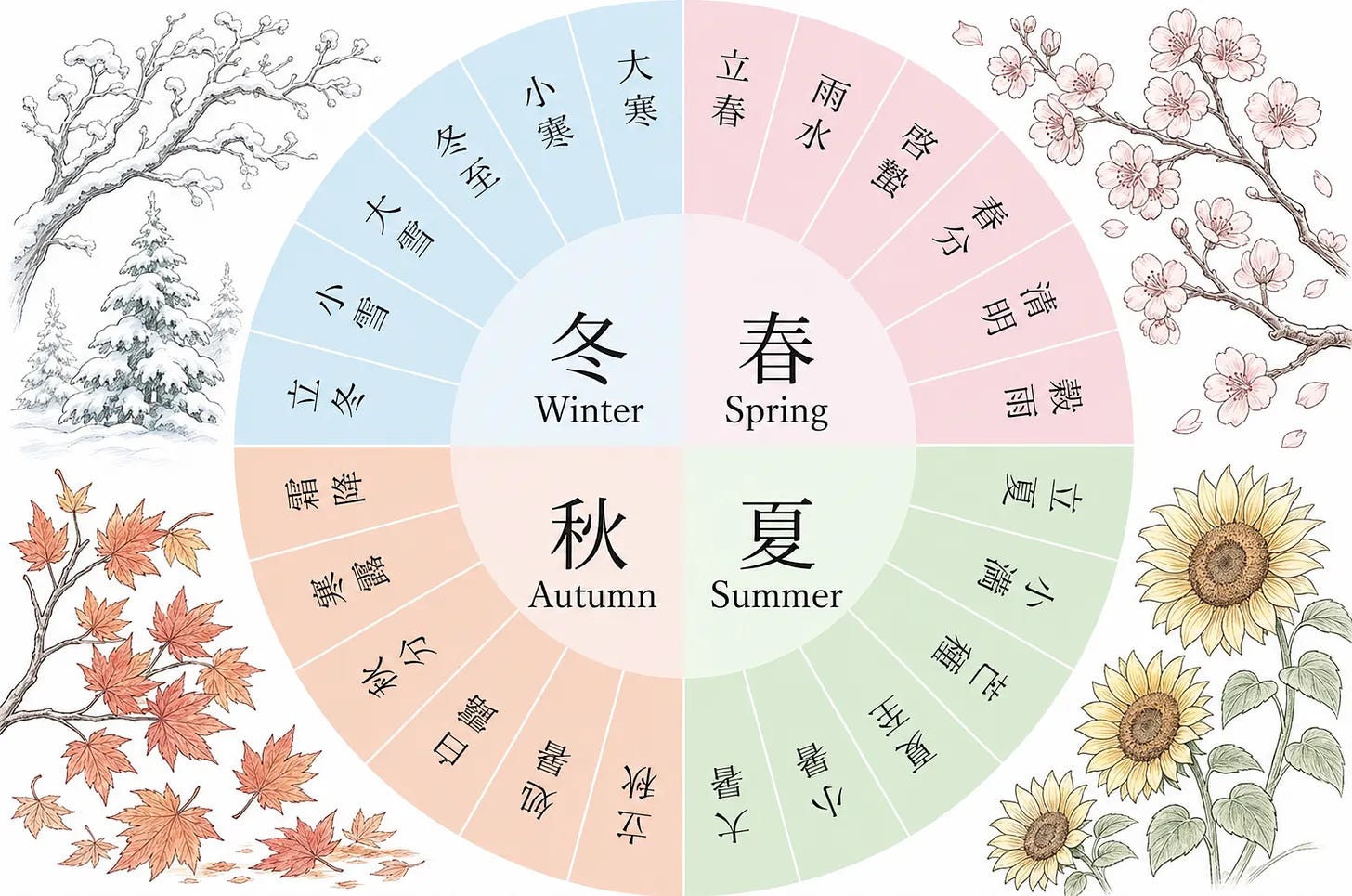
In the past, when farming and daily life were closely connected to the movements of nature, these calendar words helped people read the seasons. Even today, they still appear in weather forecasts, news reports, and seasonal greetings. They are not something most people think about every day, but when we hear them, they help us sense where we are in the year in a way that the numbers on a calendar alone cannot show.
When people hear the words “summer solstice,” many may imagine strong sunlight and a bright sky.
In Japan, the summer solstice comes during the rainy season. Even when the sky is covered with clouds, or when fine rain is falling, the evening light remains for a long time. This is the season when we can enjoy the beautiful evening sky for a little longer.
At this time of year, water fills the rice fields, and young rice seedlings are planted in rows. The timing of rice planting differs by region, but in June, rice field scenery is common in Japan. The surface of the water reflects the sky, and the thin green seedlings move in the wind.
The summer solstice is a turning point of the sun. But in Japan, the June solstice is also close to rice fields, water, rain, and the growth of plants. Rather than feeling the season only through the sun, we can sense the approach of real summer in the flooded rice fields and in the young seedlings beginning to grow.
While writing this article, I also looked a little into how the summer solstice is observed overseas.
For example, in England, many people gather at Stonehenge to see the sunrise on the summer solstice. Stonehenge is known as a place deeply connected with the solstice sunrise. In Sweden, Midsummer is cherished as an important annual event. People make flower crowns, gather with family and friends for meals, and dance around a maypole.
It is interesting how the same summer solstice can be experienced so differently depending on the country or region. In some places, people celebrate the sun. In others, they gather with family and friends.
Japan also has Shinto rituals connected with the summer solstice.
At 二見興玉神社(Futami Okitama Jinja) in Ise City, Mie Prefecture, a summer solstice festival is held.二見興玉神社(Futami Okitama Jinja) is well known for 夫婦岩(Meoto Iwa), a pair of sacred rocks standing in the sea.
According to the shrine, preparations begin on the day before the solstice. On the day itself, a ritual is held before sunrise to pray for the happiness and health of the participants, as well as for world peace. At sunrise on the summer solstice, participants perform 禊(misogi), a purification ritual in the sea, and receive the divine power of 日の大神(Hi no Ōkami) and 興玉大神(Okitama Ōkami).
日の大神(Hi no Ōkami) refers to a solar de


ity and brings to mind 天照大神(Amaterasu Ōmikami), the sun goddess. On the morning of the summer solstice, people pray to the sun rising between 夫婦岩(Meoto Iwa) and enter the sea to purify themselves. I think of it as a Shinto ritual in which the sun, water, and prayer come together, rather than merely a seasonal event.
In Japan, mountains, seas, and rivers have long been seen as more than scenery. People have regarded them as presences beyond human power. The direction of the sunrise, the water of the sea, the shape of rocks, the form of mountains. People have sensed something sacred in such parts of nature.
The summer solstice festival at 二見興玉神社(Futami Okitama Jinja) is one example of a calendar day becoming connected with a Shinto ritual. Rather than saying that Japan as a whole celebrates the summer solstice in a large way, it may be closer to say that in certain places, prayers connected with the sun and water remain.
Across Japan, there are also foods that have been eaten around the time of the summer solstice.
In the Kansai region, for example, there is a custom of eating octopus. The solstice season overlaps with the time of rice planting, and it is said that people ate octopus with the wish that the roots of the rice plants would spread firmly like the legs of an octopus.
In Nara, there are rice cakes known as 半夏生餅(hangeshō mochi) and さなぶり餅(sanaburi mochi). These were made around the time when the wheat harvest and rice planting were coming to an end, and they are foods connected with the turning point of agricultural work.
Other examples include grilled rice cakes made with newly harvested wheat in the Kanto region, 水無月(Minazuki) in Kyoto, a wagashi eaten around the time of 夏越の祓(Nagoshi no Harae) at the end of June, 半夏生サバ(hangeshō saba) in parts of Fukui, and いちじく田楽(ichijiku dengaku) in parts of Aichi.
Rather than having one fixed dish for the summer solstice, Japan has regional food cultures connected with rice planting, harvests, preparation for the heat, and wishes for good health.
And this year, June 21, 2026, is not only the summer solstice. It is also Father’s Day.
Father’s Day began in the United States. The first Father’s Day event was held in Spokane, Washington, in 1910, after a woman named Sonora Smart Dodd wanted to create a day to express gratitude to her father, who had raised his children after their mother died.
Father’s Day later spread across the United States and was eventually introduced to Japan. In Japan, Father’s Day Council was established in 1981. The following year, it began the Father’s Day Yellow Ribbon Campaign and the Best Father Awards. The yellow flowers and yellow ribbons now associated with Father’s Day in Japan are connected with these activities.
As the third Sunday of June approaches, Father’s Day gifts appear in supermarkets, department stores, and online shops. Alcohol, wagashi, 鰻(unagi), meat, shirts, handkerchiefs, and health related items are common. The gifts are a little different from what we often see for Mother’s Day.
My earliest memory of Father’s Day is drawing a portrait of my father in kindergarten. I remember bringing it home and giving it to him, feeling a little embarrassed. For a child, too, Father’s Day was a day to put gratitude into a visible form.
In Japan today, each family spends Father’s Day in its own way. Some people send gifts. Some invite their fathers out for a meal. When families live far apart, a phone call or message may be enough to share their feelings. In families with small children, portraits and letters are still common Father’s Day gifts.
In Japan, people do not often say “I love you” directly to their families. Daily hugs between parents and children, or between spouses, are also not as common as they are in many Western cultures. I think affection is often shown more through everyday actions than through words or physical gestures.
Working every day. Picking someone up. Preparing meals. Helping when help is needed. There can be affection in these actions.
Father’s Day gives people a chance to express feelings that can be hard to put into words in daily life. Rather than being a day for expensive gifts, it is a day to give shape, even briefly, to gratitude and affection for family. A short message, a phone call, a portrait, flowers, or food can all become ways to share those feelings. I hope it will continue to be valued as a day for expressing what we often leave unsaid.
A calendar turning point based on the movement of the sun, and a modern day for expressing gratitude to family. This year, the two fall on the same day.
How do you spend the summer solstice in your country?
Do you have foods connected with the solstice, or customs for spending time with family? I would love to hear about them.
Finally, to go along with this season of longer days, I made a vlog of a day when I started early in the morning and ended by seeing a beautiful sunset. It connects a little with the feeling of the “long day” I wrote about in this article. I hope you will enjoy watching it as well.
—Written by Sumire
You can also support my work by buying me a coffee through buy me a coffee.
You may also enjoy these stories
Bottling the Season: Japan’s Delicious Umeshigoto Tradition

June has begun. Thank you for opening this week’s article.
Matcha, Wagashi, and Wabi-Sabi

Matcha (抹茶 Powdered green tea), Wabi-sabi (侘び寂び The aesthetic of imperfect beauty), and Sado (茶道 The Way of Tea). These words have become widely known internationally when discussing Japanese culture. The time spent enjoying a bowl of tea in a quiet space is not merely eating and drinking, but is received as a complete experience. In that moment, there is an indispensable touch of color:
I have recently finished an introductory book on Shinto, and was wondering if there were special ceremonies for Amaterasu Ōmikami on the Summer Solstice, as that seemed very logical to me. Thank you for mentioning this ritual of sun and sea and Solstice.
My sons gave me a bottle of advocaat for Father's Day!