

Bottling the Season: Japan’s Delicious Umeshigoto Tradition
Life in Japan – Issue 029

June has begun. Thank you for opening this week’s article.
In Japan, June is also called Minazuki(水無月).
This is one of the old Japanese names for the months. Today, Japan uses numerical month names such as January, February, and March. But in the old calendar, each month also had a name that reflected the season. January was Mutsuki(睦月), March was Yayoi(弥生), May was Satsuki(皐月), and June was Minazuki(水無月). These names were not simply words for counting the months. They were seasonal names connected to nature, farming, and everyday life.
At first glance, the kanji for Minazuki(水無月) can look as though it means “the month without water.” But in this name, the character 無 is commonly understood not as “nothing” or “without,” but as part of an old expression that points to “the month of water.” It is the month when water is drawn into the rice fields. It is the month when water becomes necessary for rice planting. In that sense, the name Minazuki fits the Japanese season of June very well.
As I mentioned in last week’s article, Japan is now entering a season with a great deal of rain. Typhoons, heavy rainfall, and flooding can occur during this period, so water arrives both as a blessing and as something that requires caution. For those of you living in countries or regions with a similar climate, please take care during typhoon and hurricane season as well.
When the season of Minazuki arrives, green ume begin to appear near the entrance of Japanese supermarkets. They are often sold by the kilogram in bags. Nearby, you will find rock sugar, shōchū, and large glass storage jars. When those jars, which are not usually so prominent, begin to appear in visible places, I feel that ume season has arrived again.
In Japan, June is the season when umeshigoto(梅仕事) begins. Umeshigoto means the seasonal work of preparing ume. People use fresh ume to make umeshu(梅酒, ume liqueur), ume syrup, umeboshi(梅干し, salted pickled ume), ume jam, and other preserved foods. Every year around this time, this seasonal handwork appears around the kitchen and dining table.
Firm green ume are used for umeshu and ume syrup. Yellow, ripened ume are better suited for umeboshi and jam. The fragrance of ume is very distinct. Green ume have the scent of young fruit, while ripened ume have a sweet fragrance close to peaches. Even just walking near the boxes or bags, you can tell that ume season has arrived.
The easiest places to begin are ume syrup and umeshu.
Ume syrup is made by placing ume and sugar in a storage jar. It becomes ready to drink after a few weeks, so it is one of the easier ume preparations to enjoy as the weather begins to heat up. Mixed with sparkling water, it becomes a refreshing drink for summer. Since it contains no alcohol, it can also be enjoyed by people who do not drink and by children, which makes it a common seasonal preparation at home.
Umeshu is made by placing ume, rock sugar, and white liquor such as shōchū in a storage jar. It takes longer than ume syrup and usually needs about half a year before it is ready to drink. Umeshu prepared in June captures the beginning of summer inside a jar and becomes ready around winter. By the following summer, the flavor becomes deeper and more rounded.
If made and stored properly, umeshu can be enjoyed for many years. Over time, its color deepens and its taste becomes softer.
This is umeshu I made four years ago.


Even now, after four years, it still has a good fragrance, and I sometimes enjoy it in the evening. It is common to make umeshu with rock sugar and white liquor, but that year I made mine with brown sugar and Japanese sake. Being able to choose your own sugar and alcohol is one of the pleasures of making it by hand.
※When making umeshu or other fruit liqueurs at home in Japan, there are strict legal requirements. The alcohol used must have an alcohol content of at least 20% and must already be subject to liquor tax. Ordinary Japanese sake is usually around 15–16% alcohol, but the sake I used was a higher-alcohol sake intended for making fruit liqueurs.
Among the different kinds of umeshigoto, umeboshi may be the one that feels most distinctly Japanese.
Many people overseas may have heard of umeboshi. If you are interested in Japanese food, you may have seen it as a red, sour preserved food. In Japan, umeboshi can be bought at supermarkets and convenience stores, and it is also a classic filling for onigiri.
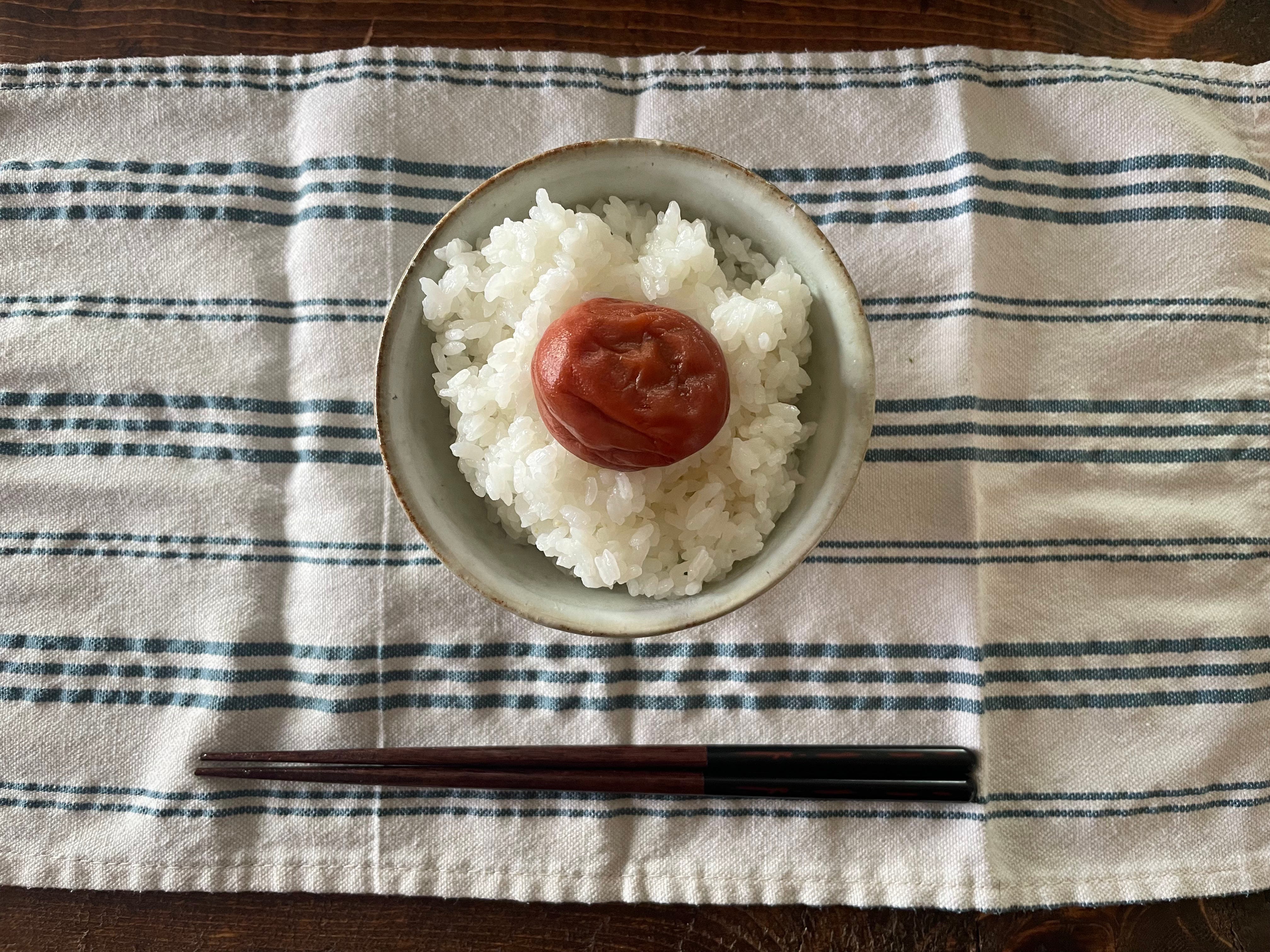
Homemade umeboshi has a different kind of deliciousness from store-bought umeboshi. The ume are carefully washed, their stems are removed, and they are packed with salt. After several days, liquid begins to come out of the ume. This liquid is called umezu(梅酢, ume vinegar). Even after the umezu rises, the umeboshi are not finished right away. The ume are left in the umezu for about a month so the flavor can settle. After that, they are dried under the strong summer sun for about three days.
Umeboshi takes time to make. That is why homemade umeboshi can taste especially good. Old-fashioned umeboshi made with enough salt have remained in Japanese homes as a food that can be preserved for a long time. Umeshigoto is not only about enjoying seasonal fruit in the moment. It is also a way of keeping the season inside jars and crocks.
At my grandmother’s house, I remember seeing many jars of umeboshi lined up in the basement. I still remember that scene from childhood. I loved the salty, sour umeboshi my grandmother made.
Umeboshi is also deeply connected to Japan’s bento culture.
In Japan, many people bring bento to school or work. A Japanese bento is often not just a sandwich or a light snack, but a proper meal packed with white rice and side dishes. Tamagoyaki, grilled fish, fried chicken, and vegetable side dishes are placed inside a small lunch box and eaten as lunch. Bento appears in many parts of Japanese life, from school events and club activities to lunch breaks at work and train journeys.


In bento, umeboshi is a very familiar presence.
A bento with one red umeboshi placed in the center of white rice is called Hinomaru Bento(日の丸弁当). It is named this way because the red umeboshi in the middle of white rice resembles the Japanese national flag. For Japanese people, it is a well-known bento style that is immediately recognizable.
Umeboshi brings out the flavor of plain white rice. Because it has a strong sourness and saltiness, it can make rice easier to eat even during the hot season, when the appetite may be low. Ume is also a classic filling for onigiri sold at convenience stores and supermarkets. There are many kinds of onigiri fillings, such as salmon, kombu, and tuna mayonnaise, but ume feels especially Japanese to me.
When I eat ume onigiri after hiking or walking for a long time, the saltiness and sourness seem to reach my body. After sweating, there are moments when I want the sharp sourness of ume more than something sweet. After walking under strong sunlight, an ume onigiri is such a simple food, yet it can feel as if the body has received exactly what it needed.

Umeboshi has long been loved in Japan not only because it tastes good, but also because it is considered good for the body. It contains organic acids such as citric acid, which gives it its sourness, and it also contains salt, making it a familiar food for seasons when people sweat. Umeboshi is often associated with preventing summer fatigue and heatstroke, and in recent years it has also drawn attention for its possible relationship to dieting and gut health.
Although umeboshi has long been eaten as part of everyday wisdom, its components and effects have also become the subject of research. Components found in ume, such as citric acid, polyphenols, ume lignans, and vanillin, have been discussed in relation to fatigue, lipid metabolism, and the intestinal environment. It is also interesting that compounds found in heated umeboshi have attracted attention for their possible action on fat cells.
The fact that we crave ume onigiri on hot days, that the sourness of umeboshi helps rice go down when our appetite is low, and that its saltiness can feel right after sweating, may have reasons beyond old household experience. Umeboshi is a food where Japanese family wisdom and modern research overlap.
June is an important time in Japanese life for preparing the body and the home for summer. The rain increases, and the heat approaches. Before the height of summer arrives, people prepare ume, pay attention to humidity, and bring sourness and saltiness into the daily table. In these small preparations, we can see how Japan receives the changing seasons.
In a previous SJJ article, I wrote about Japanese “grandmother’s wisdom.” When I look at umeshigoto, I am reminded of the kind of household wisdom I wrote about in that article. Long before such knowledge was explained as theory, people watched the seasons, chose ingredients, preserved food, and cared for the bodies of their families.

Do you have foods in your country that are prepared before summer begins, or seasonal wisdom passed down through your family? If you have never tried umeboshi, I hope you will try it someday when you visit Japan. It is sour and salty, and it may surprise you at first. But inside that small piece of umeboshi, Japan’s June way of life is tightly packed.
—Written by Sumire
You may also enjoy these stories
What Changes in Japan When June Begins?

Last week, I wrote about the wheat fields and rice paddies that can be seen in Japan at this time of year.
Matcha, Wagashi, and Wabi-Sabi

Matcha (抹茶 Powdered green tea), Wabi-sabi (侘び寂び The aesthetic of imperfect beauty), and Sado (茶道 The Way of Tea). These words have become widely known internationally when discussing Japanese culture. The time spent enjoying a bowl of tea in a quiet space is not merely eating and drinking, but is received as a complete experience. In that moment, there is an indispensable touch of color:
Great post, many thanks. We have two plum trees, we cut them back two years ago, and now we got a nice harvest. We are making plum syrup, with local sugar (not imported).