


This Saturday article is part of the “Life in Japan” series.
Unlike the in-depth essays published on Tuesdays, this series focuses on everyday life in Japan, sharing seasonal changes and daily scenes from a more personal and familiar perspective.
Japan has now entered 小暑(Shōsho / Lesser Heat), one of the twenty-four solar terms.
Shōsho refers to the time when the intense heat of summer begins. In recent years, however, there have been days in Japan when the gentle expression “the heat is beginning” no longer feels sufficient.
In some regions, temperatures rise above the temperature of the human body, creating heat that is described as disaster-level. Heatstroke alerts are issued, and it is not unusual for people to be advised to avoid going outside or exercising. Every year, many people are taken to hospital by ambulance because of heatstroke.
Drinking water frequently, using air conditioning, and avoiding overexertion are essential. Protecting yourself from the heat is an important part of spending summer in Japan.
Summer seems to bring back my childhood memories more vividly than other seasons.
Perhaps this is because I always preferred summer to winter. The long school holidays, training camps with my school club, trips to the sea, camping, and the hours I spent outside until evening all come back to me. I remember not only the heat, but also what I ate during the season and the time I spent laughing with other people.
Many of the foods associated with summer in Japan are served cold. There is shaved ice, watermelon, and chilled somen noodles.
One summer activity closely connected to my memories of watermelon is スイカ割り(suikawari), or watermelon splitting.
At summer camps, school club training camps, family gatherings, and days spent at the beach with friends, a round watermelon and a single wooden stick would sometimes be prepared whenever a large group gathered.
I also played suikawari during a school club training camp when I was a child. The time we spent standing around the watermelon and calling out to one another between demanding practice sessions remains one of my summer memories.
Some readers may have seen a suikawari scene in a Japanese anime or television drama.
One person is blindfolded and given a stick. After turning around several times, they lose their sense of direction and must find the watermelon by relying only on the voices of the people around them.
“Right!”
“A little farther forward!”
“There!”
Instructions come from every direction. Sometimes, however, everyone begins shouting different directions at the same time, leaving the blindfolded person even more confused.
Eventually, the player reaches the area near the watermelon and swings the stick down at the place where they think it is. If they strike the watermelon successfully, everyone cheers. If they hit the ground instead, the group bursts into laughter.


When described in words, it may sound like a slightly strange game: food is placed on the ground, and a blindfolded person tries to hit it with a stick.
While writing this article, I began to wonder who first started suikawari and why, so I decided to investigate.
In fact, it is not known exactly when or where suikawari began. One explanation that has been proposed connects its origins to Japanese samurai and sword culture.
For samurai, the Japanese sword was once a weapon used in battle. To learn how to handle it accurately, samurai repeatedly trained in disciplines such as swordsmanship and iai.
The technique of drawing a sword from its scabbard and cutting an opponent as part of the same movement is called 居合(iai). It has been passed down to the present as a martial art designed to develop the ability to respond immediately to an opponent’s movements and use the sword without hesitation.
試し斬り(tameshigiri), or test cutting, is also practised to assess the sharpness of a Japanese sword and the skill of the person using it. Targets may include rolled straw or bamboo.
A sword does not cut cleanly through an object simply because it is swung with great force. The position and angle of the blade, the speed of the movement, and the motion of the body must all work together for the intended point to be cut accurately.
One theory suggests that samurai test cutting and the movements of iai eventually developed into entertainment using vegetables and fruit, which then became a popular game among ordinary people and evolved into suikawari.
No historical documents have been found that prove this theory, so it cannot be presented as the definitive origin of the game. Even so, when I see someone standing before a round watermelon and swinging a large stick down toward it, I can understand why someone might have imagined a samurai holding a sword.
Today, suikawari is a summer game enjoyed together by children and adults.
In Japan, people also place importance on not wasting food. For this reason, it is common to spread a clean plastic sheet or mat beneath the watermelon before playing.
After the watermelon has been split, it is shared among everyone present and eaten until none remains.
The purpose is not simply to see whether someone can split it successfully. Everyone calls out instructions, laughs whether the attempt succeeds or fails, and then shares the same watermelon at the end. This entire experience has long been enjoyed as part of people’s summer memories in Japan.
Another thing I associate with summer in Japan is 流しそうめん(nagashi sōmen), or flowing somen noodles.
Somen are thin noodles made mainly from wheat flour. Well-known production areas can be found across Japan, including 小豆島(Shōdoshima)in Kagawa Prefecture, 播州(Banshū)in Hyogo Prefecture, 三輪(Miwa)in Nara Prefecture, and 島原(Shimabara)in Nagasaki Prefecture.
Somen can be eaten in a warm broth, but in summer, it is common to rinse the boiled noodles in cold water and serve them thoroughly chilled.
They are dipped into a cold sauce and eaten with condiments such as green onion, ginger, myōga ginger, and wasabi. Somen are easy to eat even on days when the heat reduces your appetite, and they frequently appear as a summer lunch in Japanese homes.
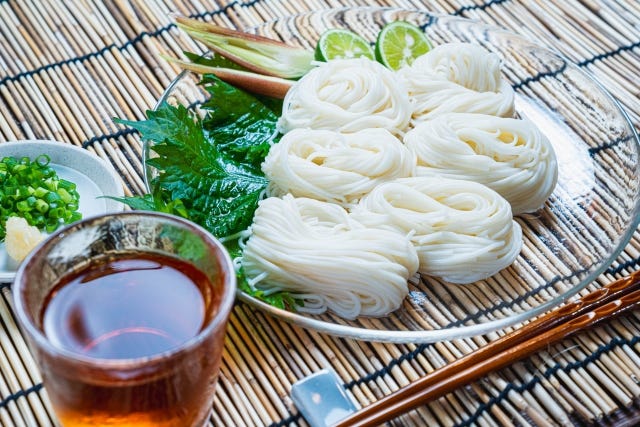
Somen are delicious when simply served in a bowl, but nagashi somen turns the meal into a game.
In the traditional form of nagashi somen, a long piece of bamboo is split lengthwise, and the internal joints are removed to create a channel. The bamboo is placed at a slight angle so that water can flow from the upper end to the lower end.
Cold water is poured through the bamboo, and small portions of boiled and chilled somen are placed into the channel from the top. The noodles travel down the bamboo with the water, sliding along its surface.
The participants stand on both sides of the bamboo, catch the passing noodles with chopsticks, and dip them into their own sauce before eating.
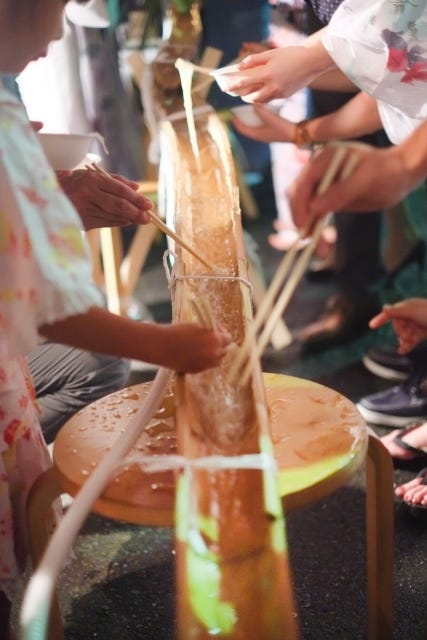
The somen do not wait until you are ready.
Sometimes the noodles pass directly in front of you just as you try to catch them. At other times, someone standing farther upstream takes all of them first. Those who catch the noodles successfully are delighted, while those who miss them wait for the next portion.
Everyone may be eating a meal, but their eyes remain fixed on the noodles flowing toward them.
I first experienced nagashi somen at a small local festival.
Local organizers had prepared long pieces of bamboo and built a structure through which the noodles could flow. Children and adults gathered around the bamboo, eagerly following the somen as they came down from above.
Just when the noodles seemed about to reach me, they passed by with the water. The people who caught them laughed, and the people who missed them laughed as well.
The sight of local people gathered around a long bamboo channel, all trying to catch the same somen, remains one of my summer memories.
Nagashi somen is held in many different settings, including family gatherings, local festivals, children’s community events, campsites, public halls, and outdoor activity centers.
In some regions, participants begin by cutting the bamboo and making the bowls, chopsticks, and structure used to carry the noodles. The entire day, including the preparations, becomes a summer event rather than an occasion focused only on eating.
There are also restaurants and facilities throughout Japan where visitors can experience nagashi somen.
千穂の家(Chiho no Ie), located in 高千穂峡(Takachiho Gorge)in Miyazaki Prefecture, is known as the restaurant where nagashi somen originated.
According to the Takachiho Tourist Association, in 昭和30年(1955), newspaper reporters boiled somen outdoors and ate it after cooling it in the cold water of Takachiho Gorge. A newspaper later introduced the scene. After seeing the article, the restaurant’s owner is said to have devised a method of sending water and somen through bamboo.
Visitors can still enjoy nagashi somen made with the clear water of Takachiho Gorge at Chiho no Ie today.
In 長瀞(Nagatoro), Saitama Prefecture, there is a restaurant where visitors can eat nagashi somen while looking out over the surrounding gorge. In 南島原市(Minamishimabara City), Nagasaki Prefecture, a large event has also been held using 島原手延そうめん(Shimabara hand-stretched somen), a local specialty, with the noodles flowing along a structure measuring one hundred meters in length.
Tabletop nagashi somen machines are also sold for households where preparing bamboo would be difficult.
Some models circulate the noodles around a round container, while others allow users to assemble a small water channel. With many different types available, ordinary somen can become a small summer event at the family dining table.
Nagashi somen is a relatively new way of eating somen that began during the Shōwa era.
It is not a traditional dish with a long history. Even so, it has been loved by many people since its creation and has become a summer scene familiar to almost everyone in Japan.
Suikawari and nagashi somen have much in common.
A watermelon can easily be cut with a kitchen knife. Somen can also be served in a bowl and enjoyed just as they are.
In Japan, however, people sometimes add an element of play to the process of eating.
They search for a watermelon while blindfolded. They chase flowing somen with their chopsticks.
Whether they succeed or fail, everyone present laughs together.
The experience is not only about eating something delicious, but also about enjoying it with other people. I believe that this shared time is also part of the taste of summer in Japan.
Should you have an opportunity to visit Japan during the summer, I hope you will try suikawari or nagashi somen. You may encounter them not only at restaurants in tourist areas, but also at local festivals, accommodation facilities, and summer holiday events.
The heat in Japan will become even more severe from this point onward. Please remember to drink enough water and take good care of your health.
Finally, I would like to introduce the latest video from the personal vlog I produce.
I did not play suikawari in this video, but I did enjoy watermelon, one of the familiar symbols of summer in Japan. I hope you will also enjoy the present-day summer scenery of Japan and the moments of everyday life shown in the video.
—Written by Sumire
You can also support my work by buying me a coffee through buy me a coffee.
I remember doing suikawari during kendo 合宿 and nagashi soumen at Takachiho! I agree they are so fun, thanks for bringing more insight into these summer practices!