


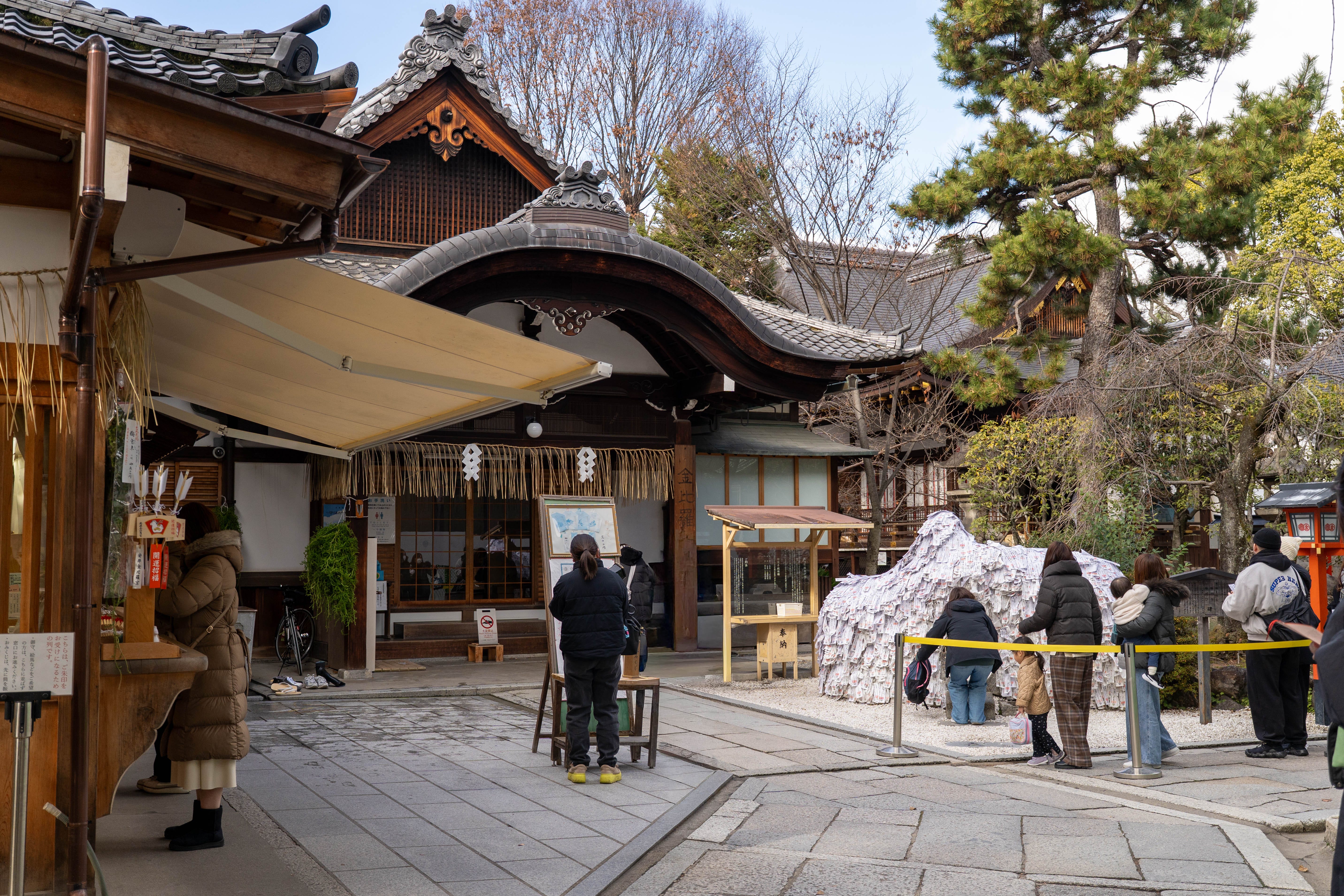
First, take a look at this photo.
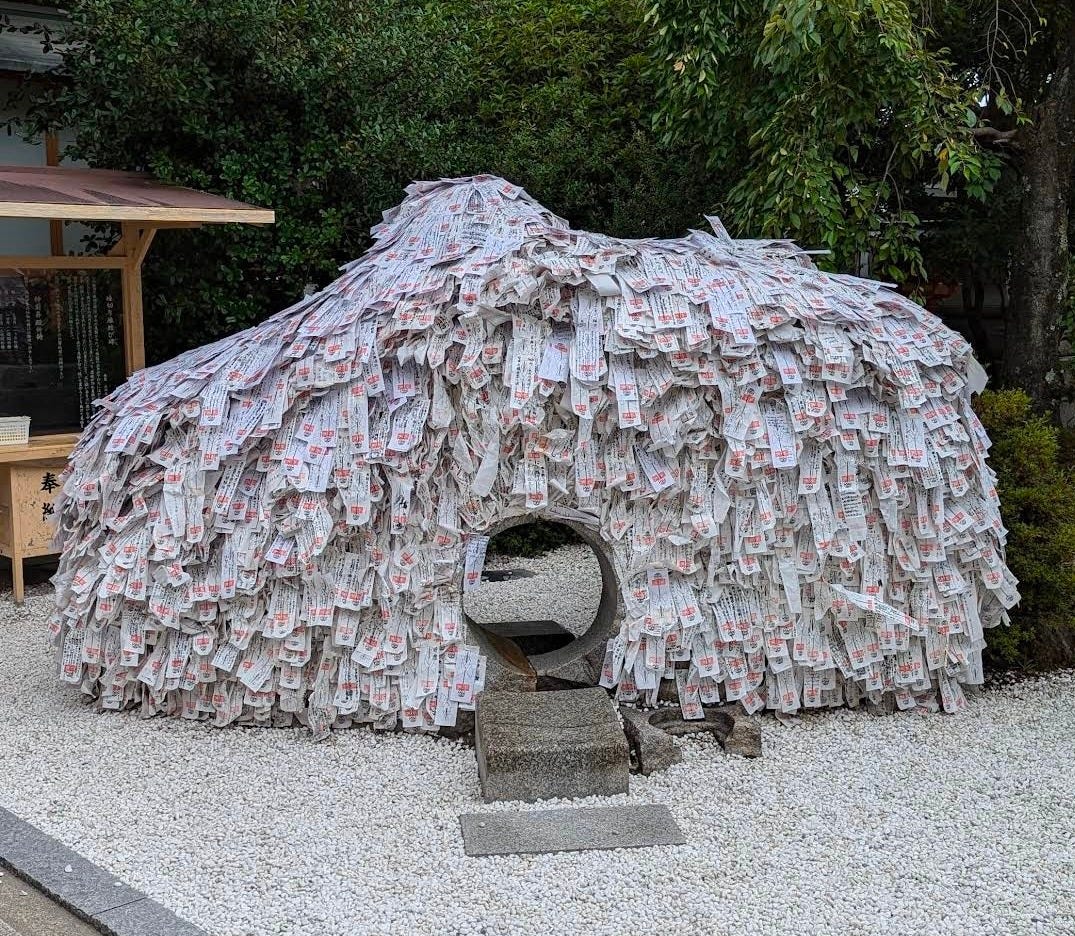
What does it look like to you? A piece of modern art? Or perhaps a かまくら (Kamakura) - Japanese igloo made in snowy regions?
At first glance, it looks like a soft mound of snow. However, if you get closer and look closely, you will realize the surface is not snow at all. This white object is covered in countless sheets of “paper.” And on every single sheet, rustling dryly in the wind, someone’s desperate “wish” is scrawled.
“I want to cut ties with my hateful boss.” “I want to cut ties with my illness.” “I want to break away from my past self.” “I want to meet my destined partner.” “I want to find a workplace where I can be at peace.”
This is 安井金比羅宮 (Yasui Konpiragu), located in the Higashiyama district of Kyoto. It is one of Japan’s most famous shrines dedicated to ‘En-kiri’ (Severing Ties).
This strange megalith has a small hole in the center, just big enough for an adult to crawl through. People form lines, and when their turn comes, they kneel on the ground and crawl through the hole as if in prayer.
Why do people go so far as to crawl on the ground to pass through this hole? The hint lies in the “God” enshrined here. While three deities are worshipped, the main deity is 崇徳天皇 (Emperor Sutoku).
Actually, he is not just an Emperor. In Japanese folklore, he is a special existence, counted as one of 日本三大怨霊 (Japan’s Three Great Vengeful Spirits). An Emperor, yet a vengeful spirit. And a vengeful spirit, yet a guardian deity who organizes human relationships. Why was such a paradox born? This shrine hides the complex way Japanese people deal with relationships, along with the deep spirituality unique to Japan.
Today, I will guide you to this mysterious sanctuary in the back alleys of Kyoto. Let’s dig deep into 縁 (En) and 縁切り (En-kiri), and the depths of the Japanese heart.
The Curse Called Kindness
Why is such a special place so sought after in modern Japan? The key to unlocking that mystery lies hidden within our Japanese “national character.”
If you were asked, “Tell me what you know about the Japanese personality,” how would you answer? “Kind,” “Polite,” “Peaceful.” Some kind people might answer that way, and in a sense, it is true. Japanese people value 和 (Wa) - Harmony and extremely dislike aggression towards others.
However, if you have a slightly deeper knowledge of Japan, you might add this: “It’s hard to tell what they are thinking.” “I wonder if I can trust their words as they are (Ambiguous).”
This feeling that “you can’t see their true intentions.” Actually, that is the flip side of a certain “weakness” we carry. That weakness is a strong sense of guilt about “Refusal.”
Go to a bookstore in Japan. Or search on YouTube. You will find an interesting phenomenon spreading there. “The Courage to Say No,” “The Courage to Be Disliked,” “Psychology of Saying No”... Books and videos with titles like these are overflowing. The fact that they become bestsellers and are viewed millions of times is proof that many Japanese people deeply harbor the struggle of “not being able to say what they dislike” or “not being able to refuse.”
In Japanese society, refusing someone’s offer or rejecting a relationship isn’t merely a simple expression of intent. It is sometimes feared to be taken as “Evil” or an “Attack” on the other person.
There is a word, 八方美人 (Happo-bijin) - Eight-direction Beauty. Translated literally, it refers to someone who acts agreeably toward everyone. This is never used in a good way, but it is also one of the social skills to avoid friction in Japanese society. At the same time, it carries risks. Being nice to everyone means suppressing your true feelings, which can result in the loneliness of “not being trusted by anyone at heart.”
“I don’t like you, so I don’t want to see you anymore.” “This relationship hurts me, so I want to end it.” In Western culture, this might often be respected as an individual’s right. However, in Japan, it is very hard to say those words. Because saying them would disturb the Wa.
So, where do the unspoken true feelings go? The emotions of “No” that have lost their escape route accumulate like sediment in the heart. I believe that is where the existence of 縁切り神社 (En-kiri Shrines) like Yasui Konpiragu becomes a salvation.
Ties you cannot cut by yourself. A “Goodbye” you cannot say with your own mouth. You entrust them to the absolute authority of the gods. At first glance, this might look like “escaping responsibility” to avoid deciding with one’s own will. However, for us who value harmony and fear hurting others more than anything, rejecting someone solely based on “individual will” is too heavy a mental burden. That is why, perhaps, by leaning on the great power of the divine, we can finally allow ourselves to make “a choice to protect ourselves.”
In other words, I think the act of crawling through that stone is a detox for the soul, where Japanese people—who live desperately maintaining harmony in society—scream the “No” they cannot put into words with their whole bodies.
The River Flow and the Piles
So, what exactly is this 縁 (En) that we Japanese fear and cherish so much?
Explaining this in English is extremely difficult. If you look it up in a dictionary, words like “Fate,” “Destiny,” or “Bond” will appear. However, En for us is something more organic that cannot be contained in those words. It is the “Invisible Web” itself that surrounds us. Humans cannot live alone. We can only exist by relating to someone and relating to society. This mesh of inescapable connections is En.
And here is the interesting yet difficult part of the Japanese language. We have another important word that resembles En but has the exact opposite nature. That is しがらみ (Shigarami).
If you check a dictionary, the antonym of En would be 無縁 (Mu-en) - No ties. However, the Shigarami we feel in daily life feels like the dark side of En, or a “similar yet opposite existence.” Interestingly, when trying to translate both En and Shigarami into English, both can end up being “Bond” or “Ties.” But in the Japanese sense, the scenery these two words hold is as different as heaven and earth.
For us, a good En is like smoothly flowing “Water.” It flows without stopping, bringing new luck and encounters with wonderful people into our lives. On the other hand, what is Shigarami? The etymology of this word refers to “Weirs” or “Piles” driven into a river to control the flow. Originally, they were piles for flood control, but what happens if driftwood and trash get caught there? The water flow is dammed up, loses its momentum, and the water gradually becomes muddy.
This is the true identity of the Shigarami we feel. Relationships we cannot refuse, social obligations, past failures, or the endurance accumulated from not being able to say “No.” These become “Piles” that dam up the river flow of our lives. In English, both might be “Ties.” But for us, the former is “Flow” that carries life, and the latter is “Blockage” that binds life.
I think the philosophy of En-kiri preached by Yasui Konpiragu can be explained exactly with this river scenery. In Japan, there is an old saying: 流水腐らず (Ryusui kusarazu) - Running water does not rot. It teaches that water remains pure as long as it flows, but if it stops, it becomes stagnant and putrid. Also, Shinto has a ritual called 禊 (Misogi), where one purifies the body with river or sea water. This is an act of washing away 穢れ (Kegare) - Impurity with the water flow. In Shinto, Kegare is said to refer not just to dirt, but to a state where the flow of energy has withered (気枯れ - Ki-gare).
The En-kiri we wish for from the gods is not about attacking someone specific. It is a task to destroy the Shigarami (Piles) that are damming up the river of one’s life and to make the stagnant water flow again. If the weir is broken, the water will flow out vigorously and surely merge with a new clear stream (Good En) ahead. In other words, the act of “cutting” that we wish for even by crawling on the ground is not a rejection of others, but a 浄化 (Purification) to regain the circulation of our own lives.
The Guardian Born from Sorrow
Who is it that removes the “sediment” of our lives and helps with purification? The answer lies in the fierce life of 崇徳天皇 (Emperor Sutoku), who actually existed in the 12th century.
At that time, a fierce power struggle over imperial succession, the 保元の乱 (Hogen Rebellion), broke out. Defeated in this conflict, Emperor Sutoku was chased from his absolute position and exiled as a criminal to far-off 讃岐 (Sanuki) (current Kagawa Prefecture). The capital, power, and connections with close people—stripped of everything, he ended his life without ever stepping on the soil of the capital again.
After his death, his sorrow was passed down as a “grudge.” According to the war chronicle The Tale of Hogen, he completed a copy of the scriptures as a sign of reflection at his place of exile and sent it to the capital. However, the Imperial Court suspected it contained a curse and rejected it. Trampled on his prayers, he became furious, bit off his own tongue, wrote with the blood, and showed strong resentment. According to medieval tales, he eventually became feared as one of 日本三大怨霊 (Japan’s Three Great Vengeful Spirits).
However, another image of Emperor Sutoku is handed down at Yasui Konpiragu. According to the shrine’s history, he secluded himself at Kotohira-gu Shrine in his place of exile and spent his time cutting off all distinct “Desires.” From this image of “cutting off desires,” he came to be worshipped as the 断ち物の神 (God of Breaking Ties). Also, in later interpretations, he came to be seen as a figure who removes obstacles that hinder good ties, and people turned to him in hopes of avoiding painful ruptures like the ones his life came to symbolize.
A tragic Emperor who was forced to “be cut off” from everything in his life in an unwanted way. Because he knows the pain of that severance, he can become a guardian figure who stands by our “uncuttable ties” and severs them for us.
A Journey of “Rebirth” Through the Hole
Now that you understand who the deity associated with “cutting” is, let’s move on to the specific “Ritual.” This is not just an attraction; it has a process like a story. If you visit here, please cherish this order.
Step 1: Worship at the Main Hall
Do not go straight to the megalith; first, greet the gods at the Main Hall. This is not a transaction for wishes, but a time to convey your own “Declaration” to sever bad ties.
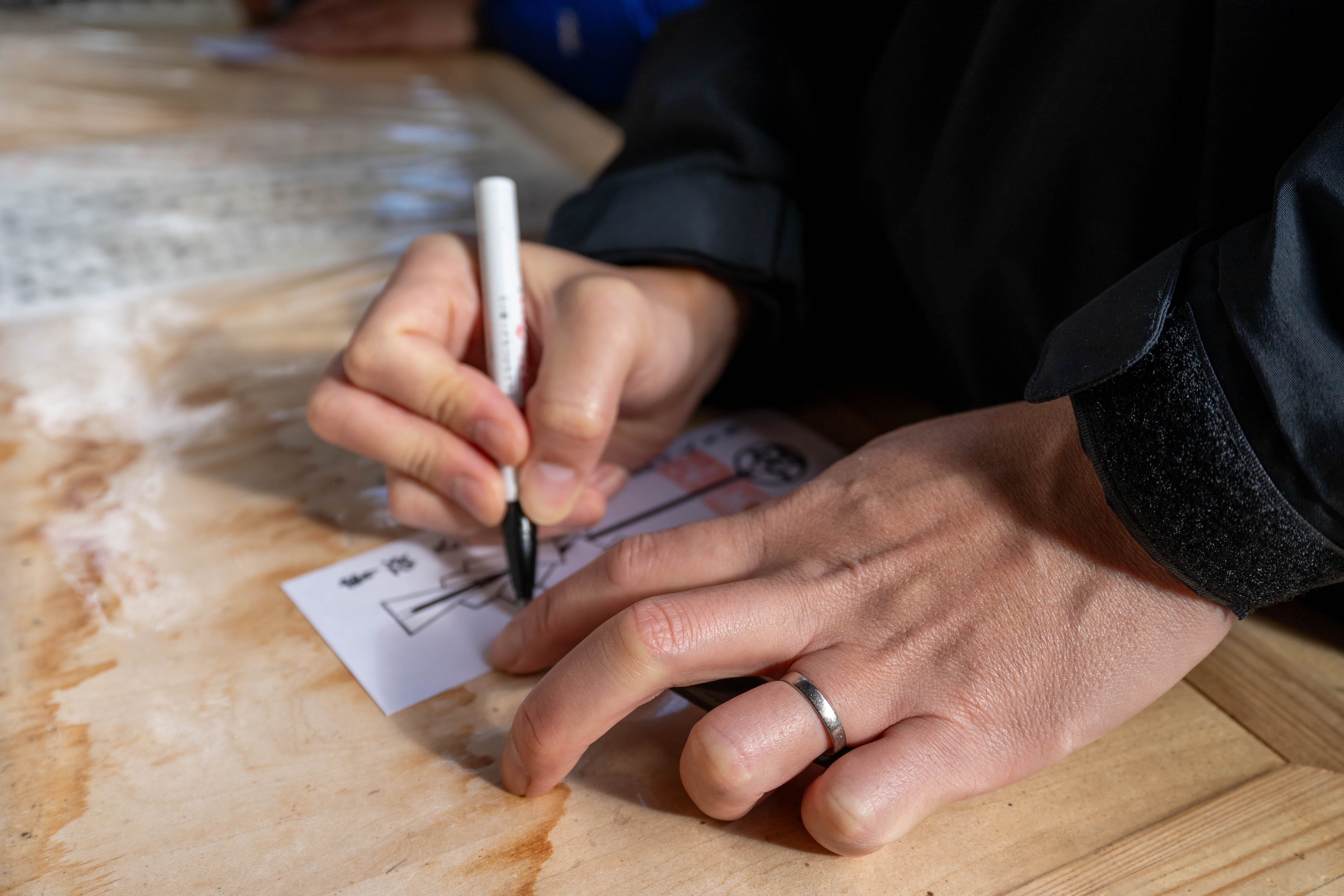
Step 2: Write the 形代 (Katashiro)
Receive a white paper amulet called 形代 (Katashiro), and write the ties you want to cut on it. “Visualize” the fog in your heart by putting it into words.
Step 3: The Outward Journey (Front to Back)
Holding the Katashiro, crawl through the hole from the front to the back. This action of crawling through the narrow hole signifies “Severing” the bad ties within you.
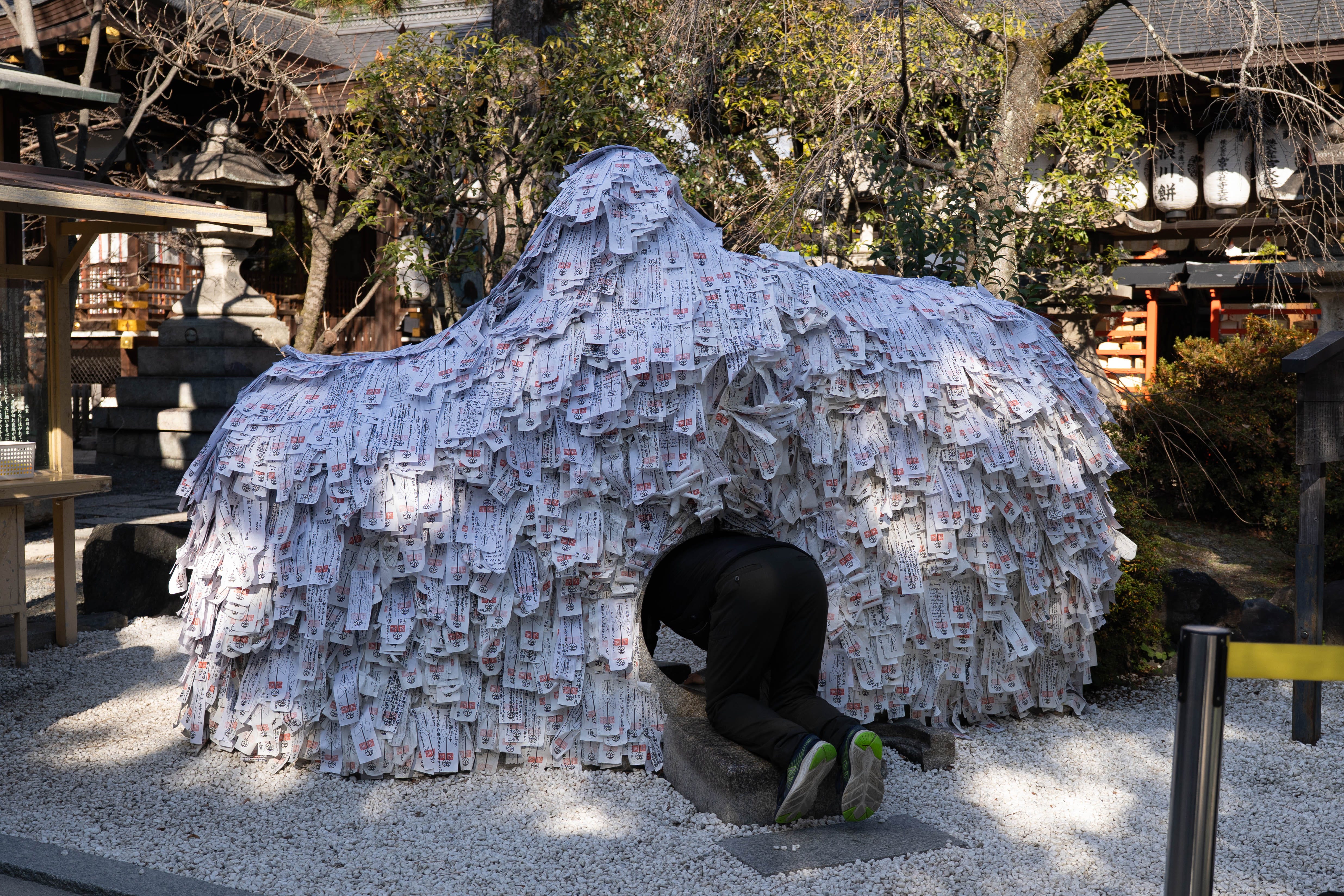
Step 4: The Return Journey (Back to Front)
Crawl through the hole again from the back to the front. This is the action of “Binding” good ties. You return to the front world while taking in new ties into the “Space” in your heart where you left the bad things behind.
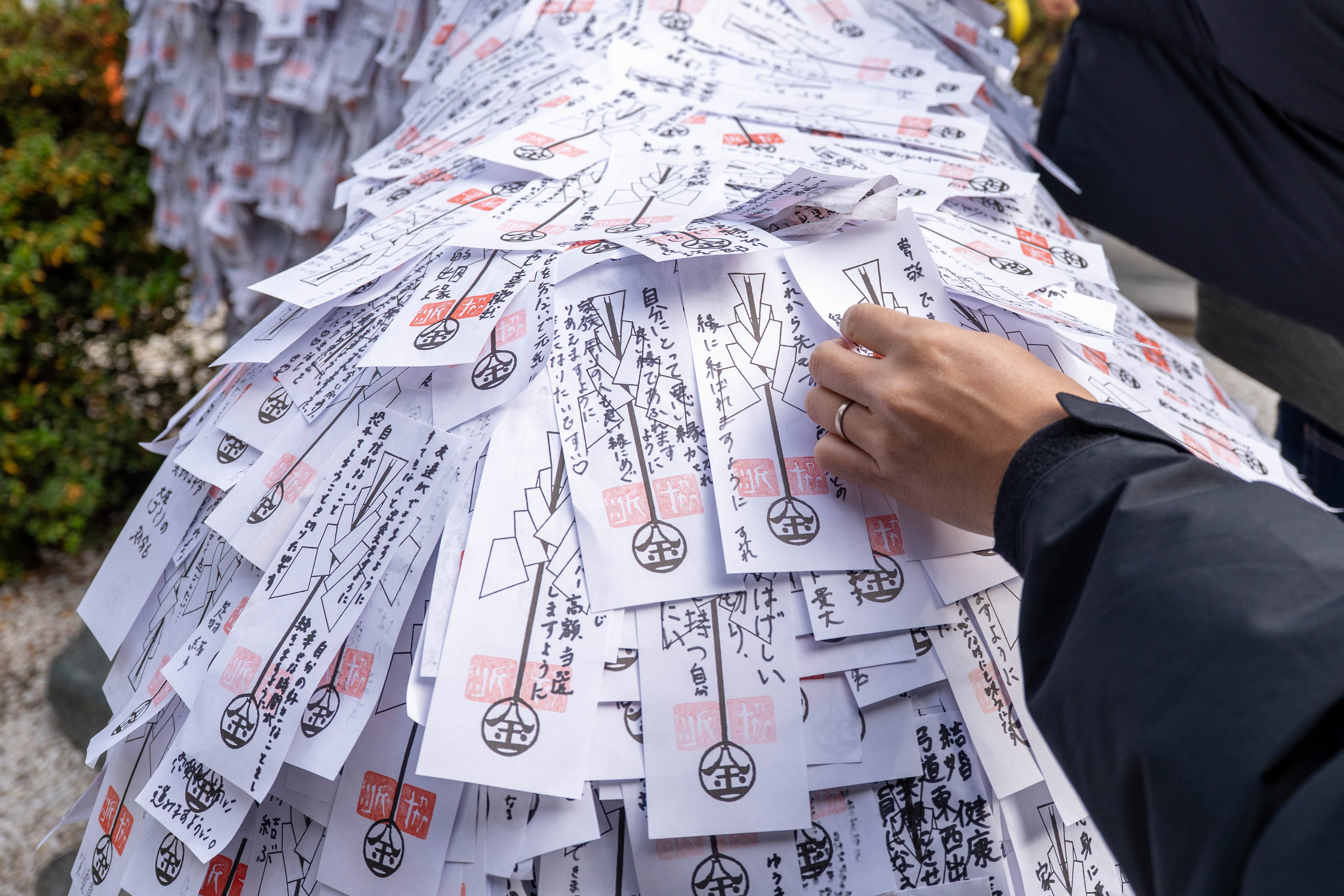
Step 5: Pasting
Finally, paste the Katashiro onto the stone with glue to complete the ritual. The appearance of that megalith is an accumulation of countless people’s “wishes for rebirth.”
To conclude the ritual, I recommend trying the 縁みくじ (En-mikuji). You shake a container and tell the number to the 巫女 (Miko). Uniquely, this fortune tells you your 悪縁度 (Akuen-do) - Degree of Bad Ties. Knowing how much you are currently trapped by "entanglements" might be the final hint you need to view your situation objectively.


People who visit here are not just those with serious troubles. Couples, married partners, or business people chasing dreams—their backgrounds vary. Their true purpose is to remove the factors (Obstacles) hindering the flow of their lives and to tie the truly important ties—partners or dreams—more strongly.
Actually, I was one of them. I didn’t have “someone” I specifically wanted to cut ties with, nor did I have serious relationship troubles. But I also wrote a wish on a Katashiro.
I had just quit my job to become a writer full-time and started this challenge on the Substack platform. I had already met people through wonderful ties, but to be honest, I had no confidence at all in this new challenge. “Can I really continue writing articles that subscribers will enjoy?” Such anxiety was constantly accumulating like sediment in the depths of my heart.
So, I prayed. To cut ties with the “lack of confidence” and “anxiety” that stop my feet, and to be able to tie wonderful ties with more readers I will meet from now on. And above all, that I myself can enjoy this adventure called SJJ from the bottom of my heart and continue it for a long time.
This shrine is believed to have power. Standing there, I found myself thinking not about whether my wish would be granted, but... ...No, to be precise, it is a little different. I feel this way now. Instead of just waiting for my wish to be granted, I have obtained “a strong self that can make my wish come true with my own hands.”
Why can I be so sure? Because I know the “reality” of the countless other people who visited here. If you open the Google Maps review section of this shrine, you will find surprisingly raw “realities” of people written there. People writing that they felt relieved that ties were cut, and voices describing their gratitude for being blessed with good ties. It might feel a little strange, like secretly peeking into someone else’s diary. But there, the desperate dramas held by us living in the modern age certainly exist. If you are interested, please take a peek. True stories not listed in guidebooks are spreading there.
If you feel your life is clogged by something. Or if you are tired of being too kind and unable to say “No.” Please remember this quiet stone in the back alleys of Kyoto. It is not a scary place. It is the starting line to leave all the “entanglements” you carry inside that hole and be reborn as a new you.
—Written by Sumire
This is fascinating, thank you for sharing. I visited this shrine when I was last in Kyoto but didn't know anything about it. I have since learned a bit and your article has given me even more knowledge. I will definitely return next time and participate in the ritual. Thank you.