


Tracing the roots of November 23 through a ritual at the Imperial Palace, ancient records, and the postwar holiday law.
Tomorrow, November 23, is a national holiday, printed in red on Japanese calendars. This year it falls on a Monday, the last day of a long weekend that begins on Saturday. Schools and many workplaces are closed, and plenty of people already have plans.
The holiday is called 勤労感謝の日 (Kinro Kansha no Hi), or Labor Thanksgiving Day. Taken literally, it is a day to give thanks for work.
But the day has another side.
Tomorrow night, in a building called 神嘉殿 (Shinkaden) inside the Imperial Palace, the Emperor will give thanks to the gods for the year’s harvest in a ritual called 新嘗祭 (Niinamesai).
I myself knew the name Niinamesai only because I had come across it in the news. The name of the holiday does little to bring a harvest festival to mind.
In my article of October 7 on 神嘗祭 (Kannamesai), I wrote about how the year’s new rice is offered to 天照大御神 (Amaterasu Omikami) at 伊勢神宮 (Ise Jingu). At the end, I noted that Japan’s autumn prayers continue from October into November. Niinamesai is what comes next.
How did a festival of thanks for the harvest become a holiday called Labor Thanksgiving Day? And what has become of the festival that disappeared from the holiday’s name?
Offering to the Gods, Then Eating It Oneself
The 宮内庁 (Imperial Household Agency) describes Niinamesai as a ritual in which the Emperor offers newly harvested grain in the Shinkaden to the imperial ancestor and the gods, gives thanks for their blessings, and then eats the grain himself. It is regarded as the most important of the court’s regular annual rituals.
Newly harvested grain simply means grain harvested that year. The “imperial ancestor” (皇祖, kouso) refers to Amaterasu Omikami, the deity regarded as the ancestor of the Imperial Family.
What stands out is the phrase “eats the grain himself.”
Offering food to the gods is nothing unusual at Shinto shrines in Japan. Here, though, the person conducting the ritual also eats the grain that was offered. This is described as the distinguishing feature of Niinamesai.
The ritual runs from night into the following morning, in two parts: the evening rite (夕の儀, Yu no Gi) and the dawn rite (暁の儀, Akatsuki no Gi). Scholarly accounts record that rice, rice porridge, and sake made from the new grain are laid out on oak leaves before the gods. However, the details of the ceremony are not open to the public.
So where does the grain offered at the ritual come from?
According to the Imperial Household Agency, His Majesty the Emperor grows rice every year in a paddy inside the Imperial Palace grounds. In April he sows seeds in a seedbed (苗代, nawashiro), in May he plants the seedlings, and in September he harvests the rice. An agency article from 2023 (Reiwa 5) records that he cut twenty plants by hand, one at a time, from two varieties: ニホンマサリ (Nihonmasari), an ordinary non-glutinous rice (粳米, uruchimai), and マンゲツモチ (Mangetsumochi), a glutinous rice (糯米, mochigome). This rice-growing was begun by 昭和天皇 (Emperor Showa), passed on through the Emperor Emeritus, the previous emperor, and has now been taken up by the present Emperor.
The rice harvested in this way, whether as unhusked rice or as polished rice, is offered at Kannamesai and Niinamesai.
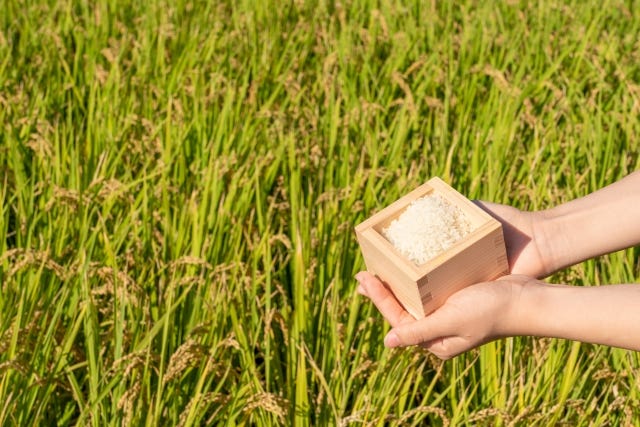
Planting the seedlings himself in spring, cutting the rice himself in autumn, offering it to the gods, and then eating it. Behind Niinamesai lies a full year of rice farming.
In my previous article, I introduced Kannamesai as the ritual in which the year’s new grain is first offered to Amaterasu Omikami. According to Ise Jingu, Kannamesai offers thanks for the harvest to Amaterasu Omikami ahead of all other gods. The following month, the Emperor performs Niinamesai and gives thanks for the harvest to all the gods of heaven and earth (天神地祇, Tenjin Chigi).
Tenjin Chigi means the gods of heaven and the gods of earth. In other words, all the gods.
The first harvest goes first to Amaterasu Omikami. Then thanks go to all the gods. It helps to think of Kannamesai and Niinamesai as two stages of the same gratitude for the autumn harvest.
And when the offerings have been shared with the Emperor himself, the harvest year comes to an end.
But how long has this ritual been performed?
From the Age of Myth to the Present
The origin of Niinamesai cannot be stated with certainty.
The Encyclopedia of Shinto, published by Kokugakuin University (國學院大學), explains that its origins are thought to go back to the Yayoi period, when rice cultivation began. The word 新嘗 (niiname) means “a celebration of first tasting,” and the Edo-period scholar 本居宣長 (Motoori Norinaga) interpreted it as a festival in which newly harvested grain is offered to the gods as a fresh feast.
In writing, the 日本書紀 (Nihon Shoki, or Chronicles of Japan) contains a scene in its age-of-the-gods chapters in which Amaterasu Omikami performs niiname. The entry for the 40th year of 仁徳天皇 (Emperor Nintoku) also records a banquet held on a niiname day in November, at which sake was given to the court ladies.
Here, I am reminded of my earlier article on the deities of rice. In that article, I wrote that in the story of the descent of the heavenly grandson, Amaterasu Omikami is said to have given ears of rice to her grandson 邇邇芸命 (Ninigi no Mikoto), and that there is a belief in a spirit dwelling in rice, called 稲魂 (inadama).
Rice is given by the gods, and a spirit dwells in it. I think it was out of that way of thinking that a festival grew, in which newly harvested rice is first offered to the gods in thanks.
Ise Jingu’s official website also introduces this myth of the rice ears together with the autumn Niinamesai. If you would like to see the rituals in photographs, please visit the shrine’s official Instagram as well.
Still, what is written in myth and what can be confirmed as history need to be considered separately.
Niinamesai is thought to have been institutionalized as a rite of the emperor and the state in the late seventh century, during the reigns of 天武天皇 (Emperor Tenmu) and 持統天皇 (Empress Jito). According to 木村大樹 (Kimura Daiki) of Kokugakuin University, Niinamesai came last among the annual rites set out in the 神祇令 (Jingiryo), part of the 律令 (ritsuryo), the ancient legal codes that governed state rituals.
Its date was not fixed as it is today.
At that time it was held on the second 卯 (u) day of the eleventh month of the old calendar. A “u day” is a day marked by 卯, the fourth of the twelve zodiac signs, which are also used to count days. Because the twelve signs cycle every twelve days, a u day comes around once every twelve days. (The animal for 卯 is the Rabbit.)
That u day was the day of Niinamesai.
Kimura notes that the ritual was held at night, in two parts, an evening rite and a dawn rite, in the Shinkaden. It seems the form of Niinamesai today carries something of its ancient shape.
But the ritual once came to a halt.
A Festival That Stopped for More Than 220 Years
According to Kimura, Niinamesai was last held in 寛正4 (Kansho 4, 1463). After that, through the warring period that followed the 応仁の乱 (Onin War), it was not held for more than 220 years.
Rituals at the court cannot continue when the state grows weak. Even a long-standing festival can suddenly break off.
It was held again in the Edo period. It was revived in a simplified form in 元禄元年 (Genroku 1, 1688), and restored to its original form in 元文5 (Genbun 5, 1740).
Then, in 明治3 (Meiji 3, 1870), Kimura writes, the first Niinamesai was held in Tokyo.
In my previous article, I wrote about the people who support Kannamesai: the people who grow the rice, make the salt, and weave the garments, so that the ritual can be held again this year.
Learning the history of Niinamesai has led me to think about those words from a different angle. A ritual breaks off if no one tries to continue it. And even if it breaks off, it can return if someone tries to do it again. That it came back after a gap of 220 years stays with me as an event within a long history.
So when did the revived Niinamesai come to be held on November 23?
November 23 Was a “Rabbit Day”
The date was fixed in the Meiji era.
In 明治6 (Meiji 6, 1873), Japan switched from the old lunar calendar to the solar calendar. The question was where in the new calendar to place Niinamesai, which until then had been counted by the old one.
In that year, the second u day of November happened to fall on the 23rd. From then on, November 23 became the fixed date of Niinamesai, Kimura’s commentary explains.
In other words, the date November 23 carried no special meaning. The original rule was “the second u day of November,” and applying it to that year’s calendar happened to give the 23rd.
That Niinamesai is held every November 23 goes back to a coincidence in one year’s calendar, about 150 years ago.
The ritual that we remember by the date “November 23” was originally set by the zodiac days. Thinking of it that way, the situation today makes a little more sense: only the date remains on the calendar, while the reason behind it is hardly noticed.
From Meiji 6 on, the day was a national 祭日 (saijitsu), a day of state ritual. And after the war, the day changed greatly.
The Day It Became a Holiday
Niinamesai’s day was a national day of ritual because there was a law called the 皇室祭祀令 (Koshitsu Saishirei, or Imperial Household Ritual Ordinance).
The ordinance was enacted in 明治41 (Meiji 41, 1908) as a law governing the rituals performed at the court. Under it, Niinamesai was one of the important rites known as 大祭 (taisai, “major rites”), and it was also the basis for the national saijitsu.
But the ordinance was abolished in 昭和22 (Showa 22, 1947).
With the framework of saijitsu gone, Niinamesai on November 23 was no longer a national day of ritual.
The following year, in 昭和23 (Showa 23, 1948), the 国民の祝日に関する法律 (the Law on National Holidays, or 祝日法, Shukujitsu-ho) was enacted. Article 2 of the law designates November 23 as Kinro Kansha no Hi and describes it as a day to “respect labor, celebrate production, and give thanks to one another as citizens.” (The English rendering is my own.)
Several candidates seem to have been considered for the name. According to Kimura’s commentary, the proposals included 生産感謝の日 (Day of Thanks for Production), 新穀感謝の日 (Day of Thanks for the New Grain), 新穀祭 (New Grain Festival), and 感謝の日 (Day of Thanks).
Had it been the Day of Thanks for the New Grain, the link to Niinamesai would have stayed clear in the name. But the name finally chosen was Labor Thanksgiving Day. Kimura explains that, out of a belief that the foundation of postwar Japan’s rebuilding lay in the people’s labor and production, the day came to give thanks not only for the harvest but for all kinds of work.
From gratitude for the harvest to gratitude for work.
The name of the holiday widened what the Japanese people give thanks for. At the same time, the origin of the date did not remain in the name.
Let me add a note here for readers outside Japan.
Before the war, Niinamesai was a national day of ritual. Now that the ordinance has been abolished, Niinamesai is not a state event. The Constitution of Japan lists the 国事行為 (kokuji koi, acts in matters of state) that the Emperor performs, but the rituals of the court are not among them. The Imperial Household Agency describes the 掌典職 (Shotenshoku), the office in charge of the rituals, as “an organization of the 内廷 (Naitei) that is separate from the Imperial Household Agency, a national administrative organ.” (This is also my own rendering.) The Naitei is the inner sphere of the Imperial Family, where the Emperor and his family live.
In other words, Niinamesai today continues as a ritual carried out within the Imperial Family’s inner sphere.
Most people spend November 23, now a holiday, as “one day of a long weekend.” So did I, back when I did not know about Niinamesai.
Some readers in English-speaking countries may think of Thanksgiving as a holiday that gives thanks for the autumn harvest. The two share a gratitude for the harvest, but Niinamesai is a ritual in which the Emperor offers newly harvested grain to the gods, and it has been performed since ancient times. Here, I will follow the history on the Japanese side.
At Ise, and at Shrines Across Japan
Niinamesai is not only a ritual of the court.
As I wrote in my previous article, at Ise Jingu the new grain is offered to Amaterasu Omikami at Kannamesai. For that reason, Ise Jingu originally had no Niinamesai of its own. According to Ise Jingu, its Niinamesai began in 明治5 (Meiji 5, 1872), when the Emperor sent an 勅使 (chokushi, an imperial envoy) to present 幣帛 (heihaku, offerings to the gods). A chokushi is a person sent as the Emperor’s messenger. Heihaku are the goods presented to the gods.
Today, in step with the Niinamesai at the court, Ise Jingu holds a 大御饌 (Omike) rite, in which food is offered to the gods, on November 23, together with a 奉幣 (hohei) rite, in which the envoy presents the Emperor’s offerings. Niinamesai is then held at all of the shrines of Ise Jingu through the 29th.
The autumn prayers that began with Kannamesai are offered once more, in November’s Niinamesai, in many places including Ise Jingu.
Niinamesai is also held as a major festival at shrines across Japan. At around the same time as at the court, shrines in each region give thanks to the gods for the year’s harvest. How a given local shrine holds it, though, differs from shrine to shrine. I have not seen those ceremonies in detail myself.
Even so, I think the fact that thanks for the harvest are offered at the court, at Ise Jingu, and at shrines around the country at the same time shows how deeply rice farming and ritual are bound together in Japan.
A Harvest Year That Ends with Eating
So far, we have traced Niinamesai, which lies at the root of November 23.
Offering, and eating it oneself. A ritual of this form is said to reach back to the age of myth, stopped for more than 220 years, had its date fixed in the Meiji era, and, changing the name of its day after the war, continues even now.
Seedlings planted in spring in the paddy of the Imperial Palace are cut in autumn, offered to the gods, and eaten. At Ise, new rice is offered to the gods in October, and in November thanks are conveyed once more to all the gods.
Tomorrow night, somewhere within the holiday that the rest of us spend at leisure, the close of a year of rice farming will be carried out.
In my previous article, I wrote that I was raised from childhood to hear, “There are gods in the rice, so you must not leave even a single grain.” Now that I know how Niinamesai came to be, I feel that teaching and a ritual in which offered rice is eaten by the person offering it are connected somehow. Of course, this is only my own guess. But treating something so precious that it is offered to the gods with gratitude, and eating it without leaving any behind—I think that feeling reaches across the ages.
Tomorrow morning, when you take a bite of freshly cooked rice, take a moment to remember the long history of ritual that lies beyond that single grain.
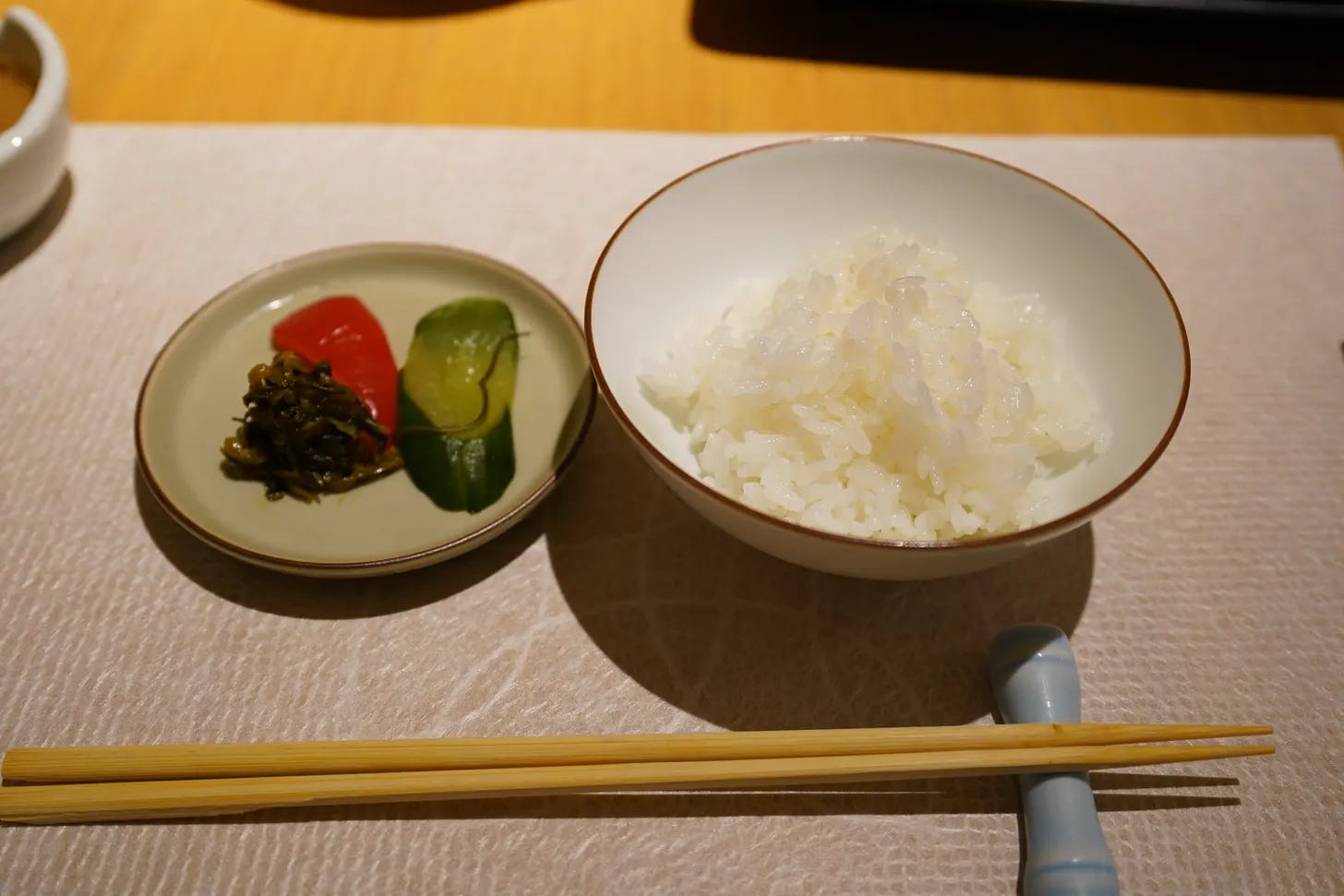
Is there a festival of thanks for the harvest in your country or region, or a custom of sharing the first of the harvest? I would love to hear about it.
You can also support my work by buying me a coffee through buy me a coffee.
—Written by Sumire
Sources
All web pages were accessed on November 14, 2026.
Imperial Household Agency (宮内庁)
Major court rituals (主要祭儀一覧): https://www.kunaicho.go.jp/learn/gokomu-kyuchu/saishi/saishi01.html
Court rituals (宮中祭祀): https://www.kunaicho.go.jp/learn/gokomu-kyuchu/saishi/
Ise Jingu (伊勢神宮)
Annual rites (年間行事): https://www.isejingu.or.jp/ritual/annual/
Kannamesai (神嘗祭): https://www.isejingu.or.jp/ritual/annual/kanname.html
Kinensai and Niinamesai (祈年祭・新嘗祭): https://www.isejingu.or.jp/ritual/annual/kinen.html
Kokugakuin University (國學院大學)
Encyclopedia of Shinto, “Niiname sai” (by Nakanishi Masayuki): https://d-museum.kokugakuin.ac.jp/eos/detail/?id=9288
You may also enjoy these stories

Why Japan Offers the First Rice of the Harvest to the Gods

Japan has many rituals and customs that have been passed down with the changing seasons. In spring, people pray for a good harvest. In summer, they pray for protection from misfortune. In autumn, they give thanks for what the land has produced. Shinto beliefs and Japanese mythology are woven into these traditions, along with a long-standing practice of …