


Last week, I wrote about the wheat fields and rice paddies that can be seen in Japan at this time of year.
The wheat has turned golden, and beside it, young rice seedlings have been planted in water-filled paddies. In early summer in Japan, fields ready for harvest and paddies just beginning to grow can sometimes appear within the same landscape.
A full week has already passed since I shared that article. When I write while following the seasons, I feel the speed of time more clearly than usual.
From tomorrow, Japan’s 72 micro-seasons will enter Mugi no toki itaru(麦秋至). This is a phrase in the Japanese calendar that describes the time when wheat ripens and reaches the harvest season.
The character for “autumn” appears in the phrase, but the season is early summer. The fully ripened wheat will soon be harvested and transformed into familiar foods such as bread, noodles, sweets, and barley tea.
The Japanese calendar contains many small seasonal words like this, and they are very interesting.
May is almost over. June is approaching.
In your country, what comes to mind when you hear the word June? In Japan, I think many people would answer, “the rainy season.”
Tsuyu(梅雨), the rainy season, is a seasonal phenomenon that comes as spring shifts into summer, bringing many rainy and cloudy days. Every year in Japan, the Japan Meteorological Agency announces the beginning of the rainy season by region. The season begins in the southern regions first, then gradually moves northward through the Japanese archipelago.
This year, Okinawa and Amami already entered the rainy season in early May. Meanwhile, from Kyushu to Tohoku, the rainy season is expected to begin later than usual. Southern Kyushu is expected to enter the rainy season in early June; Shikoku, the Chugoku region, Kinki, Tokai, and other areas in mid-June; and Tohoku in late June.
The rainy season is essential when talking about Japan’s seasons. But it is not simply a time to enjoy the rain. It is also a season when people need to be careful about heavy rain, rising rivers, and landslides.
If you are planning to visit Japan in June, it is important to prepare not only for rain, but also for heat and humidity. A folding umbrella, water-resistant shoes, quick-drying clothes, and a way to stay hydrated can make your trip much easier. On days of heavy rain, it is better not to pack your schedule too tightly. Checking transportation updates and weather information will help you move around safely.
Many visitors to Japan are surprised not only by the summer temperature, but also by the humidity. For many people, the humidity is what they feel most strongly.
If you look only at the temperature, you may think it is not so different from summer in your own country. But from the rainy season into summer, the air in Japan holds a great deal of moisture. Depending on the day, even indoor humidity can rise above 70 percent. The air can feel heavy, almost like a bathroom after a hot bath, clinging to the skin.
This humidity affects both the body and the home.
Laundry becomes difficult to dry. Moisture gathers in shoes, bags, closets, and bathrooms. If people are careless, mold can appear on clothing, leather goods, furniture, and even around walls. In Japanese homes at this time of year, moisture absorbers, dehumidifiers, air conditioners set to dry mode, ventilation, and laundry detergents for indoor drying all become useful.
Drugstores and supermarkets also begin to show signs of rainy-season preparation. Moisture absorbers, mold-prevention products, raincoats, folding umbrellas, cooling goods, sweat wipes, and many other items appear on the shelves.
In an earlier article, I introduced some of the heat-protection goods used in Japan. If you are planning to visit Japan from June onward, that article may help you prepare.

There is one region in Japan where the beginning of the rainy season is not announced.
That is Hokkaido, where I was born and raised.
Hokkaido does not have the rainy season in the same way that Honshu and Kyushu do. Even in June, it is relatively comfortable, and the heaviness of the air feels very different. Of course, in recent years, Hokkaido has also had more hot days because of climate change. Even so, compared with regions that have a rainy season, the feeling of June is very different.
I grew up without experiencing the rainy season. Later, I moved to Kyushu. Last year, when I spent the rainy season in Kyushu for the first time, I was truly surprised by the humidity and the amount of rain.
I realized how different the same country can feel.
Japan is sometimes imagined as a small island nation. But between northern Hokkaido and southern Kyushu, the experience of the seasons is completely different. The cold of winter, the humidity of summer, and the way rain falls cannot be fully explained with a single description.
If you are traveling in Japan in June, Hokkaido can be one good option. For people who are not comfortable with rainy-season humidity, it is a relatively easy region to visit.
But June in Japan is not only a season of high humidity and rain.
There is a flower that blooms beautifully across Japan at this time of year: Ajisai(紫陽花), hydrangea.


Gaku-ajisai(ガクアジサイ), one of the original forms of hydrangea, is considered native to Japan. After the Edo period, it was taken to Europe, where it was selectively bred and spread as Western hydrangea. Today, the hydrangeas seen in Japan include older Japanese varieties, varieties that were developed overseas and returned to Japan, and many other cultivated forms.
Hydrangeas are plants that love moisture. A hydrangea in the rain shows a different expression from one seen on a sunny day. Water droplets gather on the parts that look like petals, and the blue, purple, white, and pink colors can appear deeper.
The rain of the rainy season can sometimes make daily life feel heavy. But the fact that there is a flower that becomes beautiful in that rain is also part of June in Japan.
There are many well-known hydrangea spots across Japan.
Meigetsu-in(明月院) in Kamakura, Kanagawa Prefecture, is widely known as an “ajisai temple.” The blue hydrangeas that fill the temple grounds are often called “Meigetsu-in Blue,” and many people visit during the season.
Yata-dera(矢田寺) in Yamatokoriyama, Nara Prefecture, is another place known as an “ajisai temple.” Many varieties of hydrangeas are planted throughout the temple grounds, and visitors can enjoy the flowers from mid-May into summer as different kinds bloom in succession.
Kibitsu Jinja(吉備津神社) in Okayama City, Okayama Prefecture, is also a place where hydrangeas can be seen. When I previously visited Kibitsu Jinja for reporting, I photographed hydrangeas blooming within the shrine grounds.
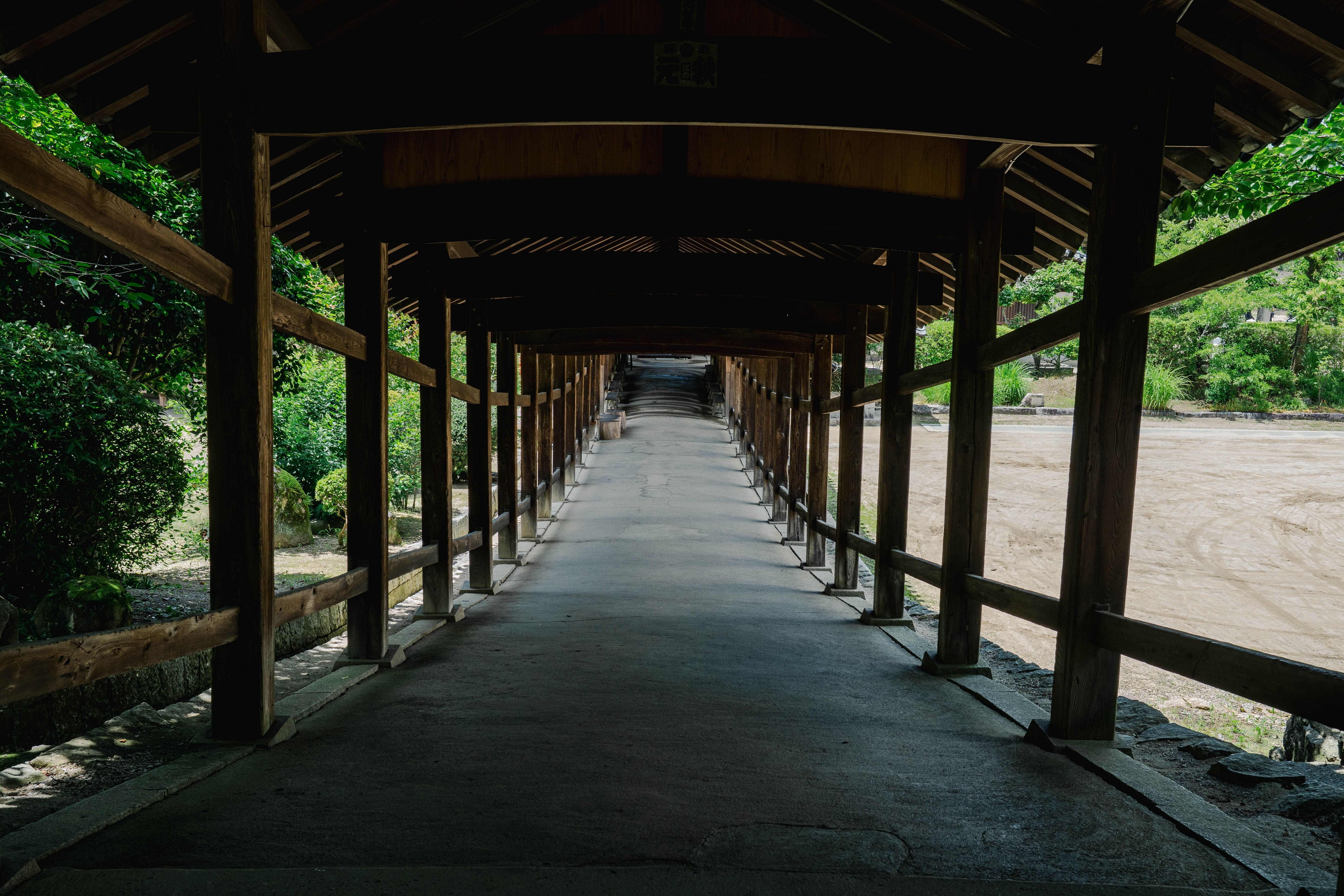
Kibitsu Jinja is also known for its long corridor and its connection to the legend of Momotaro. If you are interested not only in the hydrangeas, but also in the shrine’s history, architecture, and the stories that remain in the land, you can also read the article.

Hydrangeas are often seen in the grounds of temples and shrines.
One reason is the environment. Temples and shrines are often built on mountain slopes, in green places, or on land that holds moisture, and these conditions can overlap with places where hydrangeas grow well. Hydrangeas are also relatively hardy plants, so they are thought to have been easy to use as plantings in temple and shrine grounds or on slopes.
Hydrangeas are also sometimes connected with the Buddhist idea of shogyō mujō(諸行無常), the teaching that all things continue to change. Because hydrangea colors change, it is easy to place the flower beside that way of thinking.
Hydrangeas have also been spoken of in connection with memories of illness and prayers for the dead, partly because they bloom during the rainy season. They are beautiful flowers, but they have also stood near human prayer and sorrow.
Hydrangeas seen at temples and shrines look a little different from hydrangeas seen on ordinary streets. Stone steps, old trees, wet ground, and the greenery along an approach all change the way the flowers appear. In such places, hydrangeas show the rainy season in Japan very clearly.
As beautiful as hydrangeas are, their flower meanings include some surprising words.
The general flower meanings of hydrangea include “changeable heart” and “infidelity.” These meanings are said to come from the way the flower’s color changes.
On the other hand, meanings by color can be more positive. For example, blue and purple hydrangeas are sometimes associated with “patient love,” white hydrangeas with “tolerance,” and pink hydrangeas with “energetic woman.”
Change, instability, beauty, and patience all exist within the same flower. In that sense, hydrangeas may be a fitting flower for the rainy season in Japan.
At the end of May, wheat ripens in Japan, water enters the rice paddies, and preparations for the rainy season gradually begin. Inside the home, people deal with humidity. Outside, hydrangeas bloom in the rain.
There are still many June topics and landscapes in Japan that I would like to share with you: the rain of the rainy season, early summer flowers, seasonal foods, and the changes in daily life that appear only at this time of year. I will continue introducing them little by little in upcoming articles.
What kinds of events or seasonal topics do you have in June in your country? There may be landscapes completely different from Japan, or customs that feel unexpectedly similar. Please tell me in the comments.
Whether you are in a hot region or a cold one, please eat well and take good care of yourself.
—Written by Sumire
You may also enjoy these stories
This Is What Japan Looks Like in Late May

This Saturday article is part of the “Life in Japan” series.
Why Carp Are Swimming Across Japan’s Sky

This Saturday article is part of the “Life in Japan” series.
There are many similarities to Houston in your description of June: rain, humidity, flowers and growth. June 1st is the start of hurricane season, so it is also a month to prepare.
June as a month has always been associated with weddings in North America. A famous Joni Mitchell song “Both Sides Now“ has a line, “moons and Junes and feeling proud to say I love you right out loud…“ June has always been a time for love and marriage in North America.