
Walking through Tsuetate Onsen, a Hidden Village in Kyushu
A hot spring town where carp streamers and traditional steam culture still thrive
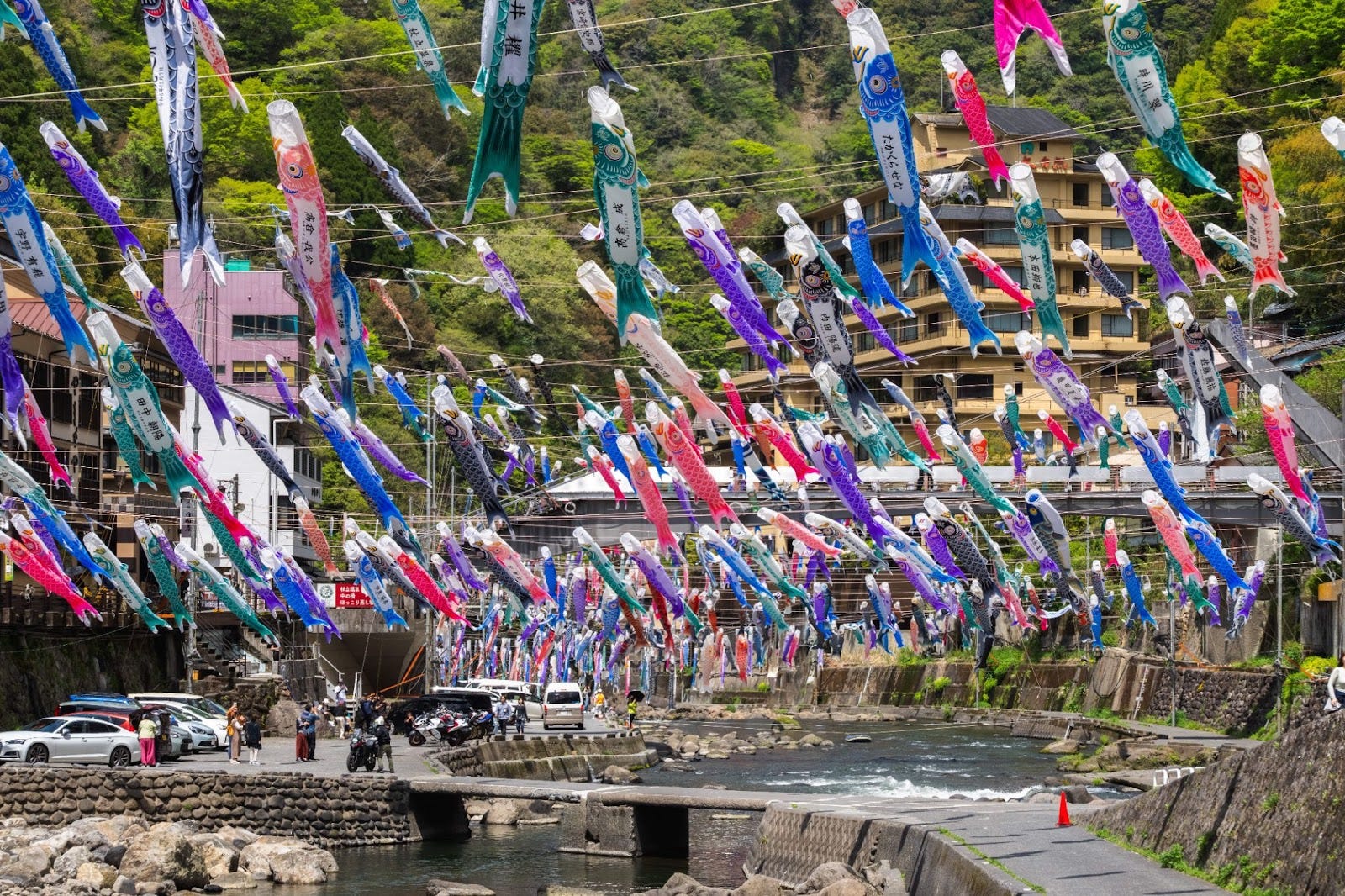
When spring arrives, the hot spring town of Tsuetate in Oguni, Aso District, Kumamoto Prefecture, becomes famous for an unforgettable scene: countless carp streamers rising to fill the sky above the river.
From April through May each year, roughly 3,500 colorful koinobori hang across ropes spanning the Tsuetate River, transforming the mountain-bound hot spring town into a vibrant display. This “Carp Streamer Festival” ranks among the largest in Japan, welcoming visitors with a sense of spring’s arrival and the warmth of local culture.
Yet the charm of Tsuetate Onsen extends beyond that spectacle. With a venerable history of about 1,800 years, this onsen town offers a slow, soothing rhythm to both body and soul—particularly through its unique communal “steaming areas” that harness the hot spring steam.
A spa town shaped by history and faith
The origins of Tsuetate Onsen trace back to the early Heian period. According to tradition, the Buddhist monk Kūkai (Kōbō Daishi) visited this place during his travels and was so moved by the healing power of its springs that he composed a poem.
“Entering the bath, illness healed, leaving behind the cane once relied upon, travelers return.”
This poem refers to people immersing themselves in the waters until they no longer needed the cane they had leaned on. From this tale comes the name “Tsuetate,” which is said to mean “place where one can set aside their cane and return in good health.”
In the early Edo period, a Yakushi-dō temple dedicated to the Medicine Buddha was built. Its presence fused healing springs and religious faith into a long‑standing cultural tradition.
Although the town flourished as an entertainment district in the early Showa era—earning the nickname “Kyushu’s inner parlor”—today it is cherished as a tranquil, refined onsen retreat.
Sources that bubble up at 98°C and a skyline of steam
The waters of Tsuetate Onsen are classified as a simple chloride spring, with source temperatures reaching approximately 98 °C. That makes it one of Japan’s most powerful natural springs. Over twenty-six separate sources lie scattered across the town, and the steam rising from them creates a scene as though time itself were moving slowly.
There are about eighteen lodging establishments, ranging from classic traditional ryokan to more modern hotels. Many are lined along the Tsuetate River, offering guests serene views of the valley and curling steam as they relax in style.
The water feels soft on the skin—clear, gentle, and nearly alkaline as a weak saline chloride spring. With high levels of metasilicic acid (about 138 mg/L), the springs are known for beautifying the skin, earning the name “beauty waters.” The minerals help cleanse oils and impurities from the skin, and the baths are believed to help with neuralgia, joint pain, rheumatism, skin conditions, sensitivity to cold, and fatigue recovery.
Most accommodations provide direct flow from the natural springs without dilution or reheating, quietly nurturing the well‑being of every visitor.
Our stay at Jun‑Wafu Ryokan Izumiya
We stayed at “Jun‑Wafu Ryokan Izumiya,” a historic, purely Japanese inn. Spread our bedding on tatami mats, gazed out the window at carp streamers, and enjoyed meals in unhurried comfort. We let go of everyday concerns and reflected on the history and the people who preserved it. That priceless time felt deeply restorative.
The tradition of steaming areas and “mushi-yu”
Tsuetate Onsen is uniquely known for its “steaming areas” and “mushi-yu.” The “steaming areas” are communal spaces using high‑temperature steam from the springs to cook food. Visitors may bring eggs, vegetables, or sweet potatoes to steam themselves. Some lodgings even offer guided experiences. These areas are managed jointly by locals and inns, with attention to hygiene and safety—embodying both the wisdom of integrating natural hot spring energy into daily life and the region’s welcoming spirit.
Meanwhile, “mushi-yu” is a traditional bathing practice in which the body is steamed using spring vapor. Even though the source water is extremely hot (around 98 °C), the steam chambers maintain lower temperatures with high humidity. The method gently encourages perspiration without stressing the body. As a therapeutic practice, it is deeply rooted in local health traditions, with many saying, “When you get a cold, first try the mushi-buro.”
Forms of mushi-yu vary: individual wooden boxes where only the head remains outside, or communal sauna‑style rooms. Temperatures and humidity differ by facility, so experiencing several can reveal subtle differences in comfort.
There are over twenty mushi-yu facilities scattered throughout the town, including public baths and inns, making it easy for travelers to try. A local legend even ties back to Kōbō Daishi praising the practice’s benefits, reinforcing its centuries‑long link with health‑seeking culture. In addition, June 4 has been designated “Tsuetate Onsen Mushi‑yu Day” by the Kumamoto Prefectural Tourism Division and is registered with the Japan Anniversary Association as a dedicated day to honor and preserve the steaming‑bath tradition.
The spring‑heralding Carp Streamer Festival
In Japan, carp streamers are traditionally displayed around May 5 (Children’s Day), wishing for children’s healthy growth and happiness. The spirited carp symbolize strength and vitality. They are commonly displayed in homes, riversides, and public spaces as a delightful seasonal sight.
At Tsuetate Onsen, ropes stretch across the Tsuetate River hosting around 3,500 carp streamers. Their vibrant dance in the breeze is truly breathtaking. The festival typically ends before May 5 in consideration of safety and crowd control during the Golden Week holidays. Because the exact schedule can vary from year to year, please check the latest details before visiting.
Access and what to do
Tsuetate Onsen is accessible by car in about 90 minutes from Kumamoto IC or Hita IC on the Kyushu Expressway. By public transit, take a bus bound for Oguni Town from JR Hita Station or Kumamoto City and get off at “Tsuetate Onsen.”
Alongside lodging options, the town features foot baths and communal hot springs. Many inns and hotels welcome day visitors, making it easy to enjoy the baths even without overnight stays.
Editor’s diary
The first time I visited Tsuetate, what struck me most was the sweeping sight of carp streamers filling the river. Their bright colors swaying in the breeze felt far more vivid and awe‑inspiring in person than any photo could capture. Walking through the narrow alleys where steam rose gently, the town evoked a nostalgic atmosphere—as if time itself had slipped backward. At one of the steaming areas, a local grandmother was quietly steaming vegetables. This fusion of daily life and hot spring culture felt beautiful in a way that transcended tourism and expressed the community’s daily rhythm.
Tsuetate’s peace and warmth left a lasting impression, and at SJJ we intend to continue honoring it with thoughtful coverage of this place.


What a beautiful destination. I will be on Kyushu next spring and plan to go to Tsuetate.