
Tsukimi in Japan
Admiring the Autumn Moon
Many of you may be familiar with hanami, the custom of viewing cherry blossoms in spring.
But did you know that in autumn, there is also a tradition called tsukimi—moon viewing?
On quiet nights, people gaze at the moon and give thanks for the harvest. This practice has been cherished in Japan since ancient times.
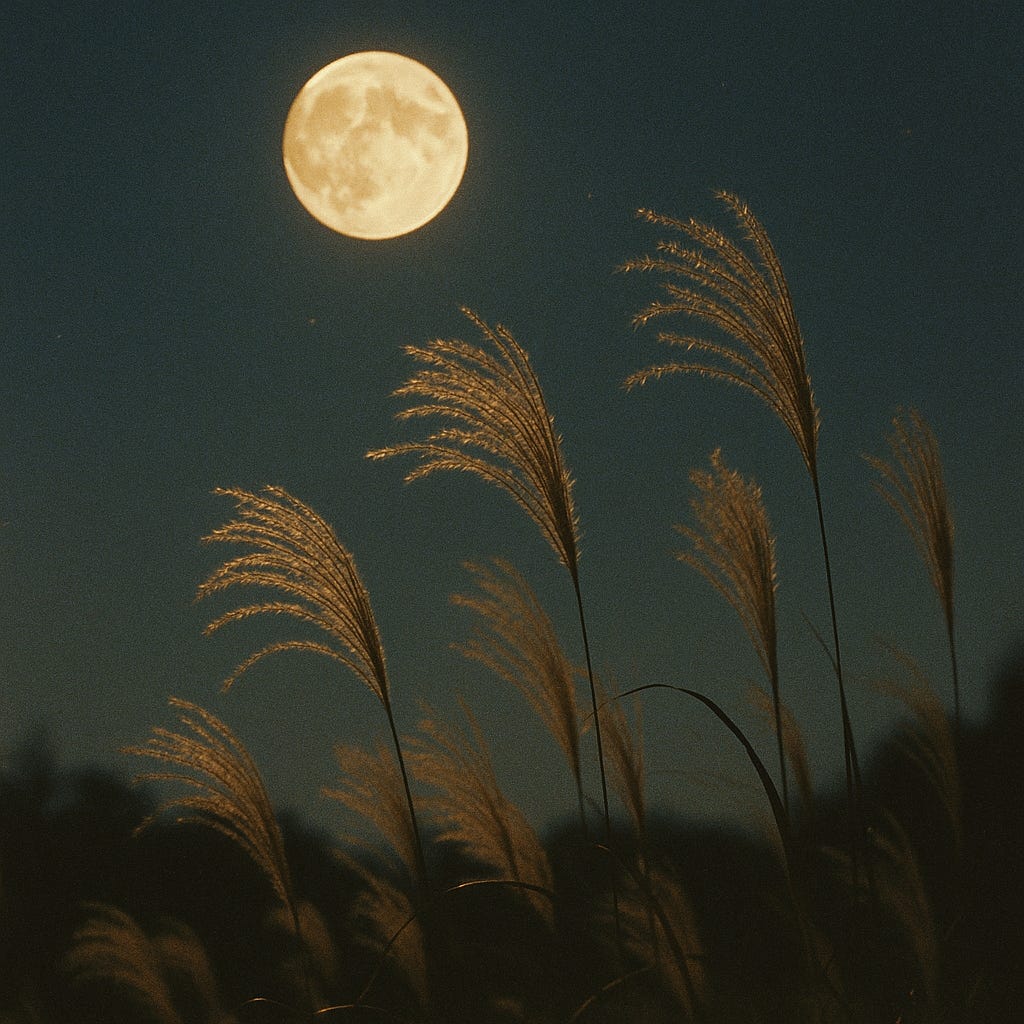
In Japan, autumn is marked by a custom of gazing at the moon and giving thanks for the harvest. This is called Tsukimi (moon viewing).
In 2025, the Jūgoya (Fifteenth Night / Chūshū no Meigetsu, Mid-Autumn Moon) falls on October 6. This corresponds to the 15th day of the 8th month in the old lunar calendar (kyūreki), which is why it is called the “Fifteenth Night.” The lunar calendar, used in Japan before the Meiji era, was based on the phases of the moon. A year had about 354 days, shorter than the current solar calendar (365 days), and the discrepancy with the seasons was adjusted by adding an intercalary month (uruzuki). As a result, some years had 13 months. Because of this, the date of Jūgoya changes each year and does not always coincide with the full moon. In 2025, the full moon falls on the following day, October 7.
The custom of Tsukimi began in the Heian period. Influenced by moon-viewing practices, the nobility held banquets under the moonlight. Later, as the custom spread to commoners, it became closely tied to rice cultivation, transforming into a tradition of offering harvest foods. This prayer for a bountiful harvest shows how deeply important rice cultivation was to the Japanese people. This point is also explored in the article The Deity Dwelling in Rice Grains.
Even today, many households and communities offer white dumplings (tsukimi dango), along with seasonal foods such as taro, chestnuts, and beans, as well as pampas grass (susuki) arranged toward the moon. The style of offering and the form of the dumplings vary by region, with local traditions serving as the guide.
About one month after Jūgoya comes another moon-viewing night, Jūsanya (Thirteenth Night), which falls on the 13th day of the 9th lunar month. In 2025, this will be on November 2. Known also as “Chestnut Moon” or “Bean Moon,” Jūsanya reflects the Japanese sensibility of finding beauty in the slightly waning moon. By celebrating both Jūgoya and Jūsanya, one can more deeply appreciate the flow of time and the changing season of autumn.
The Rabbit on the Moon — Why a Rabbit?
In Japan, the patterns on the full moon are imagined as the figure of a rabbit pounding rice cakes with a mortar and pestle. The practice of interpreting lunar shadows as animals or stories has long existed, not merely observing the moon but projecting narratives onto it.
There are several backgrounds to this “moon rabbit.” One is its link to autumn life: the harvest of rice and the making of rice cakes with mortar and pestle. The fullness of the moon and the labor of preparing rice naturally overlapped, and the image of the rabbit making rice cakes became familiar.
Another background lies in Buddhist stories. In the Jātaka tales, a rabbit sacrifices its own body to a wandering ascetic, and in recognition of this virtue, its figure was said to be imprinted on the moon. In Japan, this tale was also embraced, and the moon rabbit came to symbolize “good deeds” and “the blessing of life.”
By the Edo period, with the spread of books and illustrations, the image of the rabbit with mortar and pestle became widely popular. It naturally paired with the dumplings offered at Jūgoya and took root in daily life.
The moon’s pattern appears differently depending on location and time of night, its tilt and impression changing. In Japan, the rabbit with mortar and pestle is most common. But how does the moon appear from where you are? Around the world, people have seen different figures, such as a human profile, and the variety of stories projected onto the same moon is itself part of the charm of moon viewing.
Offerings and Their Meanings
The traditional arrangement for Tsukimi includes moon-viewing dumplings, autumn crops, and seasonal grasses or flowers. The flow is always the same: offer seasonal things to the moon, then share them together afterward, giving form to gratitude for the harvest. There are regional variations in practice, and there is no single nationwide rule for numbers or arrangements.
Moon-Viewing Dumplings
White dumplings reflect the shape of the waxing moon and symbolize the sharing of the harvest. Plain white or simple vessels suit them best, and shaping them uniformly makes them visually pleasing. A slight sheen on the surface helps them catch the moonlight. The number and arrangement vary by region, and there is no single “correct” way. In modern life, supermarkets and confectionery shops line their shelves with moon-viewing dumplings at this time of year, making the tradition familiar and accessible today.
Autumn Crops
At Jūgoya (Fifteenth Night), it is customary to offer taro, chestnuts, and beans before the moon. The night is also known as Imo-Meigetsu (“Potato Moon”), because taro, representing the category of potatoes, has traditionally been central to the offering. At Jūsanya (Thirteenth Night), offerings of chestnuts and beans are common, which gave rise to the names “Chestnut Moon” and “Bean Moon.” These offerings are not mere decorations; they embody gratitude for the harvest of autumn. In essence, they represent returning the blessings received from nature during the year back to the moon, together with a heart of thankfulness.
Autumn Grasses (Such as Pampas Grass)
Pampas grass (susuki) has traditionally been displayed as a symbolic substitute for rice ears in Tsukimi offerings.. In some regions, it is also spoken of as a sacred vessel (yorishiro) or as having protective powers. During Tsukimi, it is arranged together with dumplings as part of the offering.
Modern Ways to Enjoy
Tsukimi was originally a quiet event: gazing at the moon and giving thanks for nature’s bounty. The practice of offering dumplings and crops and sharing them with family is still preserved in many places, but in modern times new ways of enjoying Tsukimi have appeared.
For example, throughout autumn, seasonal food and drinks inspired by “Tsukimi” appear everywhere. Fast food chains release seasonal burgers topped with an egg, symbolizing the full moon, while sweets featuring dumplings or rice cakes are sold as limited-time pies and drinks. Supermarkets and confectionery shops display beautifully prepared dumplings, making it easy to bring the tradition into daily meals. These products serve as reminders, even in the midst of busy lives, of the spirit of “gazing at the moon.”
Tourist sites and community events also offer new opportunities to enjoy the moon. Historic temples and gardens host moon-viewing gatherings, where lights and music accompany the evening. Enjoying the moon in combination with culture and art represents a new form of Tsukimi that connects tradition to contemporary life.
In this way, Tsukimi is not merely an “old custom,” but a living tradition that continues to evolve. The heart of gazing at the moon has not changed, but the ways of offering, eating, and celebrating have broadened with the times. As tradition and modern creativity overlap, Tsukimi remains beloved and continues to shine as one of autumn’s most cherished customs.
Editor’s Diary
As a Japanese person, I feel strongly that the beautiful culture of Tsukimi should be preserved. At the same time, I am not sure how many households today actually prepare pampas grass or crops for the event. In my own childhood, I remember looking up at the moon with my family on Jūgoya and eating dumplings, but I do not recall preparing grass or crops. In urban areas especially, the custom may be simpler.
Family Tsukimi tends to be modest, but in kindergartens and elementary schools, classrooms were decorated and lessons taught about why this tradition exists. These experiences may be why the word “Tsukimi” still carries a sense of nostalgia for me as an adult.
At the same time, modern Tsukimi seems to be changing form. For younger generations, seasonal “Tsukimi menus” may feel more familiar than the event itself. It would not be surprising if more people know the release date of McDonald’s Tsukimi Burger than the actual date of Jūgoya.
That too is part of the flow of time. Yet I hope that the culture of Tsukimi, inherited since the Heian period, will endure in some form for generations to come. Perhaps it is this very hope that lies at the heart of SJJ’s work.
Thank you for reading to the end.
Over the next two issues, I will write about the kami, the deities of Japan. Japan is said to have countless deities, and this is the special season when they all gather from across the country. Are you curious? Please look forward to the upcoming articles on Tuesday and Saturday.
—Written by Sumire


Lovely post! I have cherished the tsukimi viewing for several years especially among my family and friends.
Thank you for this wonderful article, I love the tsukimi tradition. Where I live it is spring not autumn but it is still a beautiful time to gaze at the moon. I really appreciate you sharing your knowledge and I am excited to learn more in your next articles.