


Today is 七夕(Tanabata).
Tanabata is one of Japan’s summer seasonal events. Every year on July 7, people write their wishes on long, narrow strips of paper called 短冊(tanzaku)and tie them to bamboo grass. Tanabata decorations are placed in many everyday places, such as schools, shopping streets, stations, shrines, and hotels.
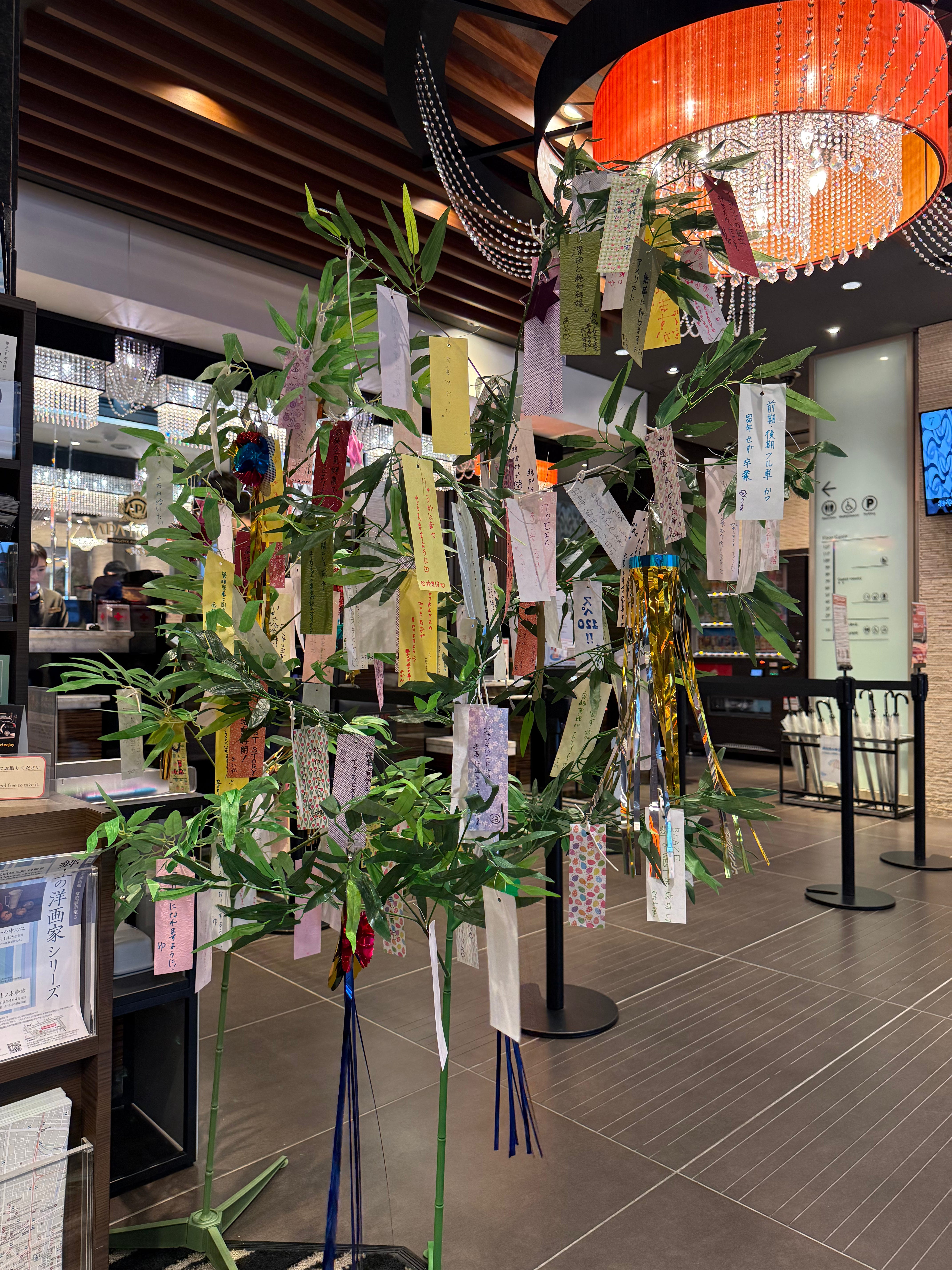
In the lobby of a hotel where I stayed recently, there was also a Tanabata bamboo decoration. Tanzaku were prepared beside the bamboo grass, and guests were free to write their wishes and tie them there.
When you live in Japan, you sometimes come across these small signs of the season. Tanabata can be celebrated as a large festival, but at the same time, it is also a familiar event that appears in hotel lobbies or in a corner of a station.
Tanabata has a story about two stars, 織姫(Orihime)and 彦星(Hikoboshi). In Japan, Orihime is described as a woman who weaves cloth, and Hikoboshi as a man who tends cattle. The two are separated by the 天の川(Amanogawa, the Milky Way), and it is said that they can meet only once a year, on the night of July 7.
This story is based on a star legend that came to Japan from China. Tanabata also had another side as an event for praying for improvement in the arts and skills. A culture that came from China was accepted in Japan and came to be valued as a court ritual.
At the Japanese court, Tanabata was held as an event to pray for improvement in sewing, calligraphy, and waka poetry. It became associated not only with the story of the stars, but also with the wish to work with one’s hands, polish one’s skills, write words, and compose poems.
People in the past wrote words and poems on 梶の葉(kaji leaves)and entrusted their wishes to them. Kaji leaves are known as a plant closely connected with Tanabata. The custom of writing wishes on tanzaku today still carries the history of Tanabata, in which people polished their skills, wrote words, and gave shape to their wishes.

