


When people think of a place that represents Japan, many imagine Kyoto.
Temples and shrines, traditional streets, and the beauty of the four seasons. Kyoto is one of the country’s most famous destinations and attracts visitors from around the world.
Yet just north of Kyoto’s city center, deep in a narrow mountain valley, there is a shrine that has long held a special place in Japanese spiritual tradition.
That place is Kifune Shrine.
The Kamo River, which flows through the city of Kyoto, begins in these mountains. Kifune Shrine stands near that source, and for centuries people have come here to pray to the deity of water. It is considered the head shrine of more than two thousand shrines across Japan that are dedicated to water deities.
What Kifune Shrine Is
The main deity of Kifune Shrine is Takaokami no Kami, a god associated with water and rain.
The character okami (龗) is an ancient word that refers to a dragon. In Japanese mythology, this deity governs rain, flowing water, and the springs that emerge from the mountains.
Kyoto itself was built in a basin surrounded by mountains, and its agriculture and daily life have long depended on water flowing down from those mountains.
Because rainfall was essential to the survival of the city, the imperial court regarded Kifune Shrine as an important place for prayer. Historical records tell us that emperors sent offerings here during times of drought to pray for rain, and during long periods of rain to ask for clear weather.
The Name “Kifune” and Its Meaning
The name Kifune was once written with the characters 「気生根」.
These characters mean “the root where energy is born.” In other words, it refers to a place where the vital energy of the earth emerges.
Today the place name is often pronounced Kibune, with a voiced sound in the middle. In fact, the nearest train station is called Kibuneguchi Station.
However, the shrine itself is pronounced Kifune, without the voiced sound. The official English name used by the shrine is also Kifune Shrine.
In Japanese, it is common for sounds in the middle of a word to become voiced—for example, “fu” changing to “bu.” But because this shrine is dedicated to the deity of water, the pronunciation has traditionally been kept clear and unvoiced.
It is said that this reflects a simple wish: that the sacred water of the deity should never become clouded or impure.
The Approach to the Main Shrine
When visitors arrive at Kifune Shrine, one of the first things they notice is the stone staircase leading to the main shrine.
The approach begins at the second torii gate and climbs 87 steps, lined on both sides with red lanterns. This scene has become one of the most recognizable images of Kifune Shrine.
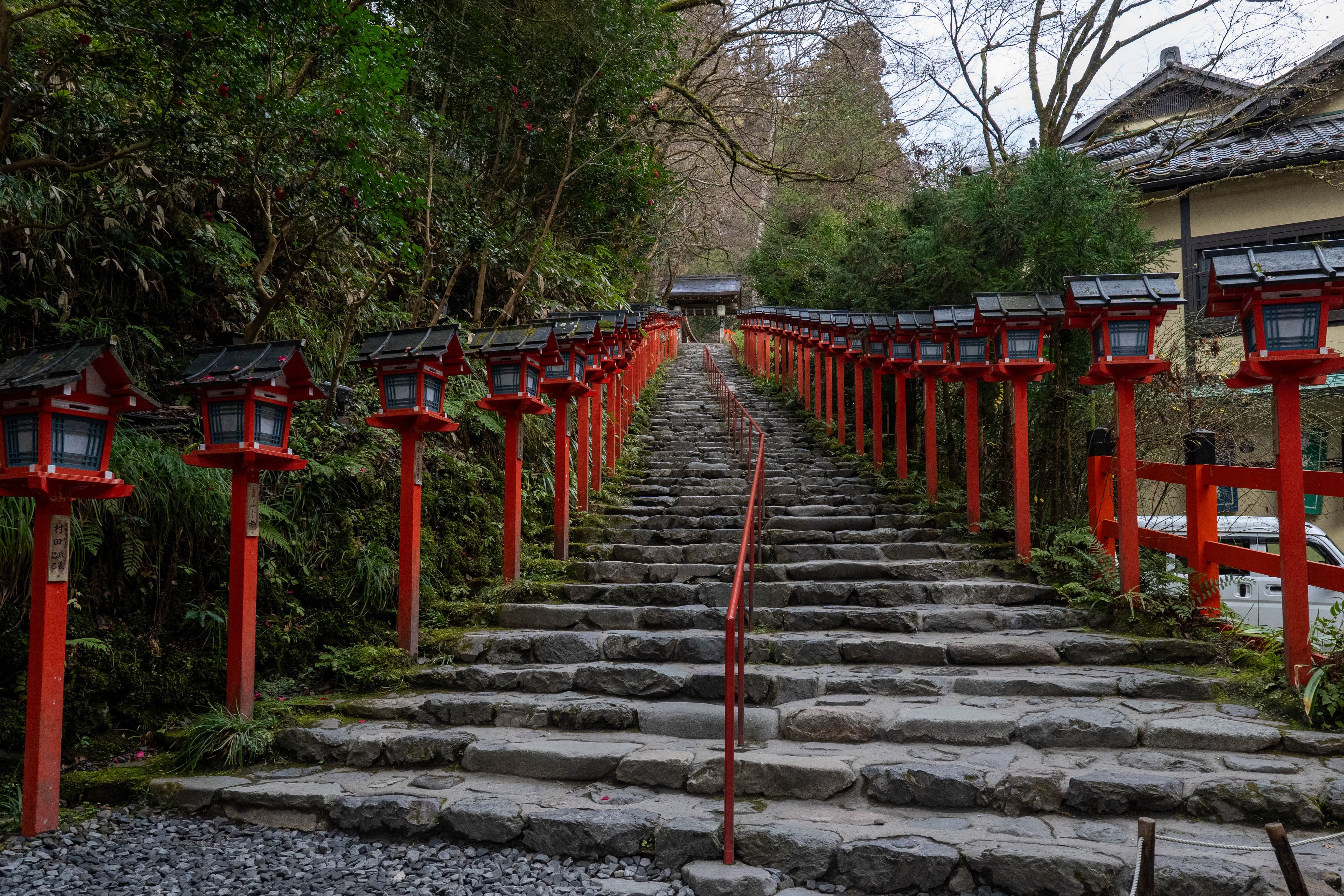
At the top of these steps lies the main shrine building.
The Origin of Ema Prayer Plaques
Within the grounds of the main shrine, you will see many wooden plaques known as ema.
