


In the second half of this article, we will share breathtaking views of Daisetsuzan—Kamuy Mintara, the Garden of the Gods—through a series of photographs. We invite you to read on and enjoy them to the end.
When people in Japan speak of “Kami,” the gods that come to mind are often those of Shinto, which developed mainly on Honshu. The countless deities described in the Kojiki and Nihon Shoki—including Amaterasu Ōmikami—were eventually systematized through shrines and festivals, becoming deeply embedded in daily life. In SJJ, the deities we have introduced so far have largely been these Shinto gods.
This time, however, we turn to another form of “Kami.” In Hokkaidō—once called Ezo—there existed a belief system distinct from the pantheon of Shinto, as well as from the single god of Christianity or Islam.
For the Ainu, the indigenous people of Hokkaidō, the word Kamuy is usually translated as “god,” but it conveys an entirely different concept. Kamuy are believed to dwell not only in nature and animals but also in the tools of daily life. Fire has its Kamuy, water its Kamuy, and the bear its Kamuy. Every element of the natural world was seen as a presence worthy of reverence and gratitude. Invisible forces such as disasters and epidemics were also recognized as the Kamuy of calamity or plague.
At first glance, this resembles Shinto’s countless deities. Yet for the Ainu, Kamuy were not beings to be worshipped unilaterally, but counterparts in a relationship of equality. They expressed gratitude for blessings received, but they also at times protested against the Kamuy of disease or disaster.
Although both “Kami” and “Kamuy” are translated as “god,” they carry very different cultural meanings. One place that symbolizes the worldview of the Kamuy lies at the heart of Hokkaidō: Daisetsuzan. The Ainu called this vast mountain range Kamuy Mintara—“the garden of the gods.” You may be wondering what kind of place this “garden of the gods” truly is.
Historical Background and Hokkaidō’s Uniqueness
Before delving further into Kamuy, let us briefly touch on Hokkaidō’s history.
You may be surprised to learn that Hokkaidō was once home to a distinct cultural sphere where the Ainu lived as seafaring people with their own language and traditions. Until 1869, this land was called Ezo. Here, ways of life and spiritual culture were sustained on the foundation of coexistence with nature. The Ainu lived through hunting, fishing, and gathering, while also maintaining trade networks with Honshu and Russia.
Some theories trace the origins of Ainu culture back as far as 30,000 years. By the 7th century, it had grown into a culture engaged in active overseas trade [National Museum of Ethnology surveys]. In the early 17th century, the Matsumae clan came to dominate Ezo, monopolizing trade. Rice and iron tools from Honshu were introduced, but economic control and unbalanced resource use deeply impacted Ainu society.
In 1869, during the Meiji era, Ezo was officially renamed “Hokkaidō,” and the government initiated systematic colonization. Migrants from Honshu poured in, farmland and towns were rapidly developed, and Ainu culture—its language and spirituality included—was repressed and quickly diminished.
In the 21st century, however, efforts to revive Ainu culture have grown. In 2019, the “Act on Promotion of Ainu Policy” was enacted, legally recognizing the Ainu as an indigenous people of Japan for the first time. In Shiraoi, the Upopoy (National Ainu Museum and Park) was established as a center for sharing Ainu history and culture.
According to the 2023 Survey on the Living Conditions of Ainu in Hokkaidō, municipalities recorded 11,450 people of Ainu heritage. Yet because the definition of “ethnicity” is complex, the precise nationwide figure remains unknown.
Thus Hokkaidō, historically transformed from “Ezo” into “Hokkaidō,” continues to carry forward a cultural lineage distinct from Honshu.
Daisetsuzan — Kamuy Mintara, “The Garden of the Gods”
Let us return to our main theme: Kamuy Mintara.
Daisetsuzan, rising at the center of Hokkaidō, forms the core of Japan’s largest national park, Daisetsuzan National Park, covering 2,268 square kilometers. Its highest peak is Mt. Asahi (2,291 m), joined by mountains such as Kurodake and Tomuraushi. For its vast scale, it is often called “the roof of Hokkaidō.”
This range offers dramatic scenery in every season. In its short summer, alpine flowers bloom like a carpet. In autumn, the earliest fall foliage in Japan paints the mountains in vivid colors, before the region yields to a long winter buried in snow. The Ainu revered these mountains as Kamuy Mintara—the garden of the gods.
In Ainu, Kamuy means god, and Mintara means garden. The literal meaning, “the garden of the gods,” reflects a worldview that regarded nature itself as sacred—a place where gods dwell and bring blessings to humankind. In recent years, the phrase has sometimes been translated as “the playground of the gods” in the context of tourism.
It is a symbolic space where nature and the divine meet, deeply rooted in the Ainu way of life and belief. We walked through Daisetsuzan ourselves, seeking in its landscapes the presence of the Kamuy.
Climbing from Mt. Asahi
Among Daisetsuzan’s many routes, we began our ascent from the Mt. Asahi side. A ropeway makes it easy to reach Sugatami Pond, located at the mountain’s base. Its surface reflects Mt. Asahi like a mirror, showing a different face each season.
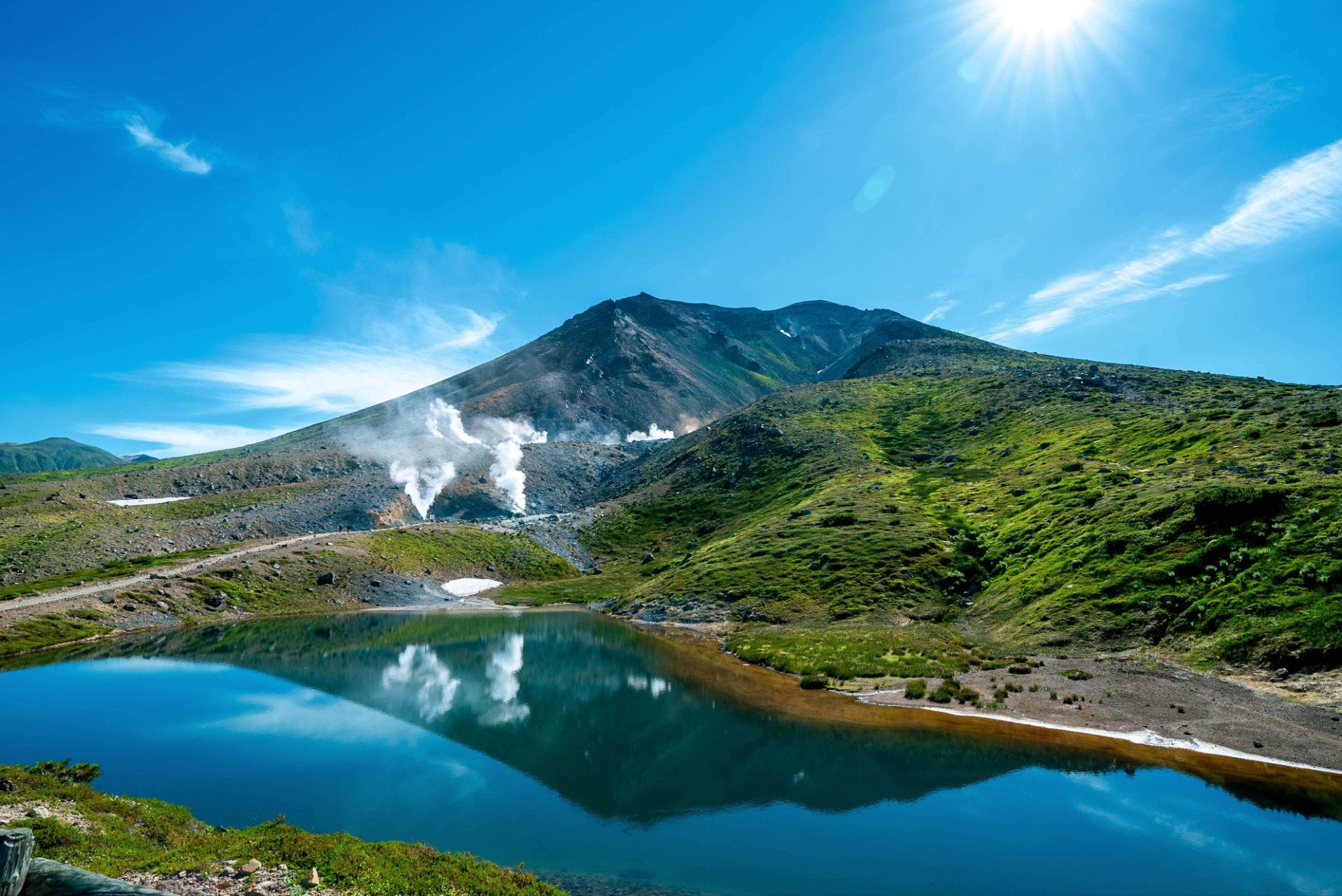
Around the pond are maintained paths, allowing a relatively gentle walk that still conveys a sense of alpine harshness. Sugatami Pond is a kind of gateway to Daisetsuzan’s grandeur. From here, the real climb begins.
Though Mt. Asahi rises to 2,291 m, Hokkaidō’s climate makes it comparable to 3,000 m peaks on Honshu. Proper gear and preparation are essential.