

Takachiho Gorge Where Myths Live On
Experience the Breathtaking Scenery of Takachiho, Miyazaki

Hello everyone.
This time, I visited Takachiho Town in Miyazaki Prefecture, one of the legendary sites of Tenson Kōrin — the Descent of the Heavenly Grandson.
It is said that Ninigi no Mikoto(瓊瓊杵尊), the grandson of Amaterasu Ōmikami(天照大神), descended from the heavens to this land, where traces of ancient myths still remain today.
In this article, I would like to introduce Takachiho Gorge, a place of both breathtaking scenery and quiet mystique.
The Formation and Myth of Takachiho Gorge
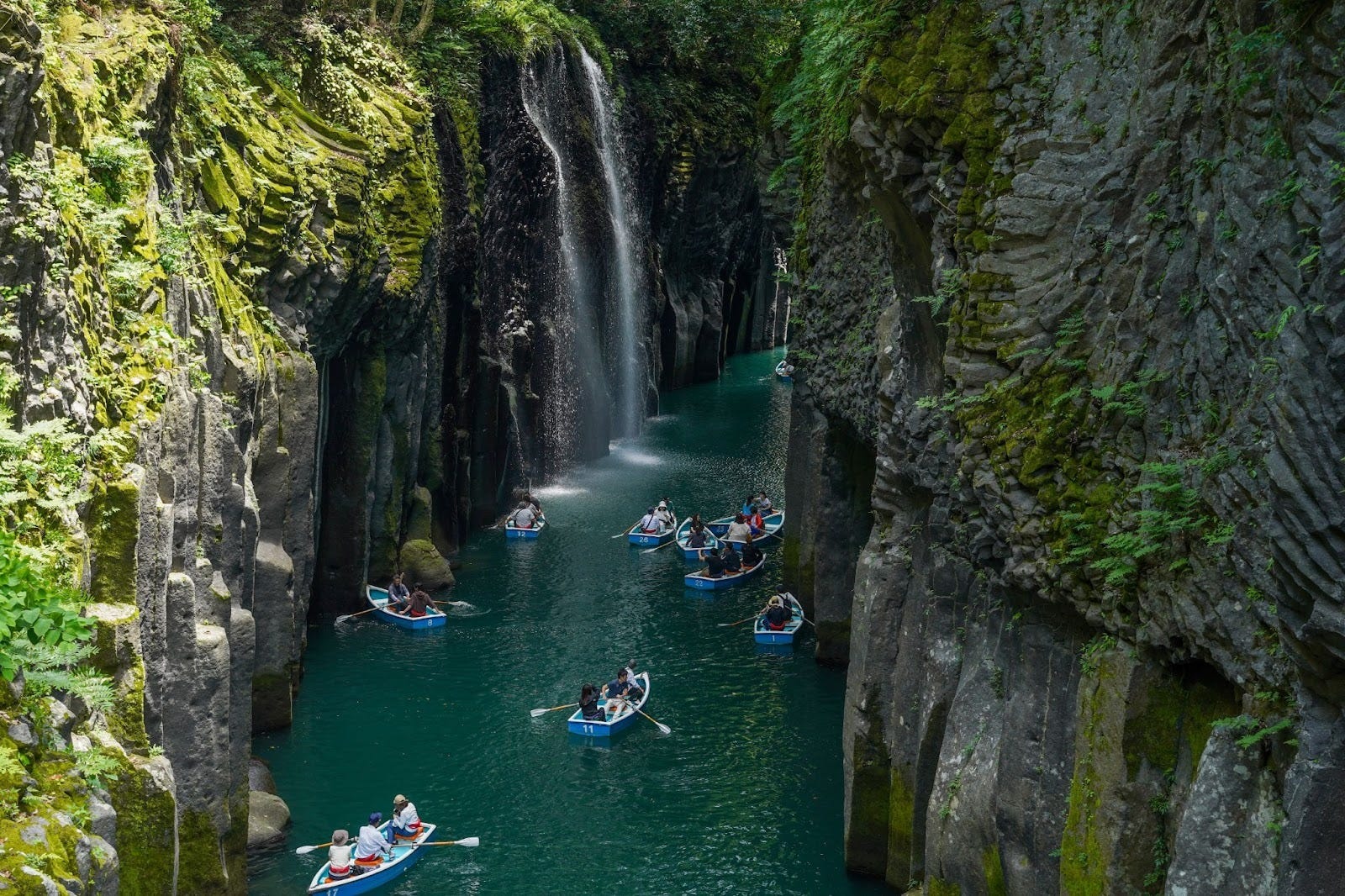
Takachiho Gorge was formed around 90,000 years ago, when pyroclastic flows from a massive eruption of Mount Aso cooled and solidified, then were slowly carved by the flow of the Gokase River over thousands of years.
The cliffs rise approximately 80 to 100 meters high, and the columnar joints sculpted by the river stretch for about seven kilometers.
In 1934, this area was designated a National Scenic and Natural Monument as “Gokase River Gorge (Takachiho Gorge).”
Such large-scale columnar formations are rare in Japan and are preserved as a geologically valuable landscape.
Takachiho Town, where this gorge is located, is known in mythology as the site of Tenson Kōrin, the heavenly descent.
This event marks the moment when Ninigi no Mikoto(瓊瓊杵尊), grandson of the supreme deity Amaterasu Ōmikami(天照大神),
descended from Takamagahara(高天原), the realm of the gods, to Ashihara no Nakatsukuni(葦原中国)—the world of humans.
It is said to be the moment when the divine and human worlds were first connected, and thus this land has long been regarded as deeply tied to “the beginning of Japan.”
According to legend, Sarutahiko(猿田彦) guided the descent, and traces of the deities who accompanied Ninigi no Mikoto remain today in local place names and shrines.
Flowing through the center of the gorge is Manai no Taki(真名井の滝),
a 17-meter-high waterfall that plunges powerfully between the cliffs of columnar basalt.
On sunny days, the mist catches the light and creates a small rainbow.
The source of this waterfall is tied to the ancient legend of Ame no Manai(天真名井).
When there was no water upon the descent of the heavenly grandson,
Ame no Murakumo no Mikoto(天村雲命) is said to have brought the “seed of water” from Takamagahara(高天原) to this land.
That spring still flows today in the area of Ame no Manai within Takachiho Town,
revered as sacred water and believed to be one of the sources of Manai no Taki.
In other words, we Japanese accept both the scientific explanation that this terrain was created by volcanic activity about 90,000 years ago,
and the mythological narrative told some 1,300 years ago—without contradiction.
We believe that the water of Manai no Taki originates from the celestial “Ame no Manai,” brought down by a deity,
while also understanding that the gorge itself was shaped by natural processes over millennia.
This coexistence of belief and knowledge may be one reason why Japanese people are sometimes described as “not deeply religious.”
Rather than dividing faith and science, myth and reality, many accept both as parts of the same world.
That sensibility reflects one of the essential characteristics of Japan’s relationship with nature and spirituality.
In modern Japan, there are few opportunities to study the myths of the Kojiki or Nihon Shoki in school.
After World War II, State Shinto was separated from education, and mythology disappeared from textbooks.
Today, it appears only as part of classical literature or regional folklore.
Even so, those who visit the mythological sites or read the Kojiki often accept both the geological and mythical layers of the same landscape without conflict.
The difference lies in sequence: geology comes first, and myth is layered upon it.
By understanding the natural formation of the land, people can overlay a narrative—seeing the same place through two complementary lenses.
That dual perspective continues to live within the Japanese worldview today.
Today, well-maintained walking paths allow visitors to enjoy the gorge from various angles.
Regardless of one’s faith or familiarity with mythology, there is no doubt that the beauty of this landscape moves the heart.
Some sections may close temporarily due to rockfall prevention work, but ongoing efforts are made to preserve the scenery in harmony with nature.
Viewing Manai no Taki from Below
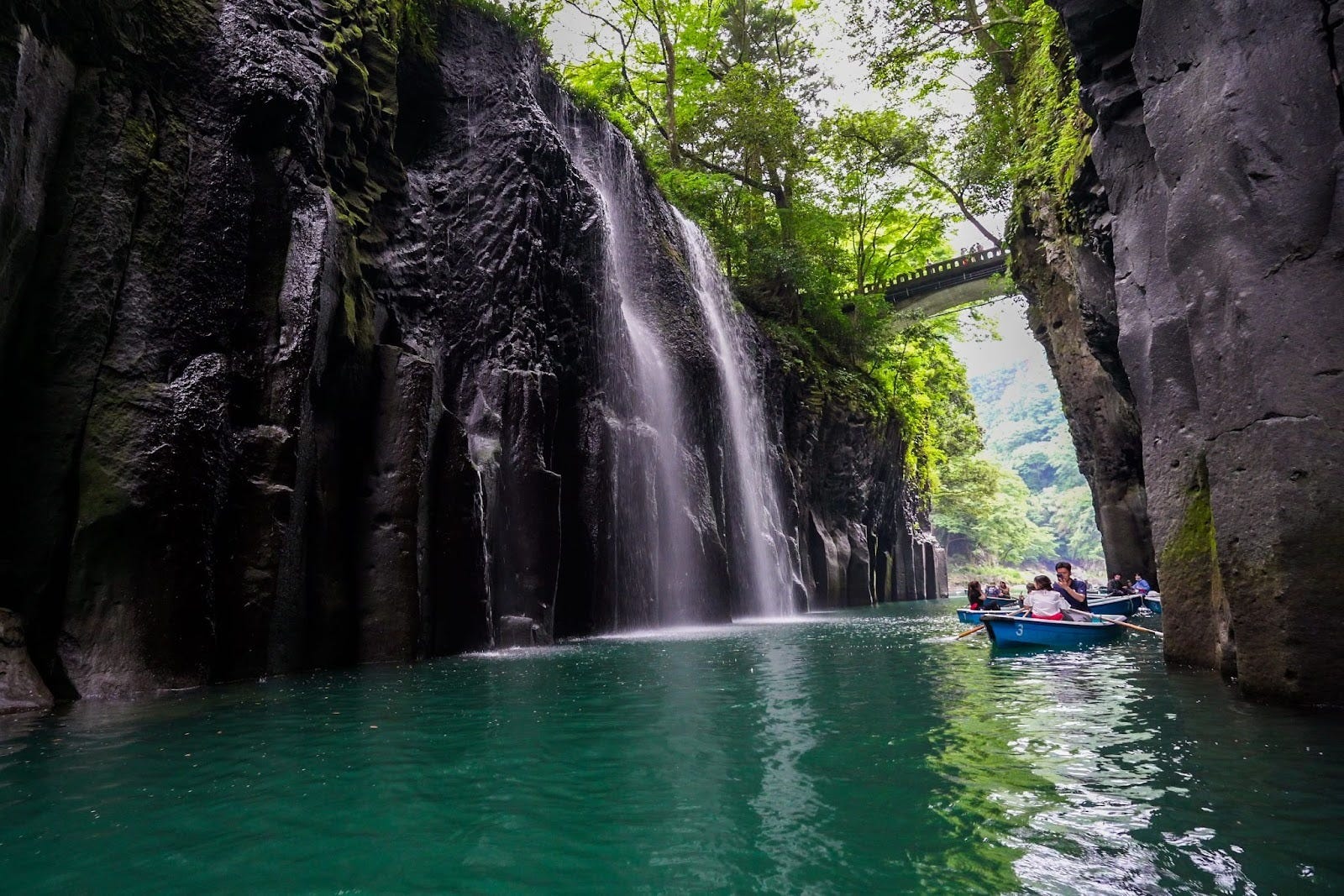
At Takachiho Gorge, visitors can take a rowboat that goes right beneath Manai no Taki(真名井の滝).
When I actually tried it, the cliffs on both sides felt closer than I had imagined,
and as I rowed through the narrow gorge, the waterfall—about 17 meters tall—came into full view ahead.
The closer you get, the stronger the spray becomes, wetting the camera lens almost instantly.
Still, I wanted to get as close as possible. The cold wind and roaring sound rising from the water were far more powerful than I expected.
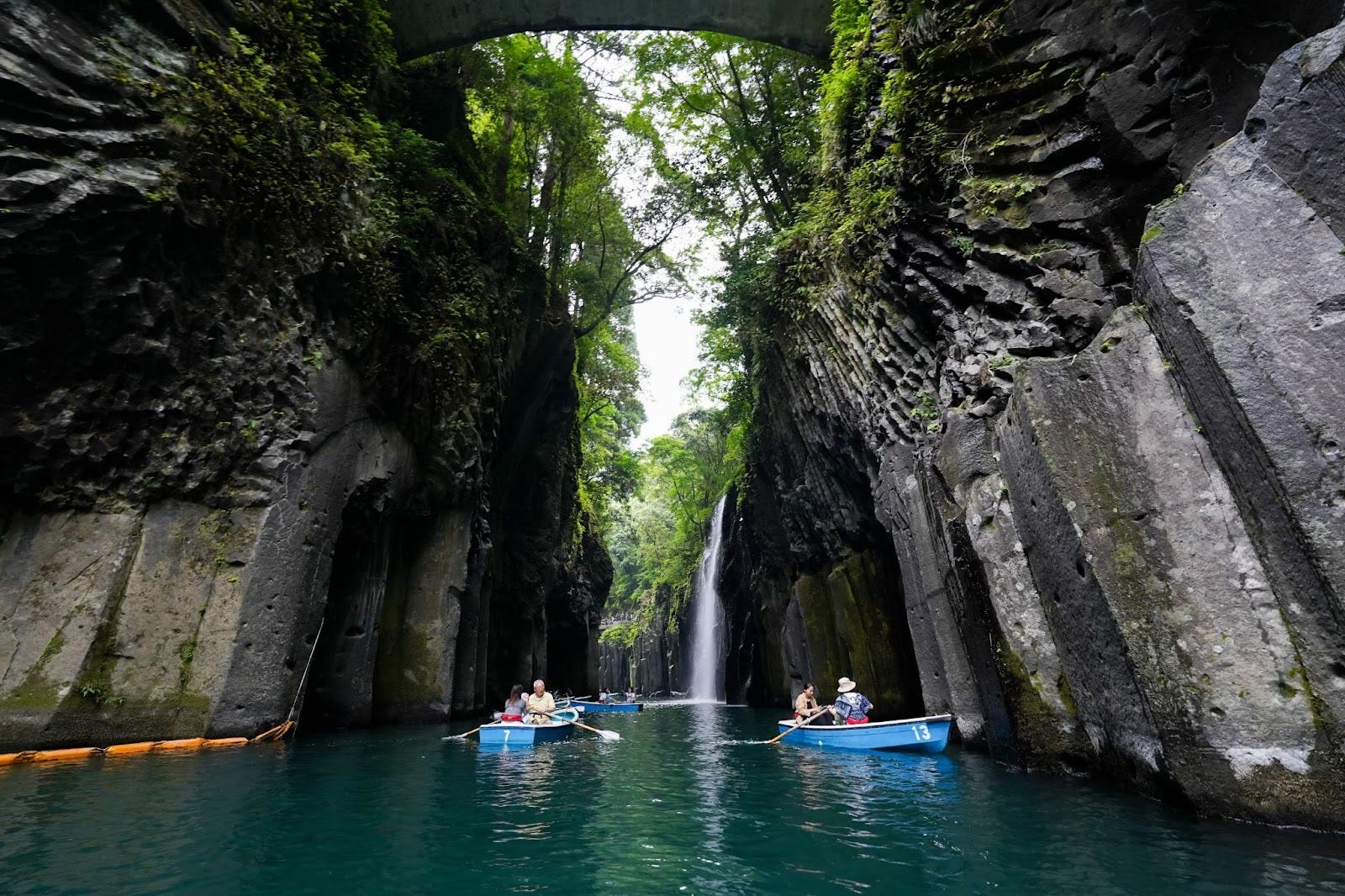
Because most visitors are not used to rowing, boats often bump into each other or spin in place as people struggle to steer.
My boat was no exception. Nearby tourists and I exchanged words like,
“Could you pull a bit to that side?” or “I’ll push from here!”—helping one another along.
Amid the mystical scenery, the sight of everyone floundering and laughing together felt both humorous and heartwarming.
Several boats always gather beneath the waterfall, but people take turns and give way so others can take photos.
The way everyone helps each other, even as strangers, made the moment feel more like human connection than mere sightseeing.
Visitor Information:
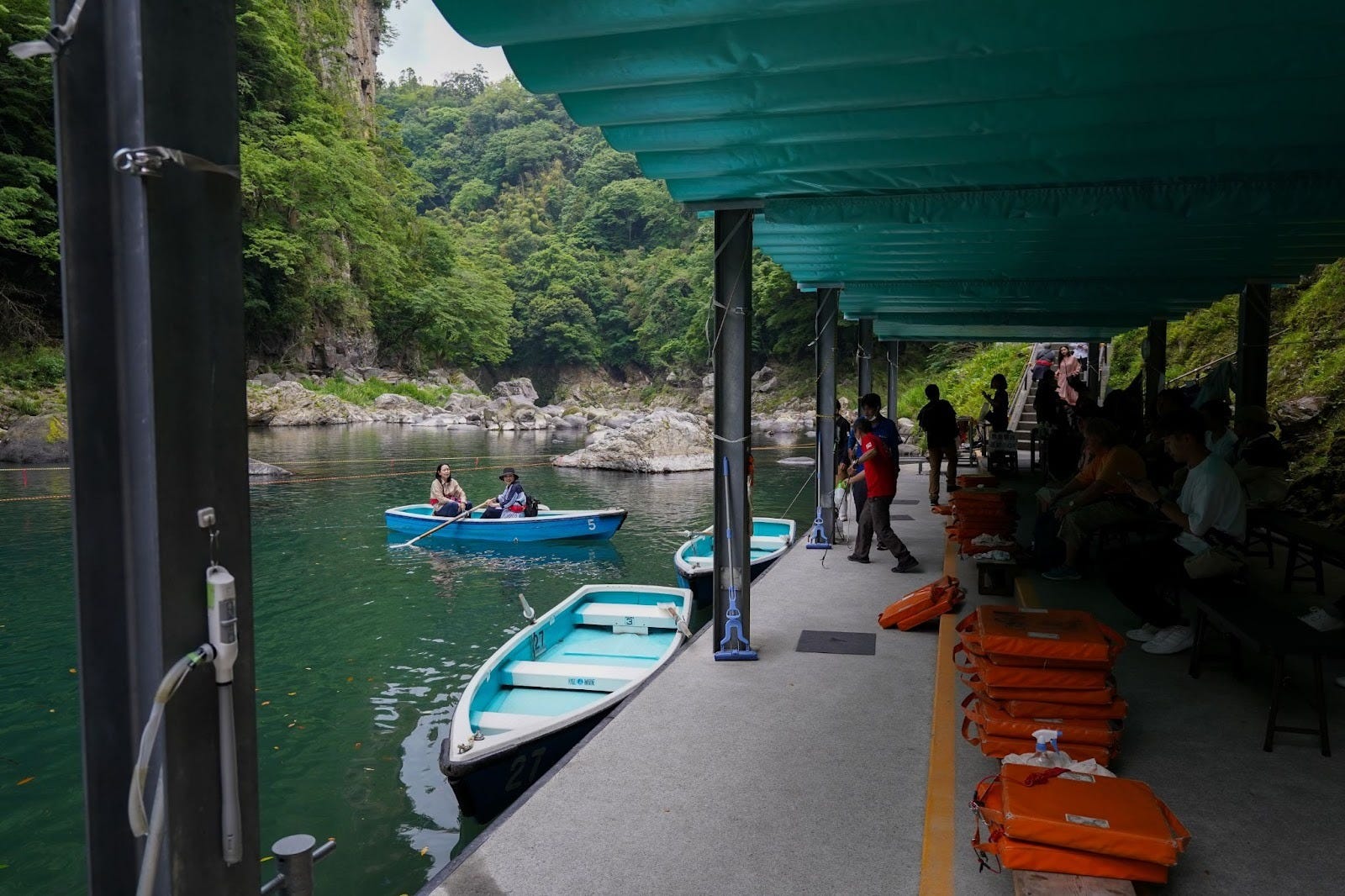
Boat rental costs between 4,100 and 5,100 yen per 30 minutes per boat (tax included),
with a capacity of three people (or up to four including small children).
Life jackets are included. Additional time is charged at 1,000 yen per 10 minutes.
Reservations can be made on the official website from 9 a.m. two weeks before your visit up until 9 a.m. two days prior.
The Mystery of Ama-no-Iwato and Ama-no-Yasugawara
Another sacred site that symbolizes Takachiho is Ama-no-Iwato(天岩戸).
This myth, recorded in the Kojiki and Nihon Shoki, is one of the most famous episodes in Japanese mythology.
The sun goddess Amaterasu Ōmikami(天照大神), distressed by the violent acts of her brother Susanoo no Mikoto(須佐之男命), hid herself in a cave called Ama-no-Iwato.
At that moment, the world was enveloped in darkness—crops withered, and people’s lives came to a halt. The Yaoyorozu no Kami(八百万の神々), countless deities, gathered at Ama-no-Yasugawara(天安河原)
to discuss how to bring back the light.
Through their wisdom and ritual dance, laughter arose before the cave,
and when the curious Amaterasu peeked out, the cave was opened and light returned to the world.
For more details about the story in the Kojiki, please see this article.


The cave where Amaterasu is said to have hidden is enshrined at Ama-no-Iwato Shrine(天岩戸神社).
It stands on the western bank of the Gokase River, and its sacred object of worship is the cave itself, located behind the main shrine.
Although it cannot be seen directly from the shrine grounds, the air around the site feels deeply imbued with the stillness of ancient myth.
Nearby is Ama-no-Yasugawara(天安河原), where the deities are said to have gathered for counsel.
Walking along the path, after a leftward curve, a vast cave suddenly appears—much larger than one could imagine.
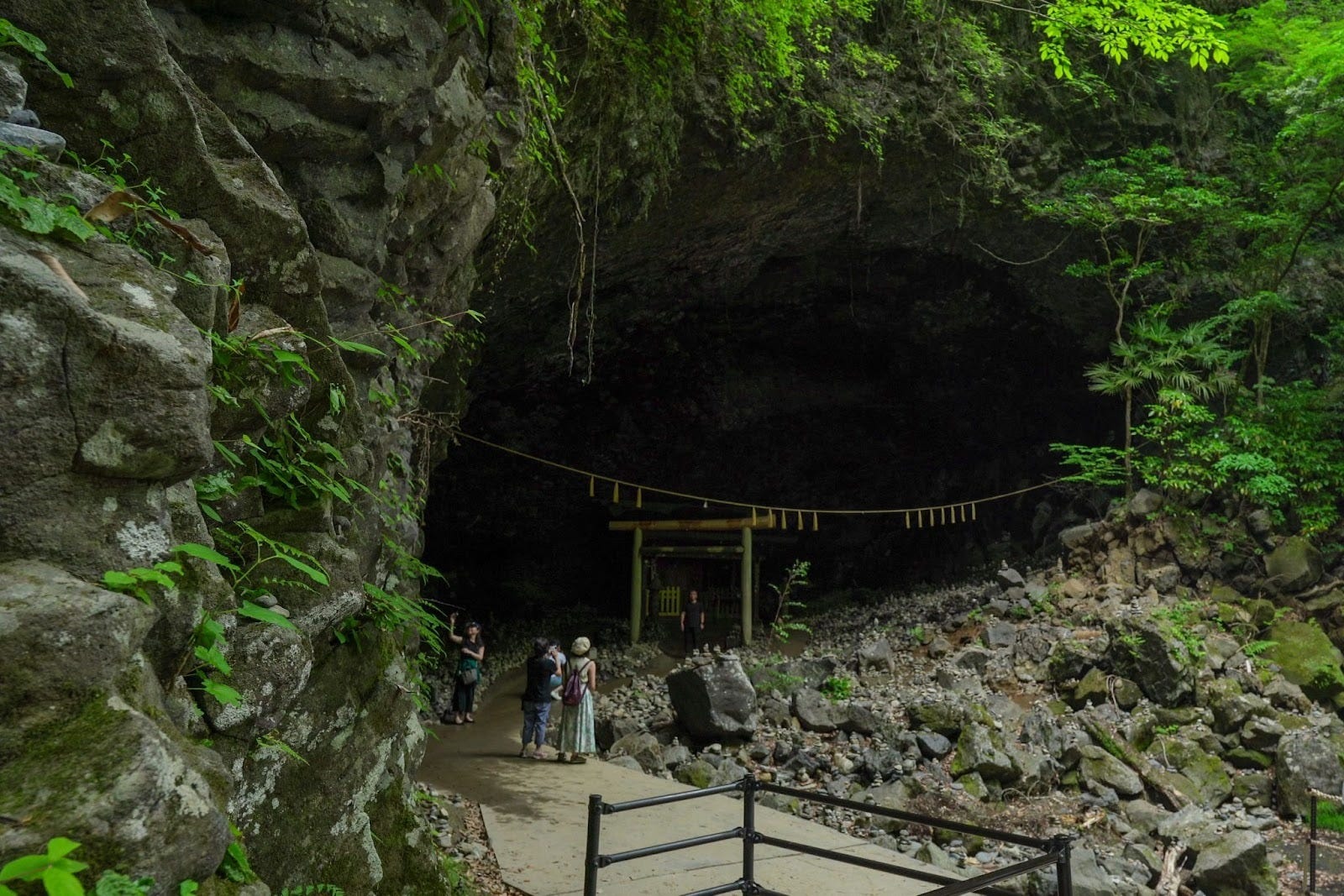
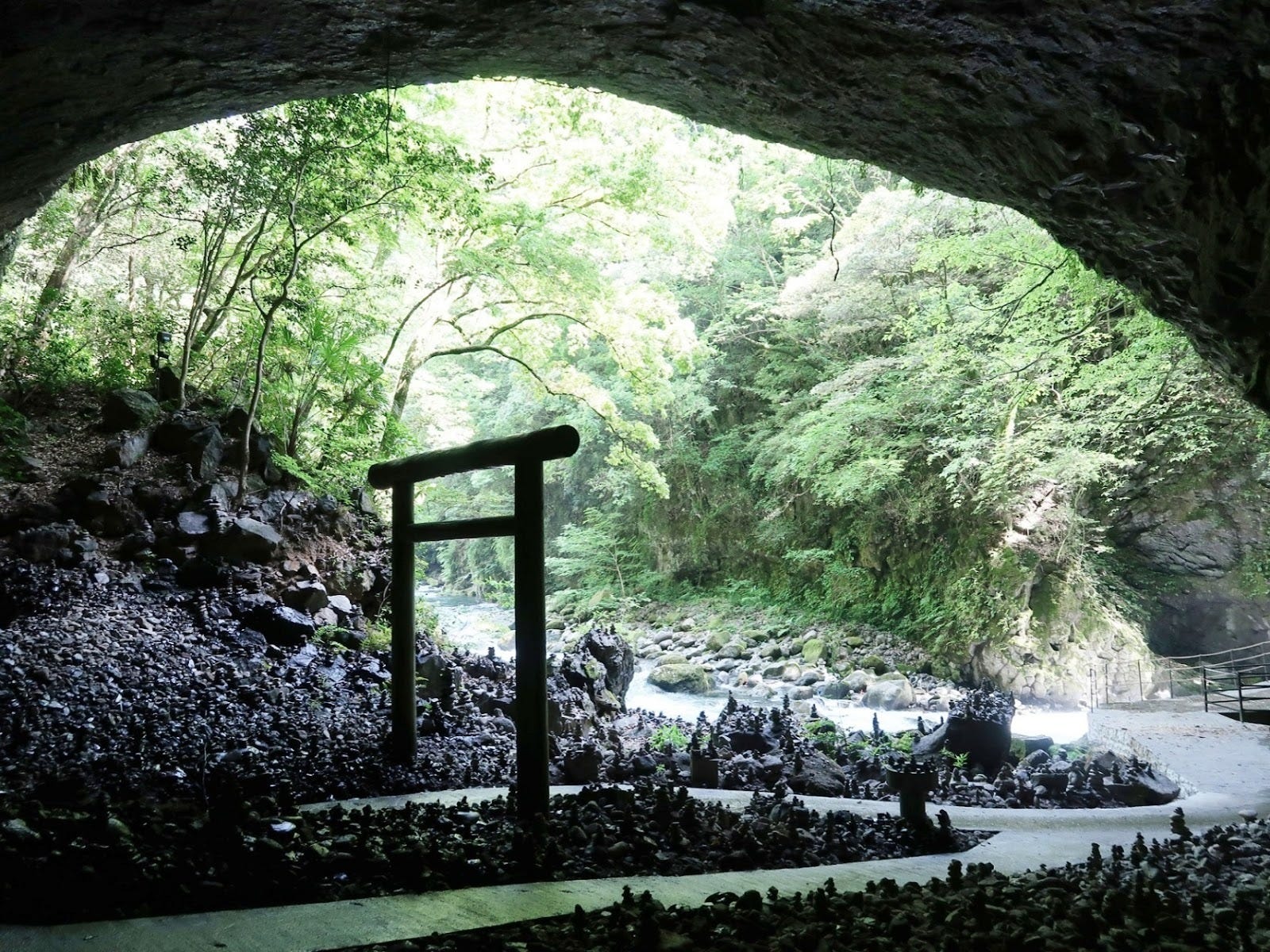
The air inside is cool and dim even during the day, evoking a world apart.
Crossing the threshold, you immediately feel the atmosphere shift—a sensation difficult to describe in words.
It is a place that almost makes you hesitate to take photographs.
Countless stones, stacked throughout the riverbed, are traces of people’s prayers,
emphasizing the quiet sanctity of this sacred space.
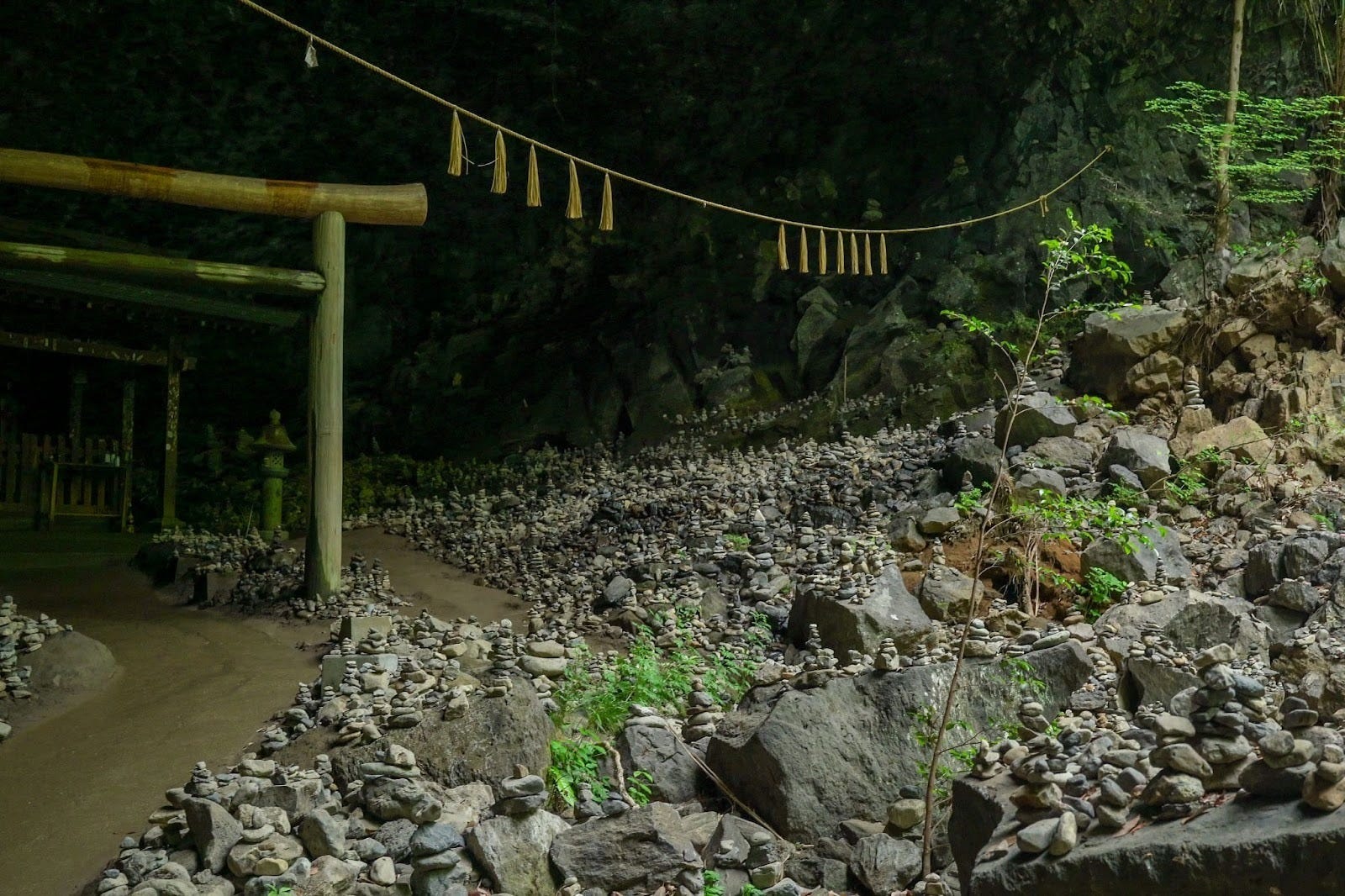
The mountains, rivers, and rocks of Takachiho are layered with ancient myths.
Place names themselves serve as enduring evidence of those stories.
These legends are not distant tales of the past—they are interwoven into daily life,
living on as part of the prayers and rituals of the local people.
To Know Takachiho More Deeply
When visiting Takachiho Gorge or Ama-no-Iwato, there are other nearby places you should not miss.
One is Takachiho Shrine(高千穂神社), said to have been founded about 1,900 years ago.
As the principal shrine of the Takachiho area, it has long been revered by local people.
Within its grounds stand two sacred trees known as the “Married Cedars,” symbolizing harmony and good relationships.
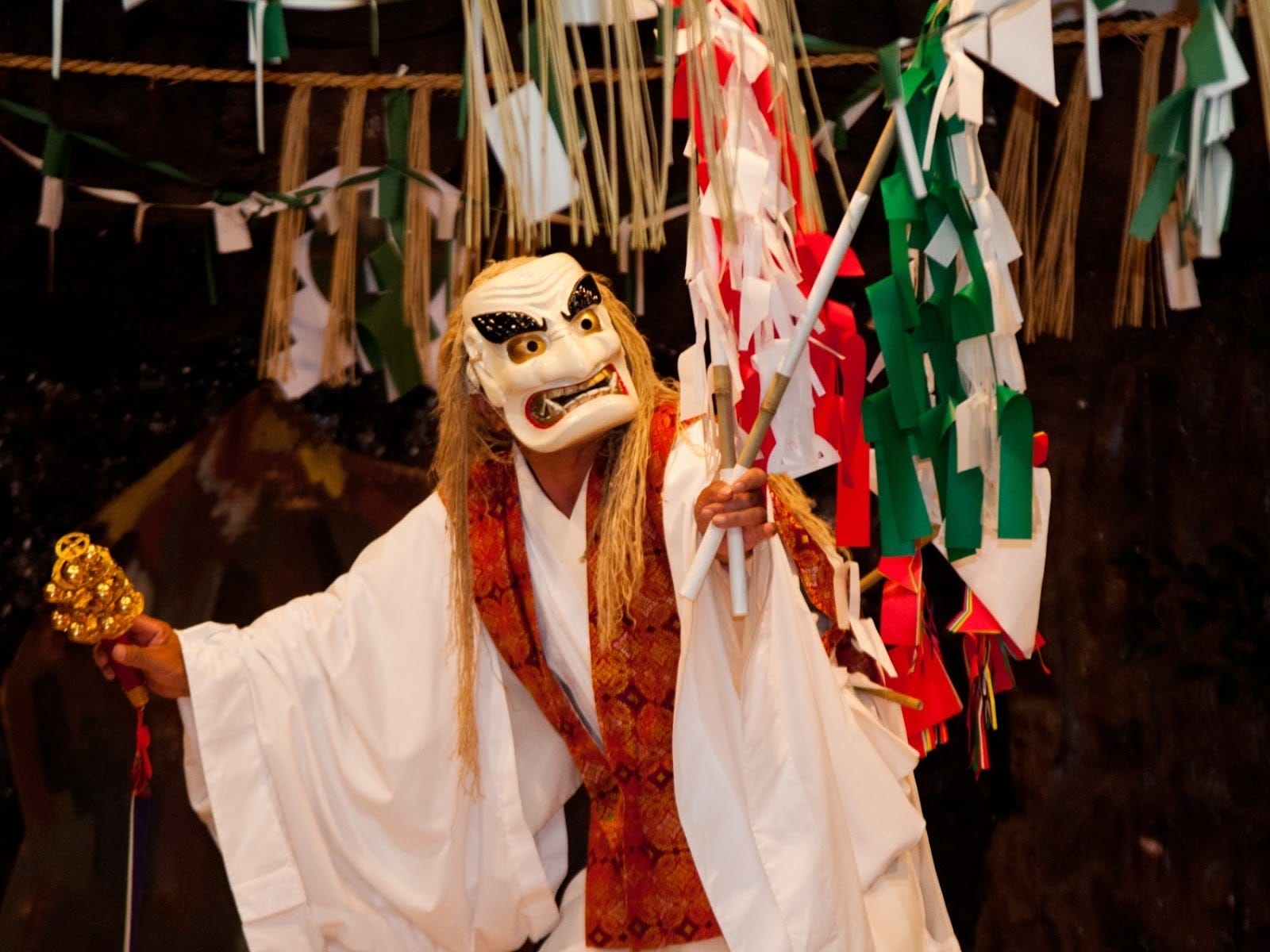
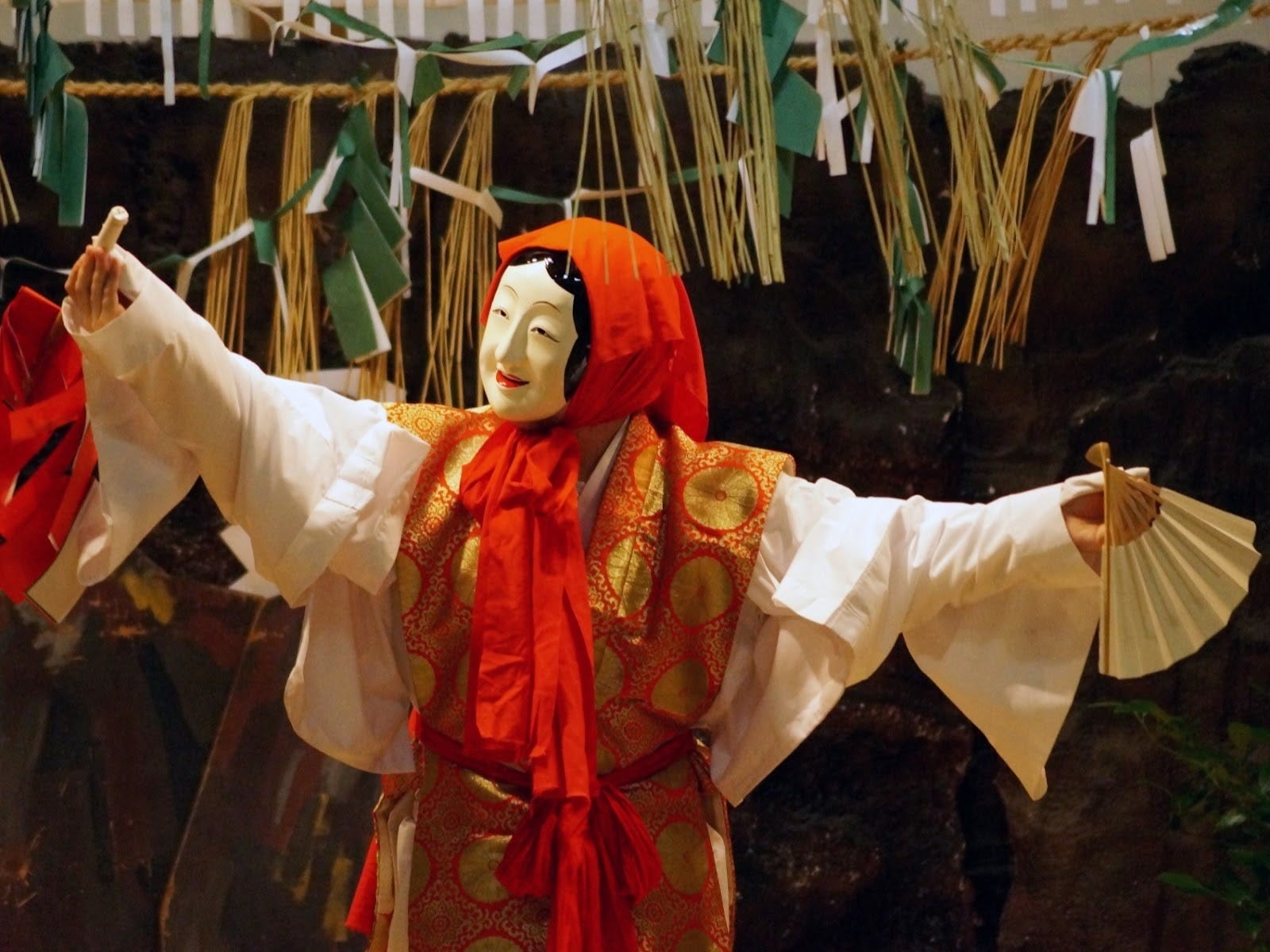
From November to February each year, the shrine hosts the Takachiho Yokagura(高千穂の夜神楽),
a traditional performing art based on the Ama-no-Iwato myth.
It is designated as an Important Intangible Folk Cultural Property of Japan.
Another site closely connected to Takachiho’s myths is Kushifuru Shrine(槵觸神社),
which enshrines Kushifuru no Mine(槵觸の峰), the peak where Ninigi no Mikoto(瓊瓊杵尊) is said to have descended.
It has long been venerated as a sacred site.
Within its precincts flows the holy spring of Ame no Manai(天真名井),
believed to be the source of the water that feeds Manai no Taki.
Walking through Takachiho, one senses how mythology continues to blend naturally into the lives and landscapes of the people.
Editor’s Diary
What struck me most while walking through Takachiho
was not so much its sacredness as a “land of myth,”
but how the presence of the divine seems to exist as a quiet extension of everyday life.
Along the paths maintained for visitors, I saw people tending their fields,
and locals bowing gently as they passed before a shrine.
It felt as though prayer was embedded in daily gestures rather than confined to ritual.
To reach Takachiho Gorge, one must park and walk a distance.
The route is longer than expected, with slopes and steps,
which may be challenging for those with weak knees.
However, there is also a barrier-free path leading to an accessible viewing platform,
allowing visitors of all abilities to enjoy the scenery.
Seeing how the local community maintains this mystical place so that anyone can experience it
filled me with a quiet sense of admiration.
Though I was a visitor from another prefecture, I felt proud of their devotion to preserving such beauty.
This is a landscape that deserves to be seen by as many people as possible.
The sound of the flowing water, the mist of the waterfall, and the light on the rock face—
each seemed to speak in its own way.
When you read the myths before visiting,
the landforms themselves appear layered with fragments of ancient stories.
Perhaps, for Japanese people, receiving these old tales not as “knowledge” but as “sensation”
is what it truly means to believe.
My curiosity toward mythology, and my appreciation for Japan’s natural beauty, deepened even more.
And I am grateful to be able to share that experience with you here.
—Written by Sumire