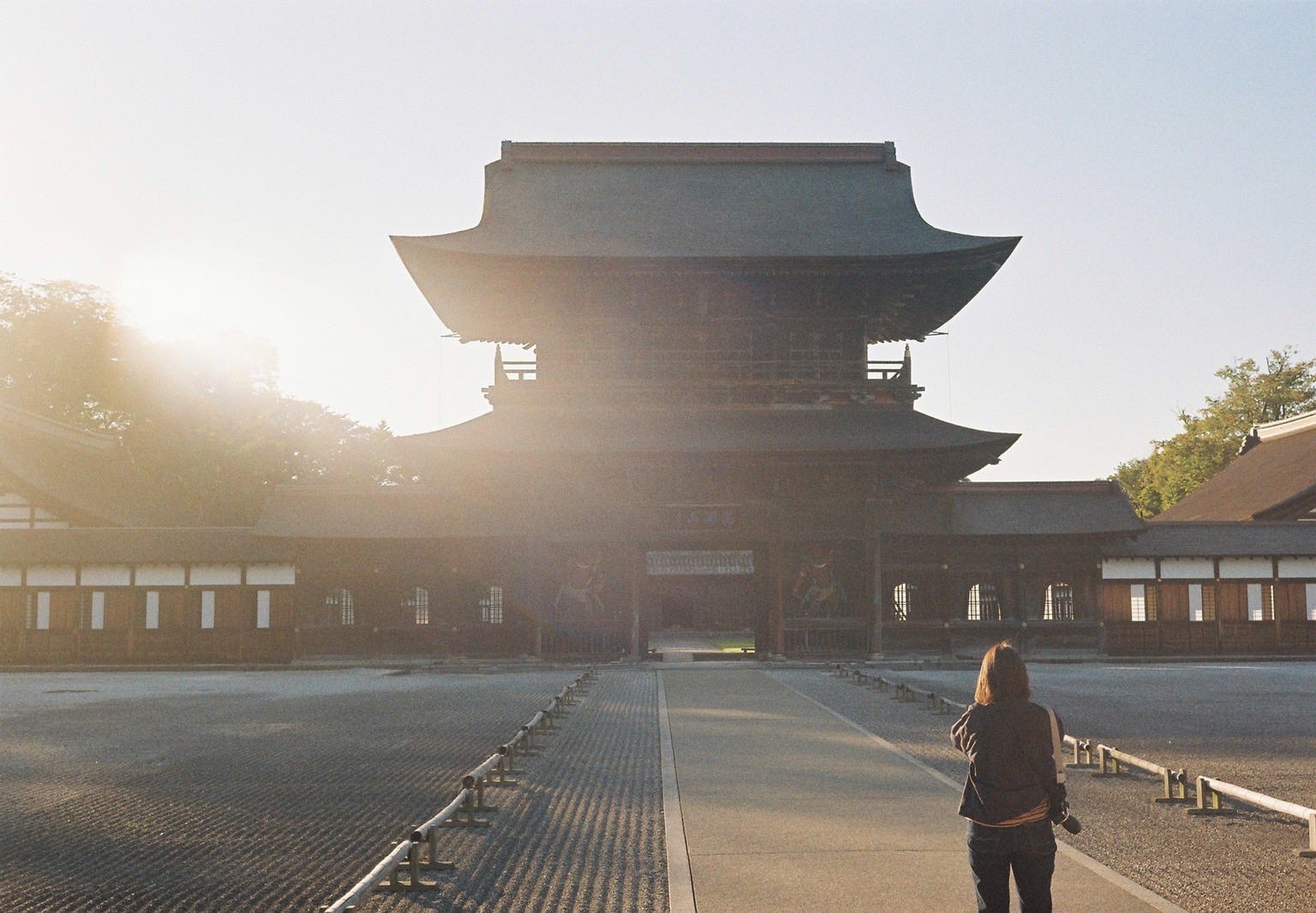
Shrines or Temples? Why Japan Has Both
What to Know Before Visiting Japan
As the year draws to a close and a new one begins, many people in Japan go out for Hatsumōde(初詣).
They visit their local tutelary shrine or a well-known shrine and pray for safety and well-being in the coming year.
Japanese people are often described as “non-religious,” yet at this moment, many quietly bring their hands together before the kami.
But do you know how people spend the moment just before that, as the year turns?
Across Japan, the solemn sound of Joya no Kane(除夜の鐘) rings out.
This bell is struck to dispel the worries and confusions that linger in the human heart, allowing people to welcome the new year with a clear mind.
It marks both the end of one year and the beginning of the next.
And this bell is rung not at shrines, but at Buddhist temples.
On New Year’s Eve, people listen to the sound of the bell at a temple, and when the year begins, they visit a shrine to pray to the kami.
We accept this shift as something entirely natural, though it could be said that Shinto(神道)and Buddhism(仏教)are being treated together without clear separation.
For visitors from abroad, this may feel distinctly unfamiliar.
Here, I would like to pause and ask you a question.
Can you explain, in words, the difference between a shrine and a temple?
Generally speaking, shrines have torii gates and enshrine kami, while temples house Buddhist statues and teachings.
By looking at the buildings, one should be able to tell them apart.
And yet, when traveling in Japan, you may encounter scenes where that boundary feels blurred: torii standing within temple grounds, or Buddhist statues found inside shrine precincts.
Why are they so deeply intertwined?
Behind this lies a relationship between Shinto and Buddhism that has been shaped over a very long period of time, in a way unique to Japan.
Understanding this history can deepen and enrich the way Japan’s landscapes of travel and faith appear to you.
In this article, I would like to explore the curious relationship between shrines and temples.
Why Shrines and Temples Became Intertwined
The religious landscape unique to Japan, in which shrines and temples appear intertwined, did not emerge by chance.
It is the result of a history of belief that has accumulated over more than a thousand years since Buddhism was introduced to Japan in the sixth century.
From ancient times, people on the Japanese archipelago believed that kami dwelled in nature itself, in mountains, rivers, and rocks.
This form of belief, later known as Shinto(神道), has no specific sacred text and no single founder.
Rather than a religion centered on learning doctrine, it took the form of practical prayer: expressing gratitude toward nature and ancestors, and holding them in reverence within the rhythms of everyday life.
Into this world of indigenous belief, Buddhism was introduced from the Asian continent.
By the mid-sixth century, the acceptance of this new religion led to intense conflict within the imperial court, most notably between the Soga clan, which promoted Buddhism, and the Mononobe clan, which upheld the traditional worship of the ancient kami.
This confrontation is known as the Teibi no Ran(丁未の乱).
The Soga clan ultimately prevailed, and Buddhism came under state protection.
What is crucial, however, is that the victorious Buddhist side did not deny or reject the kami of Shinto.
Buddhism, by its nature, does not negate polytheistic worldviews.
In Japan, it chose not to exclude the indigenous deities, but to encompass them.
Over time, the idea emerged that the kami were beings who appeared as different forms of buddhas in order to save people.
Rather than opposing one another, kami and buddhas came to be understood as expressions of the same truth, revealed in different forms.
From this perspective arose Shinbutsu Shūgō(神仏習合), the uniquely Japanese mode of religious synthesis.
Its theoretical framework was later articulated in the medieval doctrine known as Honji Suijaku(本地垂迹).
Within this doctrine, buddhas and bodhisattvas were regarded as the original forms, while the Japanese kami were understood as their manifestations.
Through this way of thinking, practices such as erecting torii gates within temple grounds or reciting Buddhist sutras at shrines came to be religiously justified.
The reason shrines and temples have not been strictly separated in Japan is not because people were careless or vague about religion.
It is the result of a long history in which kami and buddhas were deliberately not divided, but accepted together as equally sacred presences connected to everyday life and spiritual salvation.
Moreover, Honji Suijaku is not merely an idea preserved in history textbooks.
Its traces can still be found today in regional beliefs and in the stories people tell.
This became clear to me through a comment left by a reader on an earlier SJJ article about Izumo Taisha(出雲大社).
In that comment, I was told that in the Nikko area, Ōkuninushi no Kami(大国主神) and Daikokuten(大黒天) are spoken of as overlapping figures.
Ōkuninushi no Kami is known in Japanese mythology as a deity associated with the creation of the land.
Daikokuten, by contrast, is a Buddhist protective deity of Indian origin and is widely familiar in Japan as one of the Seven Gods of Good Fortune.
Although their origins and characteristics are fundamentally different, they came to be associated through the shared sound daikoku and their common role as bringers of prosperity, based on the logic of Honji Suijaku.
At the time, although I understood Shinbutsu Shūgō as a concept, I had not yet grasped how people in specific regions had experienced and internalized these ideas as lived reality.
As a result, I was unable to respond to the comment with sufficient attention to the historical background that shaped such understandings.
This exchange led me to reconsider Shinbutsu Shūgō not as a uniform doctrine imposed from above, but as a flexible way of thinking that allowed room for regional interpretation and lived experience.
I would like to express my sincere gratitude to Stewart Dorward for sharing this valuable perspective.
Officially, many shrines explain that such figures are “different deities.”
Izumo Taisha, which enshrines Ōkuninushi no Kami, also denies any direct association with Daikokuten.
Yet these interpretations vary depending on time and place.
What has been accepted as truth in one region may be rejected in another.
In popular belief, rather than strictly separating kami and buddhas, people have cherished them as overlapping and equally revered presences.
It is within this very “ambiguity” that one can find the reality of Japanese faith, passed down across generations beyond the boundaries of formal doctrine.
A Major Turning Point: Shinbutsu Bunri
The religious landscape of Japan, in which kami and buddhas had long overlapped and been accepted within the same spaces of faith, reached a major turning point in the modern era.
This was Shinbutsu Bunri(神仏分離), the policy promoted during the Meiji period.
In order to build a new state system centered on the emperor, the Meiji government set out to separate Shinto and Buddhism institutionally.
Shinto was positioned as a form of state ritual, and religion was to be reorganized accordingly.
This policy sought to revise the earlier way of understanding kami and buddhas as interconnected, and to clearly distinguish shrines from temples.
However, it did not directly order the destruction of Buddhism.
Once this policy was announced, movements to reject and attack Buddhism spread rapidly across the country, using it as justification.
This phenomenon is known as Haibutsu Kishaku(廃仏毀釈).
Its impact varied by region, but in certain areas it was so severe that the religious landscape itself was effectively rewritten.
The scale of the change becomes clear when viewed through numbers.
In the Satsuma region of Kagoshima Prefecture, all 1,066 existing temples were lost.
In the Naegi Domain of Gifu Prefecture, all 15 temples within the domain were abolished without exception.
In the Matsumoto Domain of Nagano Prefecture, only 40 out of 180 temples remained, with the vast majority disappearing.
In the Oki Islands of Shimane Prefecture, all 106 temples were lost.
These changes did not unfold gradually over time; they occurred abruptly, marking a sudden break from what had long been accepted.
Traces of Faith That Survived After Shinbutsu Bunri
After Shinbutsu Bunri(神仏分離) was implemented, there were regions where intense Haibutsu Kishaku(廃仏毀釈) campaigns took place.
At the same time, there were also regions that preserved and protected Shinbutsu Shūgō(神仏習合).
Although separation was enforced at an institutional level, ways of belief that had been shaped over long periods of time did not disappear uniformly.
One such example is Nikkō Tōshō-gū(日光東照宮).
Although it is a Shinto shrine, Buddhist halls remain within its grounds, conveying the spatial structure of the Shinbutsu Shūgō era to the present day.
Similarly, there are places across Japan that continue to convey forms that predate separation.


In Kumano, Wakayama Prefecture, Kumano Nachi Taisha(熊野那智大社) and Nachisan Seiganto-ji(那智山青岸渡寺) stand side by side.
Because they originally formed a single sacred space, the paths of worship are closely connected, and first-time visitors often find themselves wondering where the shrine ends and the temple begins.
In Nara, Kasuga Taisha(春日大社) and Kōfuku-ji(興福寺) continue to preserve their historical bond.
Their relationship is not merely a thing of the past. Even today, the monks of Kōfuku-ji formally visit Kasuga Taisha in a ritual known as Kasuga-sha Sanpai-shiki(春日社参式), held annually on January 2.
Here, the relationship between kami and buddhas remains alive in the form of a living observance.
Similar traces of Shinbutsu Shūgō can also be found at shrines and temples in Kyushu and the Kantō region.
The question that arises when visiting such places—“Is this a shrine, or is it a temple?”—is a natural one.
This sense of uncertainty emerges precisely because a history of accepting kami and buddhas together still survives today as a visible and valuable landscape.
By following this feeling of dissonance back into the past, it becomes possible to see that Shinto and Buddhism were not religions in opposition, but traditions that overlapped and coexisted over long periods of time.
From Suppression to Continuity: The Path of Buddhist Temples
In the early years of the Meiji period, as the policy of Shinbutsu Bunri(神仏分離) was enacted and Haibutsu Kishaku(廃仏毀釈) spread across the country, Buddhism and Buddhist temples in Japan suffered severe damage.
However, this situation did not continue for long.
At a relatively early stage, the government issued directives prohibiting the destruction of Buddhist images and temple buildings.
Even so, it proved impossible to fully halt local actions, and in some regions temples were lost within a short period of time.
This turmoil was not entirely anticipated by the Meiji government itself.
While the administration sought to reorganize Shinto as a system of state ritual, the complete removal of Buddhism from society was not a realistic goal.
By the 1870s, the state-led system intended to morally instruct the population began to show signs of failure.
Efforts to use Shinto and Buddhism together as tools of public instruction did not function as intended, and the system was eventually dismantled.
As a result, kami and buddhas came to occupy separate positions, each pursuing religious activity in its own sphere.
In 1889, the Constitution of the Empire of Japan was promulgated, and although subject to certain restrictions, freedom of religion was explicitly stated in its articles.
This marked Buddhism’s recognition, at an institutional level, as a religion permitted to exist.
Temples that had once been denied their place through Haibutsu Kishaku gradually reestablished themselves within society.
Many continued not by returning to their former scale or authority, but by being sustained locally, through the hands of the people who remained, and in that way have carried on to the present day.
Where Japanese Belief Still Lives
Through Shinbutsu Bunri(神仏分離), Haibutsu Kishaku(廃仏毀釈), and the institutional reforms of the postwar period, religion in Japan has undergone major transformations.
Shinto and Buddhism came to be separated at the institutional level, and shrines and temples began to be treated as distinct entities.
Opportunities to learn about Shinto and Japan’s kami also gradually became more distant within the framework of public education.
Even so, everyday life in Japan did not lose its connection with kami and buddhas.
People stop by shrines in the course of daily life, and turn to temples at important moments in life or for memorial rites.
These actions continue today not so much as expressions of religious self-identification or doctrinal understanding, but as practices handed down over long periods of time.
At the end of the year, people listen to the sound of Joya no Kane(除夜の鐘) at temples and reflect on the passing year.
When the new year begins, they visit shrines for Hatsumōde(初詣), praying for safety and well-being in the year ahead.
This feels natural in Japan because kami and buddhas have not been understood as opposing forces, but as presences that support different moments in life.
Behind these seemingly ordinary year-end and New Year actions lies a long history, stretching from the era of Shinbutsu Shūgō(神仏習合), through separation and reorganization, and into the present day.
Knowing even a little of this background can add a new depth to the way Japan’s seasonal events and travel landscapes are seen.
There are also differences in etiquette and meaning when visiting shrines and temples.
These distinctions will be explained carefully, one by one, in a separate article.
At this time of welcoming a new year, I hope this piece offers an opportunity to quietly reflect on the shape of belief in Japan.
—Written by Sumire
You may also enjoy these stories
The Month When the Gods Disappear from the Land
This article contains many images and a large amount of text, so some parts may not be fully displayed.
Yūtoku Inari Shrine — Faith and Beauty in the Mountains of Kyushu
Our journey took us to Yūtoku Inari Shrine, located in Kashima City, Saga Prefecture.


Great article, thank you.
"In the Oki Islands of Shimane Prefecture, all 106 temples were lost."
I don't think that's correct. At the very least if they were destroyed. many were built back not long after. Maybe that was just the nearer Dozen islands? There are many temples on Dogo