


In Japan, people have long believed in countless deities, traditionally known as yaoyorozu no kami (八百万の神), or the “eight million gods.”
And October has a curious traditional name: Kannazuki (神無月), often understood as the Month Without Gods.
According to an old belief, the gods leave their respective regions and gather in Izumo (出雲) once a year. While the rest of the country is said to be without its gods, Izumo welcomes them. There, the month is called Kamiarizuki (神在月), the Month of the Gods’ Presence.
Among Japan’s many deities are those associated with mountains, rivers, and other aspects of nature, as well as gods from ancient mythology and protectors of local communities. Once a year, they are said to come together in Izumo to discuss matters concerning human relationships and connections.
It’s a rather extraordinary story, especially because ceremonies based on this belief are still performed today.
Last year, I traveled to Shimane Prefecture to visit Izumo Taisha (出雲大社), one of Japan’s most important Shinto shrines. I wrote about its history and the traditions surrounding Kamiarizuki.
The shrine is dedicated to Ōkuninushi no Ōkami (大国主大神), a deity from Japanese mythology who is closely associated with the bonds that connect people. According to tradition, he presides over the gathering of the gods in Izumo. The shrine continues to hold ceremonies welcoming them and honoring their stay.
There is, however, a difference between the calendar we use today and the calendar followed by these ceremonies.
Japan adopted the Gregorian calendar in 1873. Many traditional month names survived the change and remain familiar to Japanese people, even though their original dates no longer correspond exactly to the modern calendar.
The ceremonies at Izumo Taisha still follow the traditional lunisolar calendar. In 2026, the gods will be welcomed on the evening of November 18, and the period of their stay will continue until November 25.
So although we call October Kannazuki today, the gathering of the gods at Izumo Taisha is still several weeks away.
The name Kannazuki itself has more than one proposed origin. In one interpretation, the character now understood as “without” represents an older grammatical form meaning “of.” Under that interpretation, Kannazuki originally meant the Month of the Gods. The idea that the gods are absent because they have traveled to Izumo is another explanation passed down through tradition.
I explored the ceremonies and beliefs of Kamiarizuki more closely in last year’s article about Izumo Taisha.
Meanwhile, October on the modern calendar is a busy time for shrines throughout Japan.
As autumn progresses, festivals become more frequent, and reports of celebrations in different parts of the country appear regularly on the news. October is particularly full of them.
Horseback archers shooting at targets. Enormous decorated structures carried through crowded streets. Villagers holding flaming torches to welcome a deity.
Some of these festivals are famous throughout Japan. Others are deeply familiar to people in one region and almost unknown elsewhere.
I’ve lived in Japan all my life, yet every autumn I find myself hearing about traditions I barely know. Even festivals held during the same season can look completely different from one part of the country to another.
Giving Thanks to the Gods in Autumn
My previous article explored Kannamesai (神嘗祭), one of the most important annual ceremonies at Ise Jingu (伊勢神宮).

During Kannamesai, newly harvested grain is offered to Amaterasu Ōmikami (天照大御神), the sun goddess worshipped at Ise Jingu. This year’s principal ceremonies took place from October 15 to 17.
Rice cultivation has been central to life in Japan for centuries.
Rice is planted in spring, tended throughout summer, and harvested in autumn. Farming methods have changed enormously, but weather and natural conditions still play a major part in determining the success of a crop.
For earlier generations, a good harvest meant food for the months ahead and greater security for the household.
Prayers for abundant crops in spring and expressions of gratitude in autumn became part of the annual cycle in many communities. Some of these customs remain at the heart of local shrine festivals.
The histories of Japan’s autumn festivals extend well beyond agriculture, though. Communities may hold ceremonies for their protection and well-being, commemorate the arrival of a deity, or preserve rituals connected with historical figures. In some places, traditional dance or martial arts are central to the occasion.
A few aspects of Shinto practice help explain these differences.
Alongside Japan’s famous shrines are countless smaller ones maintained by local communities. A deity worshipped as the protector of a community is known as an ujigami (氏神). The people associated with that deity and its shrine are called ujiko (氏子). Traditionally, they have helped support the shrine and organize its festivals.
Shinto priests perform the religious ceremonies, while residents often take responsibility for processions, performances, equipment, and preparations.
A familiar part of many festivals is the mikoshi (神輿), a portable shrine that carries a deity during a ceremonial journey through the neighborhood.
You may also come across the word hōnō (奉納), meaning an offering made to a deity. Music, dance, and other performances can all be presented as offerings.
That distinction is worth keeping in mind when watching footage of a Japanese festival. A dance performed before thousands of spectators may also be an act of worship.
The festivals held across Japan in October offer some wonderful examples of how differently these traditions have developed.
Autumn Festivals Across Japan
Nagasaki Kunchi: A Port City’s History, Performed for the Gods
Every October 7–9, Nagasaki (長崎), a city on the island of Kyushu, holds Nagasaki Kunchi (長崎くんち), the autumn festival of Suwa Shrine (諏訪神社).
Its origins are traditionally traced to 1634, when two women who worked as courtesans offered a dance at the shrine.
Nearly four centuries later, performances remain at the center of the celebration, although they now include far more than dancing.
Known collectively as hōnō odori (奉納踊), these offerings range from dragon dances to large boat-shaped floats and elaborate displays carried by teams of performers. Each participating neighborhood preserves its own traditions.
The Ja Odori (龍踊), or Dragon Dance, is particularly associated with Nagasaki.
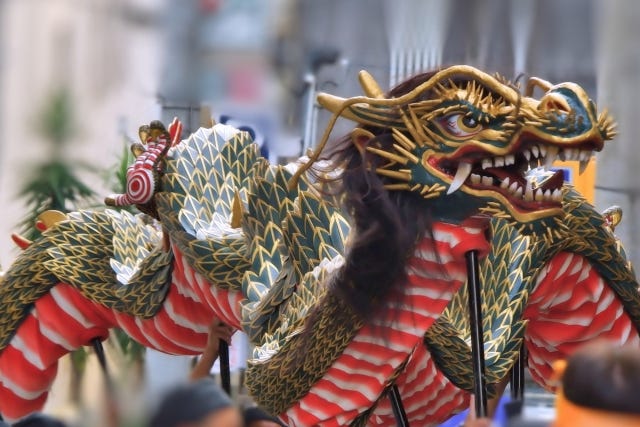
Several performers manipulate a long, colorful dragon, making its body twist and turn as it pursues a ball. The dance reflects Chinese cultural influence, an important part of the city’s history.
During the Edo period, when Japan strictly restricted overseas travel and foreign trade, Nagasaki remained a major point of contact with China and the Netherlands. Trade brought goods into the port, but cultural practices and artistic influences arrived as well.
That history is visible in the festival’s performances.
At this year’s Nagasaki Kunchi, six neighborhoods presented their offerings, including Ja Odori, a riverboat performance, a Chinese-style ship performance, and Kokkodesho (コッコデショ).
In Kokkodesho, a group of men carries a large decorated structure, throws it into the air, and catches it again. The movement requires extraordinary coordination, and the performers’ calls are part of the spectacle.
The impressive part is not simply what the performers can do. All of this takes place within a shrine festival, as an offering to the deity.
There is also a distinctive system behind Nagasaki Kunchi.
Participating neighborhoods take turns presenting performances, with each neighborhood’s turn coming once every seven years. These neighborhoods are called odori-chō (踊町).
Imagine preparing for an occasion that comes around only once in seven years.
The costumes and equipment need care, performers need practice, and younger participants must learn skills from those with experience. By the time the festival begins, a great deal of work has already taken place.
When I see Nagasaki Kunchi on the news, I usually see the most dramatic moments. What I would also like to know is how the people involved spend the months leading up to those three days.
For the neighborhoods taking part, their next opportunity to perform is another seven years away.
Yabusame at Nikko Toshogu: Archery as an Offering
On October 16 and 17, Nikko Toshogu (日光東照宮), in Tochigi Prefecture, holds its autumn festival.
The first day includes yabusame (流鏑馬), a form of traditional Japanese horseback archery.
An archer rides a galloping horse along a course, drawing a bow and shooting at targets while keeping balance in the saddle.
Watching footage of yabusame, I am always impressed by the coordination it demands. The horse continues running as the archer prepares and releases each arrow.
The practice has roots in Japan’s warrior culture, when mounted archery was an important military skill. It has also been preserved as a Shinto ritual in which archery is offered to a deity.
The history of Nikko Toshogu adds another dimension to the ceremony.
The shrine is dedicated to Tokugawa Ieyasu (徳川家康), the military leader who established the Tokugawa shogunate in 1603. His government and its successors ruled Japan for more than 260 years, during a period commonly known as the Edo period.
After Ieyasu’s death in 1616, he was enshrined under the divine title Tōshō Daigongen (東照大権現).
The second day of the autumn festival features the Hyakumono-zoroe Sennin Musha Gyōretsu (百物揃千人武者行列), often described in English as the Procession of a Thousand Samurai.
Participants dressed in traditional armor and carrying weapons recreate the procession associated with the transfer of Ieyasu’s divine spirit from Kunozan to Nikko.
A mikoshi carrying the deity proceeds with a large ceremonial entourage.
At Shinto shrines, the movement of a deity from its usual place of worship to another location can itself be an important ritual. Such processions are known as shinkō or togyō, depending on the tradition.
Nikko Toshogu’s festival preserves the worship of Ieyasu alongside ceremonies and customs rooted in Japan’s warrior history.
The contrast with Nagasaki is striking. At one shrine, a dragon dance reflects centuries of international exchange. At another, horseback archery and a samurai procession recall the age of military rule.
Both are religious festivals, shaped by very different histories.
Niihama Taiko Festival: A Harvest Tradition Carried Through the Streets
In Ehime Prefecture, on the island of Shikoku, the city of Niihama (新居浜) holds the Niihama Taiko Festival (新居浜太鼓祭り) from October 15 to 18.
The festival is famous for its enormous taikodai (太鼓台), decorated structures containing drums and carried by large groups of participants.
With their elaborate gold-thread embroidery and enormous hanging tassels, the taikodai are impressive even before they begin moving.
Different neighborhoods have their own, and their teams work together to lift and carry them through the streets.
A major event is the kakikurabe (かきくらべ), in which teams demonstrate their skill and coordination by lifting these heavy structures.
In the local dialect, kaku means to carry a taikodai.
The exact origins of the tradition remain uncertain. According to the Niihama city government, local accounts describe the taikodai as a type of festival float that once accompanied mikoshi processions and was offered to the community’s deity in gratitude for a good harvest.
Records establish their presence by the late Edo period. Over time, the structures became larger and more elaborate.
Part of that development was connected to the Besshi Copper Mine (別子銅山).
Copper mining helped Niihama grow into an industrial center. As the local economy expanded, so did the scale and decoration of the taikodai.
The appearance of the festival changed with the fortunes of the city.
Today, maintaining these enormous structures requires considerable effort. They must be stored, repaired, and prepared for each festival. Large teams of carriers also need to be organized.
The embroidery and decorations are beautiful, but I find the practical side just as interesting. These are huge objects that people continue to maintain and move by hand, year after year.
Behind every taikodai is a neighborhood that has taken responsibility for it.
The festival’s traditional association with harvest gratitude remains part of its history, while the scale of today’s celebration also reflects Niihama’s industrial past.
Kurama Fire Festival: Remembering the Arrival of a Deity
On October 22, the village of Kurama (鞍馬), in the mountains north of Kyoto, holds the Kurama Fire Festival (鞍馬の火祭), the annual festival of Yuki Shrine (由岐神社).
As evening approaches, torches appear throughout the village.
Children carry smaller ones, while adults handle much larger torches. Fires burn outside houses, and participants move through the streets calling out, “Sairei, Sairyo!”
Later, enormous torches gather and the festival continues with a procession of mikoshi.
The story behind the flames dates to the year 940.
According to shrine tradition, Kyoto had been troubled by earthquakes and unrest. Emperor Suzaku ordered the deity Yuki Daimyojin (由岐大明神), previously worshipped at the Imperial Palace, to be transferred to Kurama as part of prayers for peace and protection.
The deity’s journey was accompanied by a large procession. Torches made from reeds and bonfires along the route provided light.
The people of Kurama preserved the memory of that arrival through a festival, continuing the custom of carrying torches.
Yuki Shrine also describes distinctive practices associated with the mikoshi procession, including a participant wearing armor who rides atop a portable shrine and women pulling ropes attached to it. The latter custom is associated with prayers for safe childbirth.
The festival has changed over the centuries, but the welcome given to the deity remains central to its meaning.
I find myself returning here to the story of Kamiarizuki.
At Izumo, the gods are welcomed when they gather from across Japan. In Kurama, a community commemorates the arrival of a deity brought there more than a thousand years ago.
Their histories are separate, yet both traditions give us a glimpse of how Japanese communities have honored the arrival of the gods.
These four festivals are only a small selection of the celebrations held across Japan in October.
I grew up in Hokkaido and now live in Kyushu. Moving within Japan has made me more aware of the differences between its regions, from food and everyday speech to customs and shrine ceremonies.
Festivals are a particularly interesting example.
I may have heard of a famous celebration, but often I know little about the deity being honored or the history behind its rituals.
Every autumn, as more festival reports appear on television and in the news, I discover traditions that are completely new to me.
I have lived in Japan all my life, and there is still a great deal about my own country that I want to understand.
Local festivals also depend on work that visitors rarely see.
People care for the mikoshi and floats, practice traditional performances, prepare clothing and equipment, and organize the events. Some begin their preparations months before the festival itself.
The celebrations last a few days, sometimes only one, but the responsibilities continue throughout the year.
In parts of Japan, population decline and an aging population are making it harder to find enough people to carry these traditions forward. Communities must consider how their festivals can continue when fewer residents are available to take part.
Alongside this challenge is another, more immediate concern: safety.
On October 10 this year, two fatal accidents occurred during danjiri festivals in Osaka Prefecture. In Izumisano and Izumiotsu, large wheeled festival floats known as danjiri (だんじり) overturned at intersections. Two men died, and sixteen people were injured in total.
Danjiri are pulled through the streets by teams of participants, and sharp turns are among the demanding parts of their movement.
A week later, on October 17, a man taking part in the Saijo Festival (西条まつり) in Ehime Prefecture died after being trapped beneath a taikodai weighing approximately three tons.
These were festivals that local communities had maintained for generations.
I feel deeply saddened by the loss of life.
The speed, size, and intensity of some festival performances are part of what makes them so impressive. Changing those performances to reduce danger may affect longstanding techniques and customs. For the people who have spent their lives taking part, decisions about such changes must be difficult.
I respect the dedication involved in preserving a tradition. At the same time, I struggle with the idea that a risk to human life might be accepted simply because a practice has been passed down for generations.
Surely the lives of those taking part deserve the same care as the traditions they are working to preserve.
I hope that safety remains a central consideration in deciding how these festivals will continue, alongside respect for their history and the people who maintain them.
These ceremonies have long been associated with gratitude, prayer, and the well-being of their communities. I hope those purposes are never lost.
Above all, I wish for festivals where the people who organize them, take part in them, and come to watch can all return home safely.
I would love to travel around Japan and experience more of these festivals in person someday.
Yet I sometimes feel a little hesitant about visiting traditions that local people have taken such care to preserve.
Many festivals welcome visitors, and sharing these customs with people from elsewhere can be valuable for the community. But for the people who live there, a festival may be an occasion that their families have participated in for generations.
When I eventually visit, I want to do more than watch.
I want to learn about the shrine, the deity being honored, and the reasons behind the ceremonies. I want to understand how the people of that region have maintained their traditions, and respect the rules and customs they ask visitors to follow.
Japan has so many festivals I have yet to discover. I hope to learn about them gradually as I visit different parts of the country.
The Rest of Autumn
October is already more than halfway through, and there are still changes ahead as the season progresses.
In northern Japan, the leaves are beginning to turn. Other regions will follow, bringing the season of momijigari (紅葉狩り), the Japanese custom of going out to admire autumn foliage.
Chestnuts, mushrooms, sweet potatoes, and newly harvested rice are also appearing in markets and supermarkets.
The arrival of seasonal foods is something I look forward to every year. They are familiar parts of everyday life, but they also remind me how much our meals depend on the land and the changing seasons.
There is a connection between giving thanks for a harvest and enjoying what that harvest brings to our tables.
As autumn continues, I hope to share more of these everyday traditions with you, from the changing leaves to the foods of the season.
—Written by Sumire
Official Festival Websites
Nagasaki Kunchi(長崎くんち) — Official Website
Nikko Toshogu Autumn Festival(日光東照宮秋季大祭) — Official Website
Niihama Taiko Festival(新居浜太鼓祭り) — Official Website
Kurama Fire Festival(鞍馬の火祭) — Official Website