In Spiritual Japan Journal, I have often written about the Kojiki(古事記) and the places connected to Japanese mythology. Amanoiwato(天岩戸), Izumo Taisha(出雲大社), and ancient shrines across Japan.
Through these field visits, I have come to feel that these places cannot be described simply as “tourist sites.” They offer clues for understanding how the gods of Japan have been spoken of, and how they have been connected to nature, land, and the lives of people.
To understand Japanese culture deeply, the Kojiki is an essential entry point. The stories recorded there offer important clues to how people in ancient Japan understood the land, nature, life, and death.
Among these stories, the gods deeply connected to the birth of the land and the gods are Izanagi Ōkami(伊弉諾大神) and Izanami Ōkami(伊弉冉大神). In the Kojiki and the Nihon Shoki(日本書紀), these two deities are described as the gods who carried out Kuniumi(国生み), the birth of the land, and Kamiumi(神生み), the birth of the gods. They are said to have given birth to the Japanese islands and to many of the gods connected to them. They are also indispensable for understanding the mythological flow that later leads to Amaterasu Ōmikami(天照大御神).
The place deeply connected to these two deities is Izanagi Jingū(伊弉諾神宮) on Awaji-shima(淡路島). Awaji-shima has long been described as the island said to have been born first in the Kuniumi myth. And Izanagi Jingū is a special shrine that enshrines these two deities.
Why did this story become connected to the real island of Awaji-shima? And why does it still remain today in the concrete place of worship known as Izanagi Jingū?
With the landscapes I photographed, walked through, and experienced on site, I will trace that history.
Awaji-shima and Izanagi Jingū
Izanagi Jingū is located in Taga, Awaji City, Hyōgo Prefecture. It is known as the Ichinomiya(一宮), or highest-ranking shrine, of the former Awaji Province, and it is an old shrine whose name also appears in the Engishiki(延喜式).
In the Kuniumi myth recorded in the Kojiki, Izanagi and Izanami stir the sea with the Amenonuboko(天沼矛), the heavenly jeweled spear. The drops that fell from the tip of the spear are said to have formed Onogoro Island(淤能碁呂島). The two deities descended to that island and began the birth of the land.
The first island they are said to have created was Awaji-no-ho-no-sawake-no-shima(淡道之穂之狭別島), the island understood to correspond to present-day Awaji-shima.
What matters here is that Awaji-shima was not only a stage in myth. Since ancient times, it was also an important island in terms of maritime routes and food culture. Bronze objects such as dōtaku(銅鐸) have also been excavated on the island, showing that Awaji-shima is important when considering ancient history. It also held the role of Miketsukuni(御食国), a region that supplied food to the imperial court.
Walking around the island, I noticed that traditions connected to mythology still remain. Izanagi Jingū should also be seen within that context. The two deities who gave birth to the land in myth are still enshrined as part of the faith of Awaji-shima. Through this, the stories of the ancient texts and the actual land begin to appear connected.
The myth of the island of beginnings. The lives of people who have lived with the sea. Traditions that remain in different places. Visiting Izanagi Jingū was also a way of confirming, with my own feet, the memory of Awaji-shima as a land where these layers overlap.
Walking Through Izanagi Jingū
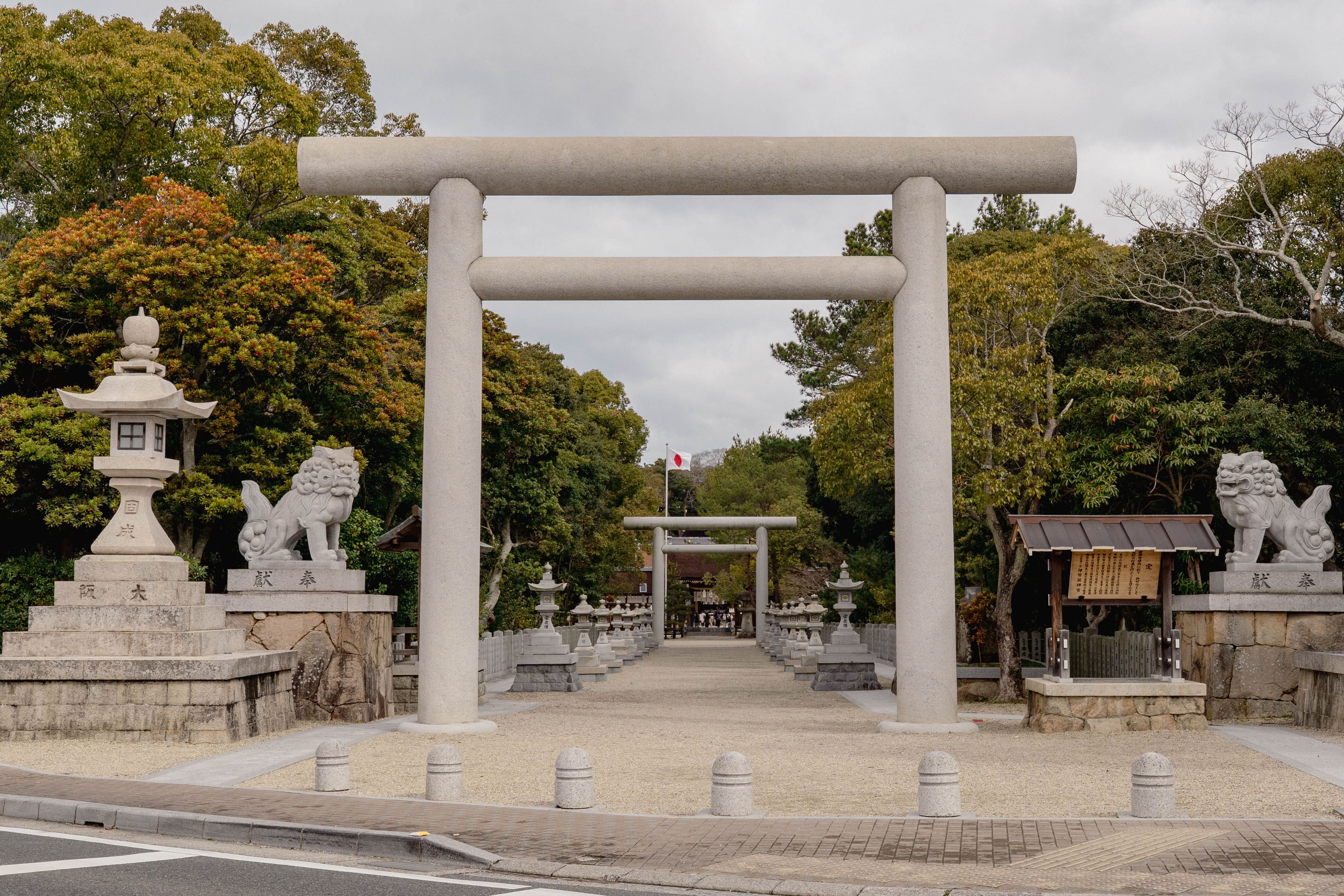
When you arrive at Izanagi Jingū, the first thing that comes into view is the large torii gate standing at the front. It is about 8.2 meters high. Among shinmei-style torii gates made of granite, it is said to be one of the largest in Japan.