In the previous article, I introduced Ama-no-Iwato Jinja(天岩戸神社) in Takachiho, Miyazaki Prefecture.
It is known as the stage of one of Japan’s most famous myths—the story in which the sun goddess Amaterasu Ōmikami(天照大神), distressed by the violent deeds of her brother Susanoo no Mikoto(須佐之男命), hid herself inside a cave.
This “Ama-no-Iwato” episode is one of the most symbolic scenes in Japanese mythology, and shrines bearing the same name—and related legends—can be found all across the country.
This time, I visited Tokushima Prefecture.
Why does a place here also have an “Ama-no-Iwato”?
Behind it lies a unique theory known as the Awa Kojiki Theory(阿波古事記説).
The Awa Kojiki Theory – Were the Myths Born in Awa?
The stories of Japanese mythology are generally set across a wide area, primarily stretching from Kyushu to the western regions of Honshu.
For example, the descent of the heavenly deities, known as Tenson Kōrin(天孫降臨), is said to have taken place in Takachiho, Miyazaki in southern Kyushu.
The cave of Ama-no-Iwato is also located in Takachiho, Miyazaki.
The myths of Izumo are set in Izumo, Shimane Prefecture, on Honshu,
and the realm of Yamataikoku(邪馬台国), ruled by the shaman queen Himiko, is believed to have been in northern Kyushu or the Nara region.
These myths and traditions span the entire Japanese archipelago from south to north,
and they have been handed down as symbolic narratives of how the nation of Japan came into being.
In other words, Amaterasu Ōmikami(天照大神) withdrew into her cave in Kyushu,
her brother Susanoo no Mikoto(須佐之男命) caused havoc in Izumo,
and the descendants of the gods descended once again to Kyushu.
According to conventional interpretation, the settings of these myths were scattered across distant lands.
However, in Tokushima there exists a completely different theory that overturns this long-held view:
the Awa Kojiki Theory(阿波古事記説).
According to this interpretation, the mythological world described in the Kojiki and the Nihon Shoki was not spread across the vast regions of Kyushu, Izumo, and Nara—but rather, it was all contained within a single limited area: present-day Tokushima Prefecture, formerly the ancient province of Awa.
For instance, the creation of the land by Izanagi and Izanami, the Yomi no Kuni(黄泉の国, Land of the Dead), and even the transition from Takamagahara(高天原, the Plain of High Heaven) to Ashihara no Nakatsukuni(葦原中国, the Central Land of Reed Plains)—all of these, the theory claims, took place within Tokushima.
Kaguraiwa Ama-no-Iwato Jinja
Among the sites central to the Awa Kojiki Theory(阿波古事記説), one of the most significant is Kaguraiwa Ama-no-Iwato Jinja(神楽岩天岩戸神社), located in Ichiu Hōshō, Tsurugi Town, Mima District, Tokushima Prefecture.
Here stands an enormous single rock known as Kaguraiwa (“Sacred Dance Rock”), and above it rests a small shrine revered as Ama-no-Iwato.
In the Kojiki account of the Ama-no-Iwato myth, the sun goddess Amaterasu Ōmikami(天照大神) retreats into a cave, grieving over the violent acts of her brother Susanoo no Mikoto(須佐之男命), causing the world to fall into darkness.
The deities then gathered and performed a sacred dance before the cave.
It was Ame-no-Uzume-no-Mikoto(天鈿女命) who danced to lure Amaterasu out.
Her dance was so spirited that her garments loosened and her breasts became exposed, drawing laughter from the assembled gods.
Curious about the commotion, Amaterasu slightly opened the cave door, and at that instant, light streamed out and returned brightness to the world.
This scene is one of the most iconic moments in Japanese mythology.
The name Kaguraiwa is said to derive from “kagura”, the sacred dance (kami no asobi) performed by Ame-no-Uzume.
The site has long been revered as the place before the cave where the gods danced, a location that reflects the myth within the contours of the natural landscape itself.
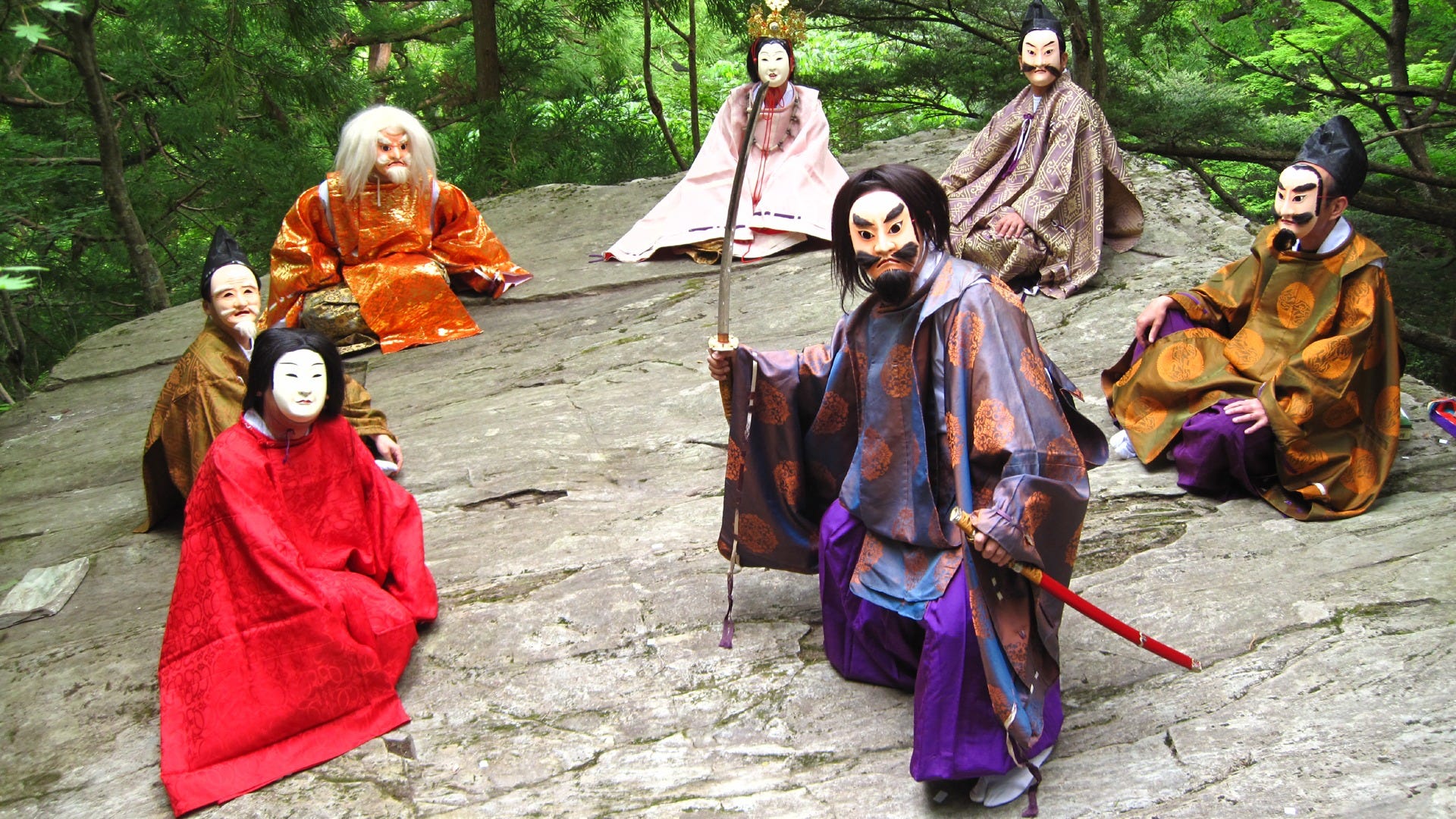
In Tsurugi Town, the Ama-no-Iwato Kagura is regularly performed at Matsuo Jinja(松尾神社), and this traditional dance has been designated as a folk cultural property by the town.
(It is scheduled to be performed again on January 1 next year.)