


Today, March 3rd, is Hina-matsuri (ひな祭り). Also known as Momo no Sekku (桃の節句) — Peach Festival, it is a radiant day of celebration to welcome the coming of spring. Walking through the streets of Japan, you will see dolls dressed in brilliant, ancient costumes displayed in department store galleries, hotel lobbies, and through the windows of private homes. During this season, the entire country seems to be enveloped in soft pink hues and festive colors.
In my own home, the Hina-ningyo (雛人形) — Hina dolls were always brought out at this time of year. As a young child, I loved sitting in front of the tiered platform, gazing at the heavy beauty of the 十二単 (Junihitoe) — Twelve-layered ceremonial robe worn by the Empress doll, and the exquisitely crafted miniature furniture. I still vividly remember my mother sternly scolding me whenever I reached out to touch them, captivated by their beauty.
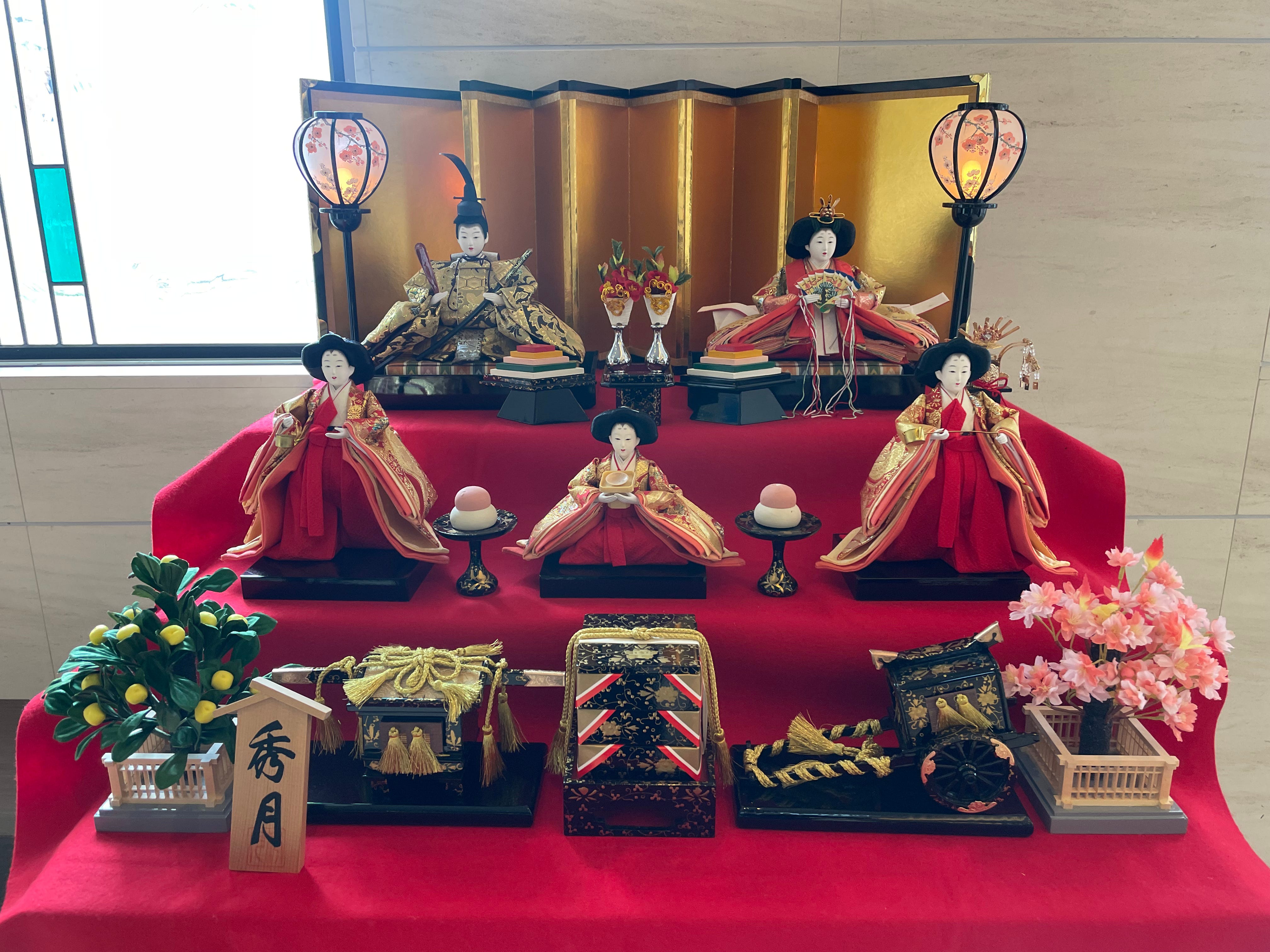
These dolls are not “toys” in the sense of a Barbie doll that a child might pick up and play with. They are meant for quiet appreciation and serve as silent, guardian-like figures that protect the young girls of the household from misfortune. There is a certain sense of “taboo” in knowing they are not to be touched, yet one cannot help but be drawn into their elegant, serene expressions. This unique sense of distance is deeply etched into the memories of Hina-matsuri.
In Japan, it is a cherished tradition for families to prepare a set of Hina dolls for a girl’s first festival to show their deep love. However, these are by no means inexpensive. Even a simple set featuring only the Emperor and Empress can range from 70,000 to 300,000 yen ($450–$2,000 USD). A full multi-tiered display with fifteen dolls or a masterpiece handcrafted by a renowned artisan can easily exceed 1 million yen ($6,500+ USD). Even in today’s rational, modern lifestyle, the passion and resources Japanese people pour into these “dolls for appreciation” reflect a deep-rooted spirituality that views March 3rd not just as a festival, but as a place for sincere prayer for a child’s lifelong well-being.
The dolls are carefully displayed starting after the beginning of spring in February. Then, once the celebrations of March 3rd are over, they are packed away all at once, as if a magic spell has been broken. Why do these expensive and beautiful dolls appear for such a short time only to vanish so quickly? To solve this mystery, we must unwrap a thousand years of history hidden behind this colorful scenery.
What is the Peach Festival? Its Origins and History
The Hina dolls we see today did not start out as such luxurious decorative objects. Their origins can be traced back to the ancient Chinese “Joshi Festival.” Traditionally, on the first “Day of the Snake” in March, people would go to the water’s edge to purify themselves and ward off the evil spirits that were thought to emerge at the changing of the seasons. When this custom reached Japan, it merged with the indigenous culture of 禊 (Misogi) — Ritual purification.
